
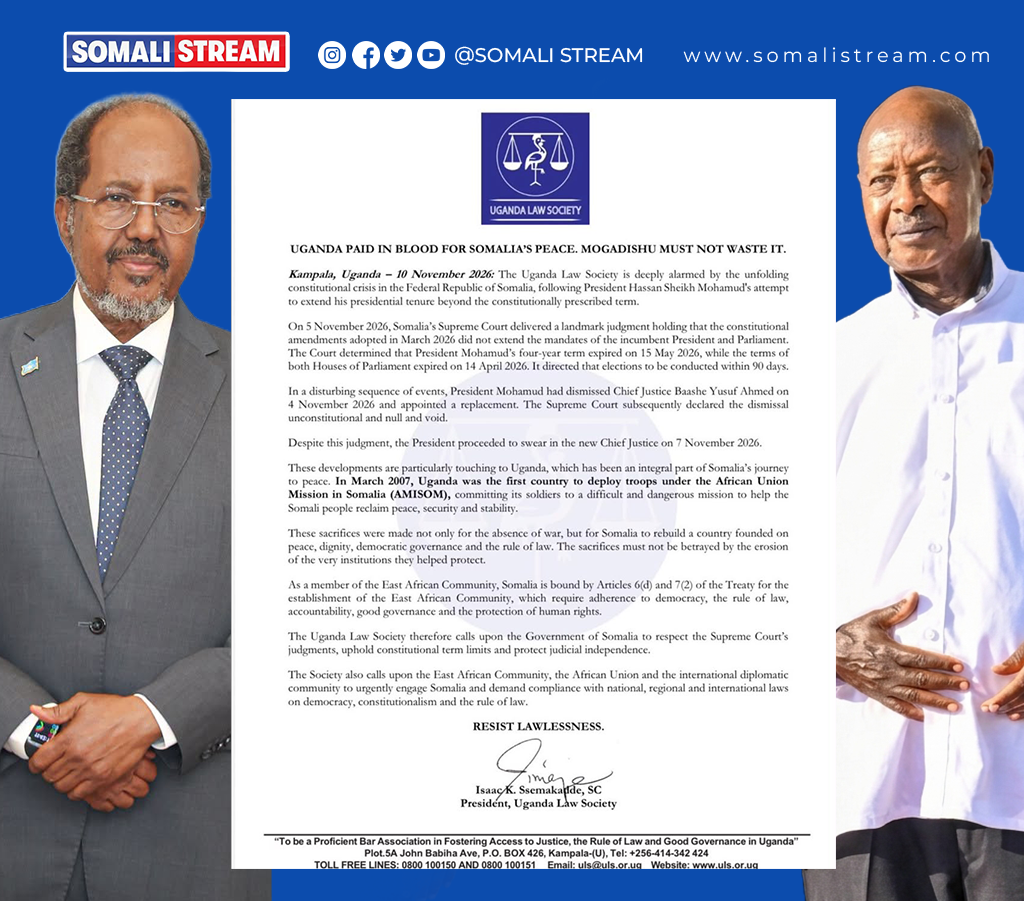
Uganda has delivered a forceful rebuke to the government of Somali President Hassan Sheikh Mohamud, warning that Somalia’s deepening constitutional crisis threatens to undermine the democratic institutions, judicial independence and rule of law for which Ugandan soldiers made extraordinary sacrifices.
In a strongly worded intervention, the Uganda Law Society (ULS) has condemned what it considers an attempt by President Mohamud to extend his presidential tenure beyond the constitutionally prescribed mandate, placing the presidency on a collision course with the country’s highest court.
The controversy is no longer simply about an election delayed or a disputed constitutional amendment. It has become a fundamental confrontation over whether a president is bound by the Constitution or whether constitutional provisions can be altered to accommodate the political interests of an incumbent.
And Uganda, a country whose military sacrifice helped Somalia emerge from years of conflict, is making clear that it will not remain silent.
A Supreme Court ruling the presidency cannot ignore
On 5 November 2026, Somalia’s Supreme Court delivered a landmark judgment with potentially far-reaching consequences for the country’s political future.
The court determined that constitutional amendments adopted in March 2026 did not extend the mandates of either the incumbent president or Parliament.
Its position was unequivocal: President Mohamud’s four-year presidential term expired on 15 May 2026, while the mandates of both parliamentary chambers expired on 14 April 2026.
The court directed that elections be conducted within 90 days.
That ruling struck at the heart of the political arrangements underpinning Mohamud’s continued occupation of the presidency.
But rather than allowing the judicial determination to settle the constitutional question, the presidency became embroiled in an even more explosive confrontation with the judiciary.
On 4 November, President Mohamud had dismissed Chief Justice Bashe Y. Ahmed and appointed a replacement. The Supreme Court subsequently declared the dismissal unconstitutional, null and void.
Yet, in a move that has intensified the crisis, Mohamud proceeded to swear in the newly appointed Chief Justice on 7 November, despite the court’s position.
The implications are serious. When a head of state disregards a judicial determination concerning the legality of his own actions, the issue becomes a fundamental test of constitutional supremacy.
Uganda’s message: Somalia must not betray the sacrifices made for it
For Uganda, the unfolding confrontation carries particular historical and moral significance.
In March 2007, Uganda became the first country to deploy troops under the African Union Mission in Somalia (AMISOM), sending its soldiers into an exceptionally dangerous theatre to help restore security and stability.
Ugandan troops served in a mission that demanded extraordinary courage, with some paying the ultimate price.
Those sacrifices were not made merely to replace one political order with another. They were made in the hope of building a Somalia governed by peace, dignity, democratic accountability and the rule of law.
The Uganda Law Society’s message is therefore particularly pointed: the sacrifices of African soldiers must not be betrayed by the erosion of the very institutions they helped protect.
Somalia cannot claim the benefits of international solidarity while disregarding the constitutional principles that give legitimacy to its government.
The East African Community cannot afford to look away
The Uganda Law Society has also invoked Somalia’s obligations under the East African Community Treaty.
Articles 6(d) and 7(2) establish commitments to democracy, the rule of law, accountability, good governance and the protection of human rights.
These are not decorative diplomatic phrases. They are foundational principles of regional membership.
The Society is consequently calling on the Somali government to respect the Supreme Court’s judgments, uphold constitutional term limits and protect judicial independence.
It has also urged the East African Community, the African Union and the international diplomatic community to urgently engage Mogadishu and press for compliance with national, regional and international obligations.
The challenge for regional institutions is straightforward: if constitutional term limits and judicial authority can be disregarded without consequence, what credibility remains in Africa’s repeated declarations against unconstitutional extensions of political power?
In a significant response, Chief Justice of the Federal Republic of Somalia, Bashe Y. Ahmed, has personally expressed profound gratitude to the Uganda Law Society for its principled statement in defence of Somalia’s Constitution, judicial independence and the rule of law.
Writing on behalf of the Supreme Court of the Federal Republic of Somalia, Chief Justice Ahmed described constitutionalism as a shared African commitment, stressing that the responsibility to defend judicial authority and constitutional limits must not rest with one nation alone.
His message carries particular significance against the backdrop of the confrontation between Somalia’s presidency and judiciary.
“At this decisive moment, your voice reminds us that constitutionalism is a shared African commitment, not a burden carried by one nation alone,” Chief Justice Ahmed stated.
He emphasised that the authority of the courts and the limits established by the Constitution form the foundation upon which lasting peace must stand.
The Chief Justice also paid tribute to Uganda’s historic military contribution to Somalia’s recovery, recalling that Uganda was the first country to stand with Somalia in 2007.
“Somalia will never forget that Uganda was the first to stand with us in 2007, and that Ugandan soldiers gave their lives so that our country could rise again,” he said.
He added that their sacrifice was made for a Somalia governed by law and that the judiciary remained determined to honour that legacy.
The message was also an expression of appreciation to Uganda’s legal fraternity. Chief Justice Ahmed thanked his learned brothers and sisters at the Ugandan Bar and specifically recognised Senior Counsel Abdinasir for his unwavering support and tireless efforts in organising the solidarity.
He concluded with a declaration of shared commitment to justice, constitutional order and the dignity of African peoples.
The intervention is noteworthy because it comes amid a confrontation over the Supreme Court’s authority, the presidential mandate and the independence of the judiciary.
It also reinforces the position that Somalia’s constitutional future is not merely a domestic political question but one with implications for regional governance, democratic accountability and the credibility of African institutions.
For Chief Justice Ahmed, the underlying principle is clear: the Constitution must remain the supreme framework governing public power, and the judiciary must be able to discharge its constitutional responsibilities.
For Uganda, which helped Somalia fight for the possibility of a peaceful future, the stakes are particularly high.
Ugandan soldiers did not make sacrifices in Somalia merely to see the institutions of constitutional governance weakened.
And if the rule of law is to mean anything in the Horn of Africa, it must apply to everyone, including those who wield the greatest political power.
The Constitution is not the property of the president. The presidency is an office created and limited by the Constitution. That is the fundamental principle now being tested in Mogadishu.


