


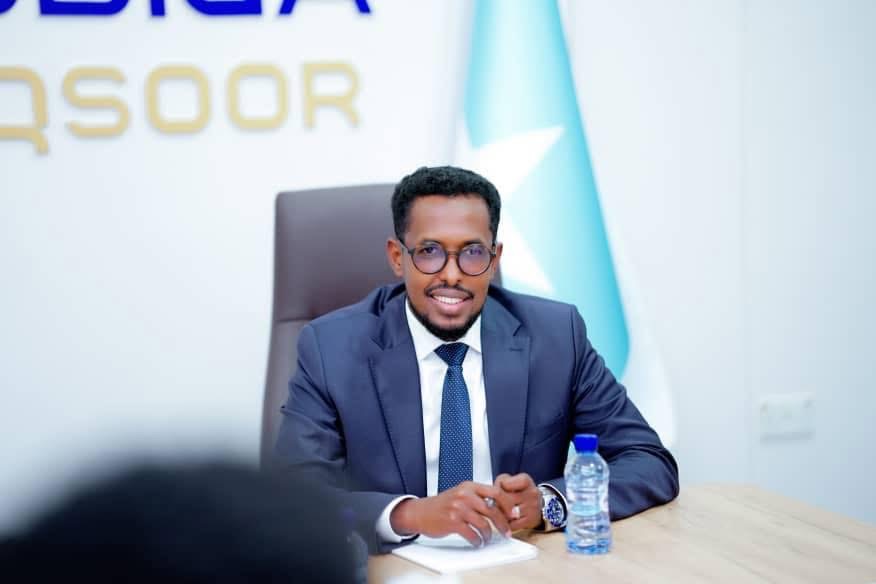
By: Ambassador Abdirahman Aynte
For nearly two decades, Somalia’s state-building project has rested on a seemingly simple but a profound bargain: The African Union would provide the security guarantees — first as AMISOM, deployed in March 2007, later ATMIS and now AUSSOM — while the nascent Somali government builds inclusive and credible state institutions, chief among them a security apparatus that is capable of containing Al-Shabaab. The international community would underwrite the enterprise, financing roughly 70% of Somalia’s national budget year after year. However, the bargain was never meant to be permanent. It was a scaffold, erected so we Somalis could build something that would stand on its own.
That scaffold faces its moment of reckoning this week as the AUSSOM troop contributing countries discuss the future of the peacekeeping mission amid mounting diplomatic challenges and a burgeoning domestic political crisis. The UN Security Council extended AUSSOM’s authorization last December against a backdrop of exhausted donors, no new pledges, and a mission receiving barely half its required funding. The United States has since informed the African Union that it will not support any renewal that includes UNSOS, the mission’s logistical backbone, while European partners remain reluctant to keep paying peacekeepers’ salaries. After 19 years, the donors have concluded what many of us have hesitated to say aloud: measured against its own objectives, the whole project looks like a spectacular failure.
A Debt Owed, A Debt Squandered
Before assigning blame, we must pay gratitude where its due. Thousands of African Union peacekeepers have paid the ultimate price because they answered Somalia’s call when almost no one else would. Their sacrifice — among the heaviest borne by any modern peacekeeping force — bought this country every inch of ground on which its institutions stand. Whatever verdict history renders on the mission, it must never be rendered against the men and women who bled for it.
Assessed objectively, the mission’s most notable achievements are concentrated in its first five years. Between 2007 and 2012, the AU forces, fighting alongside gallant Somali troops, liberated vast swathes of territory from the grip of Al-Shabaab, including Mogadishu in 2011, Kismaayo, Baidoa, Jowhar and Dhuusamarreeb in 2012. Those cities have become capitals of future federal member states. That sustained progress provided the enabling conditions for the landmark achievements of 2012: the Provisional Constitution, the first indirect elections held inside the country since the Third Republic was established in Djibouti in 2000, and — crucially — the end of the transitional period, which gave birth to the first permanent, non-transitional government since the central state collapsed in 1991. Those notable successes were not solely a result of military advances; it was also shaped by Somalia’s leadership at the time, which fostered a consensus-driven political environment that cemented the country’s elite bargain.
Regrettably, no comparable, sustainable achievement has been registered since 2012 despite the staggering human and financial toll. Territory has been liberated only to be recaptured by Al-Shabaab in a grim, brutal cycle. The fault lies not with the peacekeepers and gallant Somali soldiers, who kept dying for towns they had already died for once, but with political leaders who failed to recreate the conditions under which those early victories were secured.
The Unravelling
The one accomplishment Somali leaders could legitimately claim after the liberation of major cities in 2011 and 2012 was a series of relatively peaceful transfers of power. Despite being turbulent and flawed in their totality, they were delivered by painstakingly negotiated electoral processes that produced presidents whose legitimacy were virtually unquestioned.
Let us be honest: transfer of power is, after all, an inside game among the political elite. The public never celebrated it, because regardless of who came to power, ordinary Somalis never reaped the dividends they wanted — a modicum of stability, rule of law, good governance and basic services. But the ritual served one purpose citizens valued so deeply: the absence of violence. The two times this routine was interrupted — under President Mohamed Farmaajo in 2021 and under President Hassan Sheikh Mohamud in June 2026 — violence followed, however briefly. That is the thread now being cut.
President Mohamud, whose mandate expired on 15 May 2026 and who has led Somalia for 10 of the last 15 years, has in his second term dismantled the pillars of the post-civil war settlement: the Provisional Constitution, unilaterally rewritten; the federal compact, violated by deploying federal forces against member states that oppose him; and the tradition of negotiated electoral arrangements, replaced by so-called elections that inevitably produce predetermined results and handpicked candidates.
What is emerging is a one-party state, cocooned in Mogadishu, sustained by corruption and nepotism on a scale unseen in the nation’s 66-year history — a state that has sat at or near the top of Transparency International’s index of the world’s most corrupt countries for 20 years. The past four years added a new dimension: the large-scale theft of public land and forced displacement of hundreds of thousands of people, parceled out under the merciless watch of the state leadership. Unfortunately for Somalia, that brinkmanship coincides not only with the departure of the forces that repeatedly kept the brink from becoming the abyss, but with the closing of the open tab — the seemingly bottomless donor support that is now visibly drying up.
The human consequences are not abstract either. Some six million Somalis — roughly 31% of the population — face crisis levels of acute food insecurity, with 1.9 million in emergency conditions and a credible risk of famine. Nearly 1.9 million children require treatment for acute malnutrition, while the humanitarian response plan is funded at barely 15%. Drought and floods are triggers, but the crisis is man-made: it recurs because of incessant political crisis.
Many credible observers worry that Somalia today echoes the warning signs that preceded the 2021 Taliban capture of Afghanistan: an elite consumed by state capture rather than state-building, an exhausted international community questioning decades of investment, and a public losing faith in promises that never materialize. The parallels are alarming—and they demand immediate attention.
One need not look to Kabul for evidence. Nearly two decades after the first AU peacekeepers arrived, we still depend on them for the very survival of the state. Foreign aid finances 70% of our national budget—on top of nearly a billion dollars a year in humanitarian and development assistance. A security map of south-central Somalia reveals islands of “liberated areas” marooned in a sea of Al-Shabaab control. And every four years, we summon international partners to mediate our political elite’s disputes over electoral agreements. This is not misfortune; it is the unmistakable signature of failed leadership.
Today, Somalia is confronting a perfect storm: global disorder, regional rivalries, and deepening domestic political crisis. As the Third Republic teeters under the weight of disastrous leadership, Western partners’ refusal to underwrite another mandate extension for the incumbent is not betrayal—it is a rational response from allies who invested billions expecting responsible leadership.
A Narrow Pathway to Safety
Notwithstanding the grim picture, there remains a narrow pathway to salvage the Third Republic. President Mohamud should urgently negotiate the technical implementation of direct elections with Somalia’s key political stakeholders — now that all sides agree to allow citizens to elect their political representatives in a fair and competitive model. He must also stop attacking and undermining Puntland and Jubbaland, whose consent is needed for any durable political settlement.
That said, the burden does not rest on the president alone. Opposition actors, including those of us who carried responsibility over the past two decades, owe this country an honest reckoning. If our ambition amounts to nothing more than replacing President Mohamud as fresh custodians of the same kleptocratic machinery he built, we should know that the Somali people are tired of that vicious cycle — and are increasingly apathetic to politicians who practice it.
What is required is not a change of the occupant of Villa Somalia, but a transformative change of creed: politics that treats the rule of law, justice and good governance not as slogans for donor conferences but as the standard operating procedure of the state. Only such politics can earn the legitimacy our state needs to recover and rebuild — the legitimacy that binds a fractured society together and shrinks the cleavages our elites have spent decades widening.
Somalia has less than a year to pull back from the most consequential risk of state collapse and disintegration since 1991. History rarely sends a warning this legible. Whether we read it in time is the only question that matters.
Abdirahman Aynte is the Chairman of Xaqsoor-HaybadQaran Political Alliance, a former Minister of Planning and International Cooperation, a former Somali Ambassador to the UK and a Co-Founder of the Heritage Institute for Policy Studies (HIPS).