


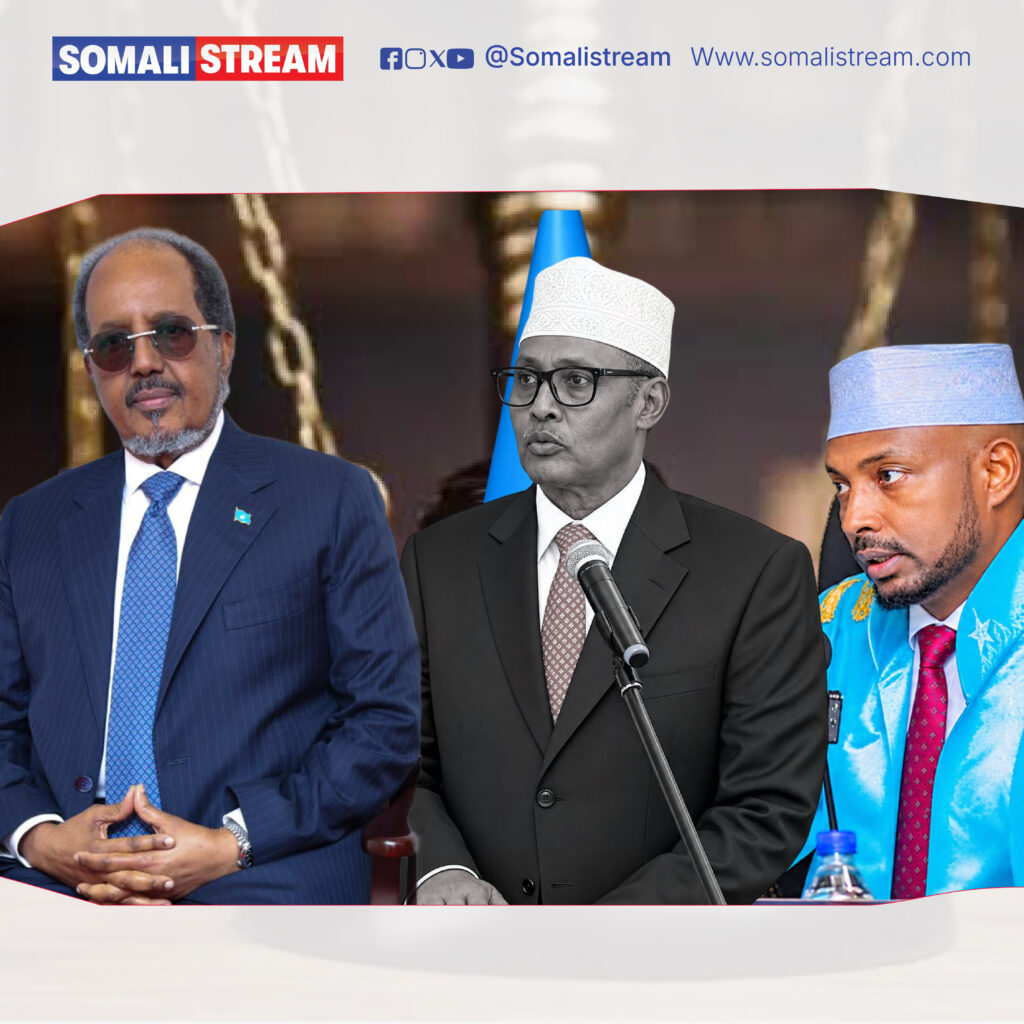
Somali President Hassan Sheikh Mohamud has appointed a new Chief Justice of the Supreme Court without publicly demonstrating compliance with the appointment procedures set out in the country’s 2026 Constitution, raising fresh questions over his government’s commitment to the constitutional order it recently introduced.
Mohamud on Saturday presided over the swearing-in of Ibrahim Idle Suleiman as Chief Justice, three days after announcing the removal of incumbent Baashe Yusuf Ahmed and one day after the Supreme Court ruled the dismissal invalid.
But Article 135 of the Constitution establishes a mandatory three-stage process for appointing the head of the Supreme Court: nomination by the Supreme Judicial Council, approval by both chambers of parliament and formal appointment by presidential decree, followed by publication in the Official Gazette.
The presidency has not publicly produced evidence that these requirements were fulfilled before Suleiman was installed.
Under Article 135(1), the Supreme Judicial Council must nominate a candidate who meets specified professional and ethical qualifications, including a master’s degree in law and at least 10 years of relevant professional experience.
Both the House of the People and the Upper House must then approve the nomination separately, each by a majority of 50 per cent plus one of its total membership.
Only after those approvals can the president formally appoint the Chief Justice through a decree published in the Official Gazette.
The presidential announcement and Saturday’s swearing-in ceremony did not disclose a Supreme Judicial Council nomination, parliamentary approval votes or publication of an appointment decree.
The presence of parliamentary leaders at the ceremony does not substitute for the separate legislative approvals required by the Constitution.
Article 136 also requires the Chief Justice to take the oath before the president in the presence of the speakers of both parliamentary chambers. The presidency said the speakers’ representatives attended Saturday’s ceremony, but questions have also emerged over reports identifying an MP as the person who administered the oath.
The government has yet to publish documentation clarifying the procedure.
The appointment comes amid an escalating confrontation between the presidency and the judiciary. On 4 November, Mohamud issued a decree removing Ahmed, who had held the position since May 2018, and naming Suleiman as his replacement.
The following day, the Supreme Court ruled the presidential action invalid, arguing that the constitutional procedure had not been followed.
Ahmed was outside Somalia when the dismissal was announced. He has since told foreign diplomats that his security detail was withdrawn, security vehicles appeared outside his residence and intelligence officers pursued him after he sought refuge at a hotel within Mogadishu’s Halane security perimeter.
He says he is now in hiding and fears for his life. He also alleges that five Supreme Court justices have been prevented from leaving Somalia. The government has yet to respond to the specific allegations.
The constitutional dispute has wider political implications.
The Supreme Court has also issued a ruling challenging the extension of the president’s and parliament’s mandates, intensifying a confrontation over the country’s political transition.
Mohamud has defended the appointment as part of efforts to address complaints about judicial administration.
But the president’s stated commitment to judicial independence now faces a direct test: whether his government will demonstrate that the appointment of the country’s most senior judge complied with the Constitution.
The government could settle much of the dispute by publishing the Supreme Judicial Council’s nomination, parliamentary voting records, presidential decree and Official Gazette notice.
Without those documents, the legality of Suleiman’s appointment remains open to question.
The irony is difficult to overlook. A president who has repeatedly invoked constitutional reform and the rule of law is now facing allegations that his own appointment of the country’s top judge bypassed the constitutional safeguards designed to prevent presidential control of the judiciary.
For Somalia, the issue is not simply who occupies the Chief Justice’s office. It is whether the president is bound by the same Constitution he expects the rest of the country to obey.
