


On Saturday, Chief Justice Bashe Yusuf Ahmed, whose removal the Supreme Court had declared void, issued a statement on the court’s letterhead. He asked plain questions about the decree that tried to remove him. Where did this power come from? Does the law allow it? Was the required process followed?
The answers are written in President Hassan Sheikh Mohamud’s own constitution, the one he fought to pass in March. Under it, removing a Chief Justice is a road with gates. The Judicial Service Council proposes the removal. Parliament, sitting jointly, votes on it. The Council proposes a successor. Both houses approve. Only then does the President sign.
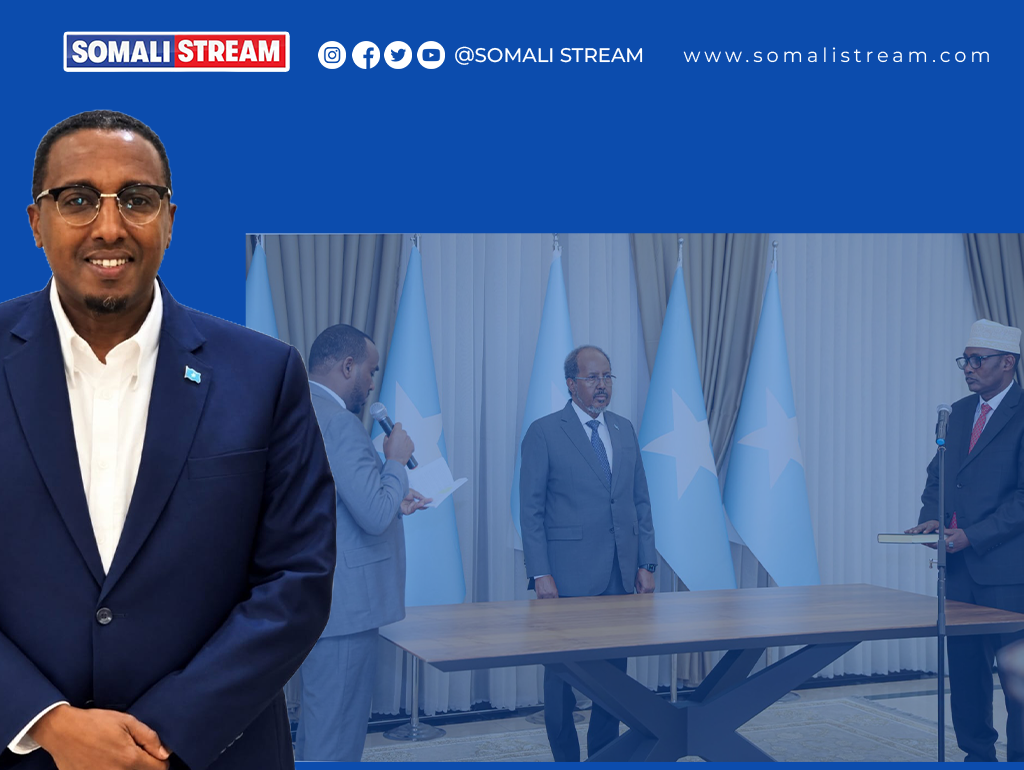
The appointment is the last gate, not the first. On Wednesday night, the President walked in through the exit. His office announced on Facebook that the Chief Justice was dismissed and a replacement named. There was no Council proposal, no vote in Parliament and no article cited. On Saturday, the man he chose took an oath at Villa Somalia.
The irony runs deeper. The Council that should open the first gate still awaits Parliament’s approval. In October 2022, the President himself cancelled the previous Judicial Service Commission because the Upper House had objected that it was not formed according to the constitution. He knew the rule. He enforced it on others. He stepped around it himself.
The Chief Justice added a sentence the decree cannot answer. He said he was ready to obey any decision removing him, if it rested on the law and its procedures. A man who asks for the law’s road is not clinging to a chair.
The Printer at Villa Somalia.
Anyone who has used an office printer knows its power and its limit. It can copy any page in seconds, letterhead, font and stamp. It cannot make the copy true.
By Thursday, the court had declared the removal null and void, saying it was meant “to obstruct the administration of justice in the constitutional case.” The decree had also aimed at the wrong man. The Chief Justice was not on the bench. Five judges of the Constitutional Division ruled without him that the President’s term had ended on 15 May, and ordered elections within 90 days. Removing one man could not cancel a judgment written by five.
The man sworn in, Ibrahim Idle Suleiman, has served as legal affairs secretary of the President’s own party, the JSP. He had been filmed telling voters, “Codkiinna siiya JSP,” give your votes to the JSP. A referee printed by one team still wears that team’s colours.
The Empty Hand
An old principle says that no one can give what he does not have. Somalis know it in Arabic: “فاقد الشيء لا يعطيه” (Faaqidu ash-shay’i laa yucdiih).
The court limited the government to routine administration until a vote. Choosing the head of the judiciary is not routine. When the President raised his hand at Villa Somalia, the gesture was full and the hand was empty. The printer had paper and ink. It had no signature.
The World Has Already Read the Ruling
The ruling travelled further than the decree. The Associated Press story ran in The Washington Post and on ABC News. The BBC, AFP, The EastAfrican and Al-Arab carried it too. Almost every report placed two facts side by side: the ruling, and the dismissal a day earlier.
That is the strategic cost. Before Wednesday, the extension was a quarrel at home. After Thursday, it was a world headline with a dismissed judge in the first paragraph. The Attorney General’s office then rejected the ruling, partly because the Chief Justice did not preside. The government removed the Chief Justice, then complained of his absence.
The partners were already uneasy. In June, 19 of them urged all sides to reach consensus on an election roadmap. Their language was concern and restraint, not congratulation. The court gave them, and Somalis at home, a reason for hope: an institution can still say no.
A government can print an appointment. It cannot make the world unhear what it heard, or unsee what it saw.
Copies Across the States
The printer did not start with the court. In South West, the regional parliament re-elected South West’s President in March, and federal troops then entered Baidoa. He still says, “I never resigned. I was pushed out illegally.” A federally backed administration later won 88 of 90 votes as rivals stayed away. In Hirshabelle, the incumbent won by 81 votes to 13 while Beledweyne spoke of an administration of its own. In Galmudug, the party that won in court was left out of the rerun.
Large margins should signal strength. When the field is empty, they only show that nobody else was allowed in the room.
Why Every Copy Is Fainter
A photocopy of a photocopy fades. Legitimacy comes from what no printer can produce, the loser’s acceptance. When the defeated side says, “There was no election,” the winner holds the office and not the authority.
When authority fades, soldiers start choosing. On Friday night in Beledweyne, a traditional leader told soldiers there was no government left to defend. By Saturday, soldiers who had left the government had joined him. In the capital, the Chief Justice says troops surround his court. When there are two of everything, the gun is tempted to become the referee.
The Chief Justice saw this clearly: “Awoodda sharcigu bixiyo ma aha awood qofka loo hibeeyey. Waa masuuliyad lagu aaminay.” The power the law gives is not a gift to a person. It is a trust placed in him.
What Somalia Already Knows
Our elders settled disputes under the tree through xeer, and a decision held because both sides had agreed to it. Arta in 2000 and the 2012 constitution were imperfect. Both lasted because they were agreed and not imposed.
The Original Still Exists
The way back is not hidden. Respect the ruling. Withdraw the troops from the court. Restore the chair to the Chief Justice whose removal the court declared void. Then sit with the states and the opposition and agree on an electoral framework within the 30 days the court set. It turns a printed office back into a trusted one.
The Chief Justice ended with a sentence the President should keep on his desk: “Madaxweynayaashu way is beddelaan… Laakiin qaranku waa inuu jiraa.” Presidents change, but the nation must endure.
An oath given with an empty hand carries nothing. President Hassan Sheikh Mohamud can print a second Chief Justice. He cannot print legitimacy.
Awale Kullane is a Somali diplomat and political analyst who writes on institutions and political leadership in the Horn of Africa. Find him at www.linkedin.com/in/awale-kullane-2632a5388
