


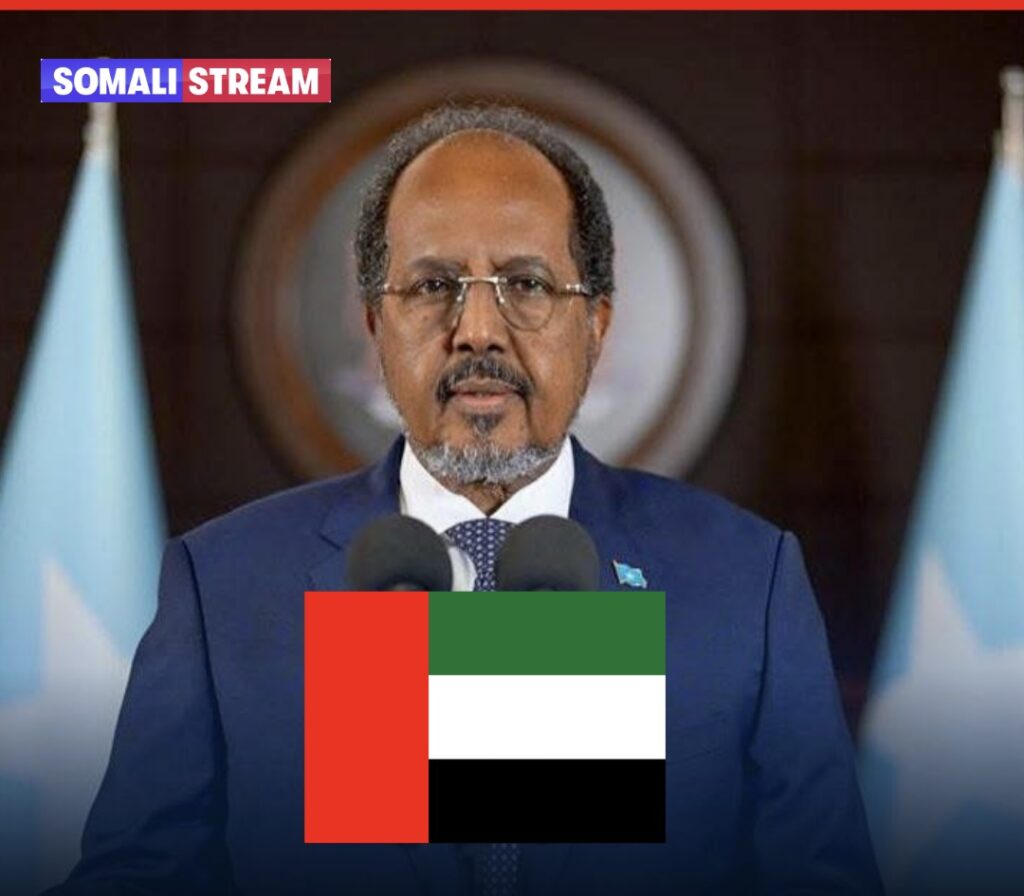
Somali President Hassan Sheikh Mohamud has accused the United Arab Emirates of pursuing policies that threaten Somalia’s sovereignty and territorial integrity, warning that his government will defend the country against further interference while leaving the door open to dialogue with Abu Dhabi.
In a strongly worded televised address to the nation, Mohamud accused the UAE of exploiting decades of bilateral relations to advance its strategic interests, bypassing Somalia’s federal government in agreements over national assets, supporting rival political and security structures and contributing to divisions within the country.
He described the actions as a betrayal of the trust between two countries with longstanding religious, cultural, historical and economic ties.
“We regarded the UAE as a brotherly country and opened our doors to it. We placed great trust in it. But that trust has been broken,” he said.
The president recalled that Somalia and the UAE had maintained close relations through shared Islamic traditions, cultural connections, the Arabic language and geographical proximity. Somali trading vessels had historically travelled between the Gulf and the Horn of Africa, carrying goods, knowledge and cultural ties.
He also highlighted Somalia’s membership of the Arab League in 1974 and the assistance thousands of Somalis received in the UAE following the collapse of the Somali state, including refuge, employment and opportunities for businesses.
Somali traders established commercial operations in the Gulf state, while remittances channelled through the UAE helped sustain families back home, he said.
Mohamud said Somalia had long appreciated these contributions, making what he described as the deterioration in relations particularly painful.
“A brother does not burn down your house. A brother does not purchase your property behind your back. A brother does not divide your family,” he said.
The president’s central accusation concerned what he described as years of Emirati interference in Somalia’s internal affairs, particularly through agreements with regional administrations that bypassed the federal government in Mogadishu.
He cited arrangements involving the strategic ports of Berbera, Bosaso and Kismayo, insisting that the facilities were national assets belonging to all Somalis rather than individual regional administrations.
“These ports are not the property of individual regional administrations. They are national assets belonging to all Somalis, wherever they live,” he said.
Mohamud argued that agreements involving strategic national infrastructure should be negotiated with the federal government in accordance with Somalia’s constitutional and legal framework.
He also accused the UAE of establishing military bases and supporting armed forces outside the country’s national security command structure without federal authorisation.
Such arrangements, he said, had weakened national institutions and created parallel security structures at a time when Somalia needed greater coordination to fight Al-Shabaab and other security threats.
The president further alleged that Abu Dhabi had provided political and financial support to certain regional administrations to challenge the federal government, encouraging disputes and undermining efforts to rebuild national institutions.
He said the ultimate consequence was to weaken Somalia’s central authority and leave the country vulnerable to external influence.
Mohamud also accused the UAE of playing a significant role in Israel’s recognition of Somaliland, which declared independence from Somalia in 1991 but remains part of the country’s internationally recognised territory.
He criticised Abu Dhabi for declining to join a joint statement issued by Arab and Muslim countries condemning Israel’s recognition, which Mogadishu considers a violation of Somalia’s sovereignty and territorial integrity.
“Can such a serious violation of solidarity be overlooked when it comes from a country that claims to be our brother?” he asked.
The president’s remarks underline growing tensions over Somaliland’s international relations and the strategic importance of the Horn of Africa, particularly its ports and coastline along major maritime routes.
He also raised allegations concerning an incident in January, when Somali territory, particularly Berbera, was allegedly used to facilitate the departure of a Yemeni separatist leader who had fled Yemen.
Mohamud said the Somali government had neither been consulted nor informed about the operation, accusing the UAE of using the country’s territory without authorisation.
“Somali territory is not an unlawful transit route. It is not a commodity to be bought and sold, nor is it a place through which anyone can enter and leave whenever they please,” he said.
The president defended Somalia’s decision on 12 January 2026 to cancel all agreements with the UAE, including those relating to security, defence and economic cooperation.
The government also prohibited Emirati military and cargo aircraft from using Somali airspace.
Mohamud said the decision followed years of unsuccessful diplomatic efforts, insisting that Somalia had repeatedly sought dialogue and attempted to resolve disagreements through established channels.
He rejected suggestions that Mogadishu had acted hastily, saying the government had exercised patience and hoped that historical relations and mutual respect would prevail over competing interests.
He described the cancellation of the agreements as a warning and a necessary measure to defend national sovereignty, rather than an act of hostility towards the UAE.
However, he accused Abu Dhabi of continuing to strengthen relationships with groups that he said threatened Somalia’s national security and the wider Horn of Africa, adding that its political and financial support for certain regional administrations had intensified political and security instability.
“Somalia today is not the Somalia of yesterday, which some may have regarded as weak,” Mohamud said.
“We are a nation with a constitution, a legitimate government and a people determined to defend their dignity, independence and unity.”
He warned that Somalia would defend its territory, independence and national unity through every means permitted by domestic and international law if the alleged interference continued.
Despite the forceful criticism, Mohamud said Somalia was not seeking confrontation with the UAE and remained prepared to restore relations on the basis of mutual respect, equality and recognition of its sovereignty.
“Our door remains open if you approach us with respect, equality and full recognition of Somalia’s sovereignty, territorial integrity and national unity,” he said.
He also sought to distinguish between the Emirati government and its population, stressing that Somalia’s grievances were directed at the policies of the UAE authorities rather than its citizens or the Somali community living in the Gulf state.
The message appeared to leave diplomatic room for a settlement, while making clear that Mogadishu would not accept agreements or security arrangements that bypassed its federal institutions.
Somalia warns against foreign exploitation of internal divisions
Turning to domestic politics, Mohamud urged Somali leaders and communities, including those in Somaliland, Puntland and Jubaland, to resolve their differences through dialogue rather than foreign intervention.
He warned that divisions along clan, regional and political lines were among the greatest threats to Somalia’s national security.
“The greatest enemy facing us is not necessarily the one coming from outside. Our greatest enemy is our own division,” he said.
The president argued that external actors seeking influence in Somalia could exploit internal disagreements by encouraging divisions between clans, regions and federal member states.
He called on Somali communities to reject attempts to deepen these divisions and urged political leaders to resolve disputes through an inclusive Somali-led dialogue.
Addressing communities in Somaliland, Puntland and Jubaland, he stressed that they remained part of the Somali nation and that political disagreements could be resolved through national dialogue without foreign involvement.
He also referred to developments in Libya, Yemen and Sudan, warning Somalis to study the consequences of prolonged political divisions and external interference in other countries.
Mohamud cautioned against allowing Somalia to follow a similar path, saying the country’s unity and statehood must take precedence over competing political and regional interests.
The president also delivered a message to Somali youth, warning against attempts to influence the country’s younger generation through financial incentives, false promises or political manipulation.
He described young Somalis as guardians of the country’s future and urged them to remain committed to national independence and unity.
He reserved a particular appeal for the Somali armed forces, describing them as the shield of the nation and entrusting them with the responsibility of protecting the country’s security, sovereignty and territorial integrity.
Mohamud invoked the sacrifices of previous generations who fought colonial rule to secure Somalia’s independence, saying the country’s strategic geographical position and natural resources made it essential to protect its sovereignty.
“Our fathers did not shed their blood, and you must not shed yours, only for us to exchange our sovereignty for leased ports, foreign military bases established on our soil or empty promises,” he said.