


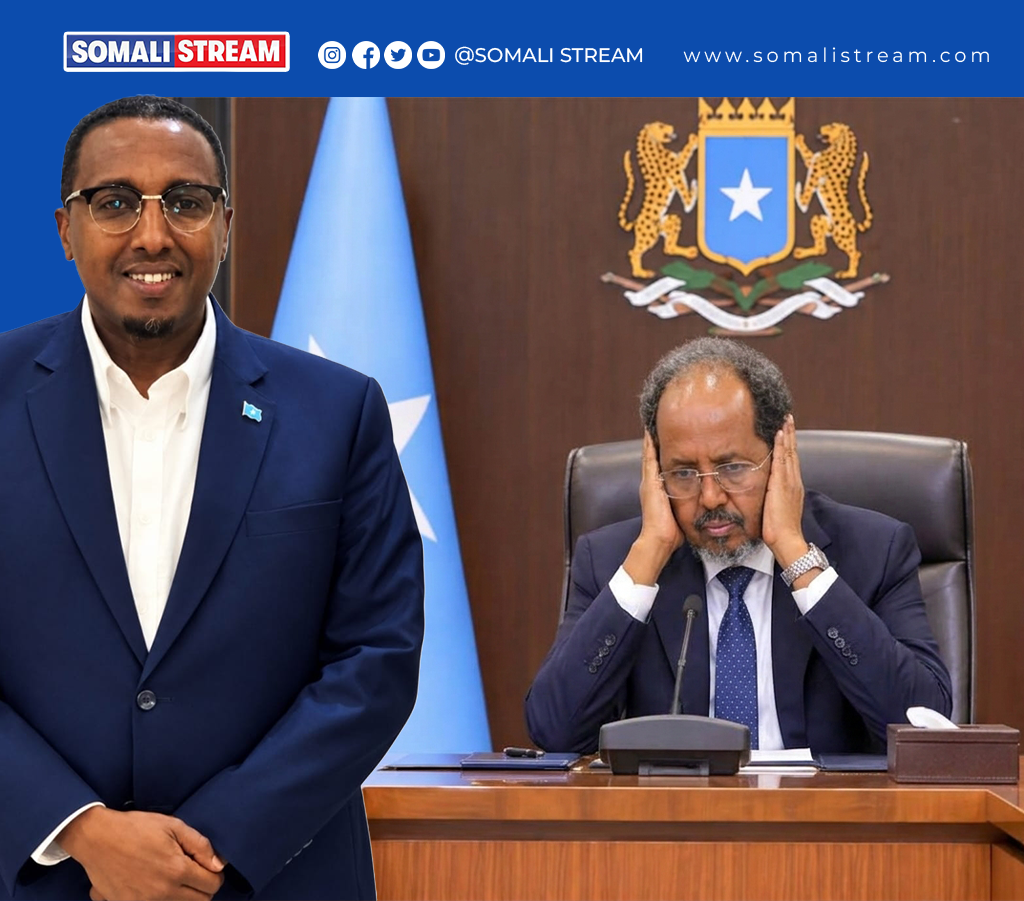
There is a gesture every child understands. When a child does not want to hear what is being said, he puts his hands over his ears. It is not an argument. It is a refusal that hopes to pass for peace.
Statesmen rarely use their hands for this. They use invitations instead. They send letters, prepare a hall, arrange the chairs and call in the cameras, so that the world can see a nation talking. A dialogue is measured twice: first by who is invited, then by who is heard. The invitation opens the door. Only listening opens the conversation. A host can fill every seat and still keep his ears covered, if the answers were settled before the guests arrived. The camera will record the handshake. It cannot record whether anyone was listening. Somalia has seen this gesture so many times that it no longer looks like an accident. It looks like a habit.
Somalia’s national dialogue has become a photograph waiting for its guests. The forum due to open on 14 November did not open. The presidency said only that it would begin “soon”, without saying when or where. The Somali Future Council refused to attend talks at Villa Somalia without international mediation.
Even Nabad iyo Nolol, the party of the previous President, which had not closed the door, set out its terms in a signed statement on 11 November. The talks, it said, must be inclusive and built on trust, must respect the earlier international mediation, and must resume from where they broke down on 3 September. Those are not the words of a party that has accepted an invitation. They are the terms of a party still waiting for a real table.
The usual question is why the opposition stayed away. The better question is what they were invited to say.
Answers Before Questions
The answer sits in the invitation. Villa Somalia issued it on 26 October, the day after the President’s televised address to the nation, and it limited the forum to “federal electoral matters” and nothing else. The three questions that caused the crisis were missing: the President’s mandate, the amended constitution, and the electoral commission born from it.
The President’s own words closed whatever the invitation had left open. In mid-October, meeting MPs from his own Justice and Solidarity Party, he reportedly said of calls for consultation on the disputed issues: “there will be no such consultation.” In the televised address, he said a clear line must be drawn between governing and consulting, because “the power to decide cannot be left in the middle”. Others may advise. He alone decides.
This is the heart of the matter, and the opposition has named it. They did not ask to be consulted. Consultation says: speak, and I will consider what you say, and then I will decide. Negotiation says: we stay at the table until we agree. A day after the address, one opposition leader in Parliament accused the President of confusing consultation with genuine political negotiations, in which both sides make concessions and work towards an inclusive agreement. The Somali Future Council, for its part, says it remains open to negotiations under international mediation. A consultant gives advice and goes home. A party to a negotiation helps write the outcome.
The President has left little room for the second. He has said the 2012 constitution “took its place in the archives” and that a return to it is not an option. In Dhusamareb he was plainer still, declaring that there would be “no compromise” on direct elections. His Information Minister then confirmed that only the “technical aspects” were open for discussion.
So the opposition was invited as consultants to a host whose hands were already over his ears, and asked to discuss where the chairs should go in a house whose deed had already been signed. That is not negotiation. It is attendance.
What the Picture Hides
Scholars have watched this play many times, on many stages. A study of 17 national dialogues, led by Thania Paffenholz, found that governments often launch such dialogues “with the aim of regaining legitimacy and retaining power by controlling the negotiation process and outcomes”. Practitioners at the Berghof Foundation warn in their guide to national dialogues that those shut out of setting the agenda end up debating topics “decided upon by others”.
The political scientists Julia Grauvogel and Christian von Soest add a distinction worth carrying in every pocket. Claiming legitimacy is one thing. Being granted it is another. A ruler can announce that he is trusted, and only the people can decide whether he is. Governments that hold elections, they show in their study of how regimes claim legitimacy, tend to focus on “procedural claims, thereby emulating democracies”. In plain words, they wear the costume of democracy and hope no one checks what is underneath.
This is where the camera earns its place. A forum is a procedure, and a photograph of a forum proves that the procedure happened. Neither proves that anyone was heard. Who, then, is the picture for? It is not for the opposition, who will know what was said and what was refused. Its natural audience sits abroad: the international partners, who see an open door in the photograph and cannot see the closed agenda behind it.
A Message Never Received
None of this is new. The closed agenda is not a sudden mood. It is the latest chapter of an old habit. For three years, the same message reached the President from every direction: change the constitution together, or do not change it at all.
Puntland said it first. The state stopped attending the National Consultative Council in January 2023, and when Parliament rewrote the first four chapters of the constitution on 30 March 2024, it withdrew its recognition of the federal government the next day. When a member of the federation walks out of the federation’s house, that is not a quarrel. It is an alarm. Jubaland followed in November 2024, suspending relations with the federal government over what it called violations of the constitution. South West was the third. On 17 March 2026, nine days after the new constitution was signed, it severed ties with the federal government and declared the 2012 constitution the only legitimate framework.
The national opposition said it next, in public warnings from former President Sheikh Sharif and former Prime Minister Hassan Ali Khaire against the changes. The international partners said it in the careful language of diplomacy, using a joint statement on the constitutional review to urge everyone to “build consensus through an inclusive process”. The UN Secretary-General said it most plainly of all, writing in his report to the Security Council that a consensus-based process was “imperative”. Four voices delivered one sentence. The message was sent many times. It was never received.
The timing made it worse. When a country’s borders are under threat, it is the worst moment to divide its people over the constitution. Even so, the first amendments moved forward while a neighbour’s memorandum with Somaliland threatened the country’s borders. The final package was signed on 8 March 2026, less than three months after the first foreign recognition of Somaliland. At the moment the nation most needed one voice, it was handed one man’s text.
What followed is arithmetic a schoolchild can do. A constitution without consensus gives birth to a mandate without consensus, and to an electoral commission without consensus. The children inherit the quarrel of their parent.
Why the Opposition Wants Witnesses
This is why the opposition now asks for mediators. It is not stubbornness. It is memory. The government and the opposition have been meeting since February, and nothing concrete has come of it. Talks facilitated by the United States and Britain ended in stalemate in May. A further round closed without resolving the dispute in July. The August discussions failed to resolve the main disagreements, and the process broke down on 3 September.
Each round produced photographs and a promise to keep talking. None moved the government on the questions in dispute. Worse, the government did not stand still while the talks went on. It pressed ahead with the very things it had been asked to stop. The Somali Future Council asked the President to halt what it called unilateral measures and come back to the table. Instead, the electoral commission born from the disputed constitution announced parliamentary elections for 15 April 2027 and a presidential vote for 15 May, a date that rests on the disputed extension of his term. The talks were about which road to take, and the government kept driving.
The opposition has learned the routine by heart: walk in, shake hands, smile for the camera, leave unheard, and then watch the government carry on as before. A guest who has been ignored at every sitting does not need another invitation. He needs a witness.
The government replies that the opposition is not united. It does not need to be. Its members will compete for the same offices, because that is what elections are for. They agree on one thing only: a player cannot rewrite the rules of the game he is playing.
The price of rewriting them alone is already being paid, and it is no longer counted only in words. The federal government answered South West with force. Within two weeks, federal forces took control of Baidoa, and South West’s President, Abdulaziz Laftagareen, was ousted. His forces have since fought federal troops in Baidoa in August, September and late October, and have taken five towns in Bay: Buurhakaba, Qansaxdheere, Berdaale, Diinsoor and Awdiinle.
Former President Sheikh Sharif opposed the decision to use force, a council of local elders and leaders pressed both camps for a ceasefire, and the UN called for maximum restraint. A state that was meant to be settled by an election now has two claimants and one battlefield.
Hirshabelle, which stayed with the President, is now split between its two regions. Its election went ahead despite protests in Beledweyne, and the President’s party took 78 of the 99 seats. Community leaders in Hiiraan rejected the result, and the governor of Hiiraan resigned, rejecting the use of military force against local communities. Beledweyne has turned its back on the state capital, Jowhar. The vote produced a winner. It did not produce a united state.
Count the states. Three walked away. One of them was brought back by force and has known violence ever since. One that stayed is split in two. Only Galmudug remains with the President, and in one piece. That is what one man’s constitution has built.
On the eve of the Supreme Court’s ruling that the mandates had expired, the President dismissed the Chief Justice. UN experts answered that he “must be restored to office”, and both the Uganda Law Society and the East Africa Law Society called for the court to be respected. The constitutional scholar David Landau calls this pattern abusive constitutionalism, in which the tools of constitutional change make those in power “difficult to dislodge” while elections carry on.
The Simple Test
The remedy is not complicated. The African Union Commission has called for “genuine negotiation, mutual compromise” and strict adherence to constitutional order. If the President believes his constitution, his mandate and his commission can survive scrutiny, he should put all three on the table and invite the Quartet in as guarantors. Facilitators carry the chairs. Guarantors make sure the promises made around the table are kept. A strong case does not fear a witness.
Why, then, refuse one? The government’s answer is always the same word: sovereignty. When international partners proposed an advisory committee to guide the transition in May, the President replied that “Somalia is an independent country” and warned against outside interference. This month his Information Minister accused some opponents of working with foreign interests to undermine the state.
Sovereignty is a serious word, and Somalia has every reason to guard it. Yet it does not belong to whoever holds the office. The 2012 constitution, the one the President says has gone to the archives, says that all power is vested in the public and that it is “prohibited for a person or a section of the public to claim the sovereignty” of the Republic for their own interest. A nation’s sovereignty is protected by a process its people have agreed to, not by the hand that holds the power. A witness at the table does not weaken a country. A quarrel that splits it does.
Until that is understood, the only obstacle to dialogue is the agenda President Hassan Sheikh Mohamud refuses to table. The invitations can keep going out, and the camera can keep rolling. Until the hands come away from the ears, no one in that hall will be heard.
Awale Kullane is a Somali diplomat and political analyst who writes on institutions and political leadership in the Horn of Africa. Find him at www.linkedin.com/in/awale-kullane-2632a5388
