


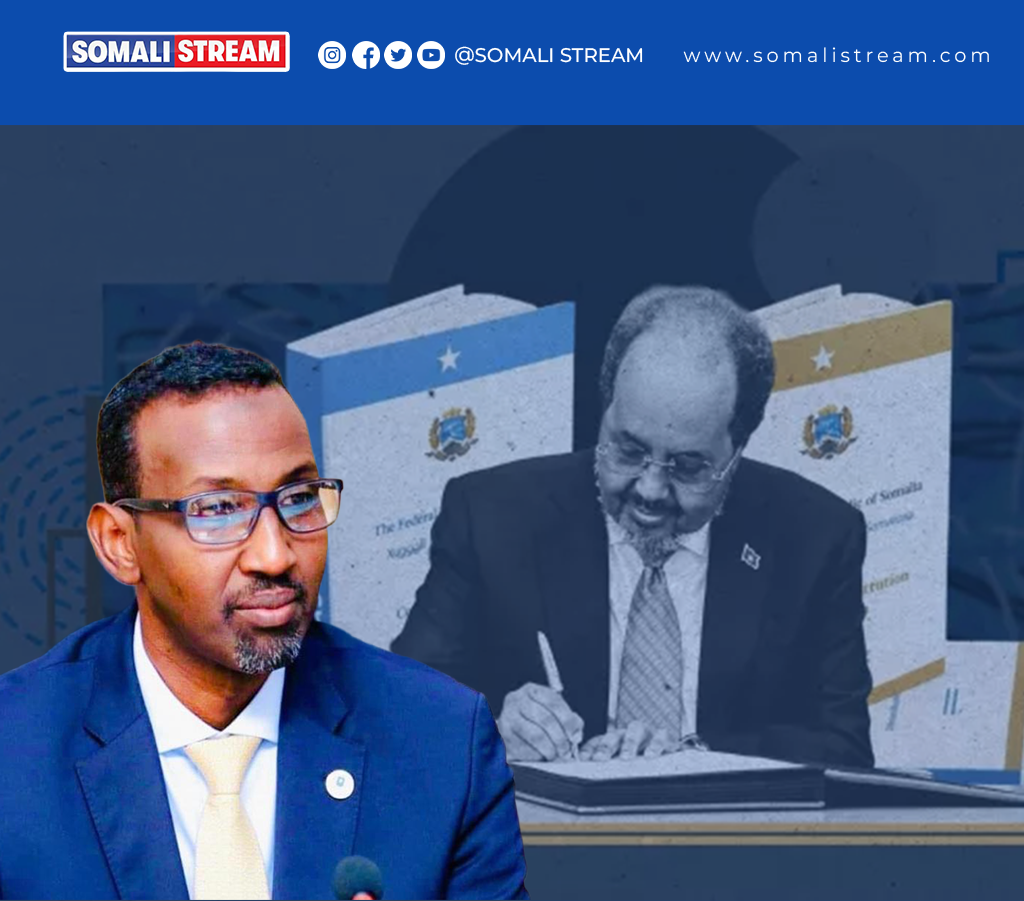
Constitutional governance depends on the separation of powers, institutional independence, accountability, and the rule of law. These principles ensure that public authority is exercised within established legal limits and that no individual or institution operates beyond constitutional scrutiny.
Since his re-election on 15 May 2022, President Hassan Sheikh Mohamud has faced growing criticism over the perceived expansion of presidential authority and the weakening of constitutional institutions.
These concerns raise a fundamental question about Somalia’s political future: Is the country strengthening a constitutional system based on institutional checks and balances, or moving toward a system in which critical national decisions are increasingly concentrated within the Presidency?
- THE PRIME MINISTER AND THE COUNCIL OF MINISTERS
One of the principal criticisms of President Hassan Sheikh Mohamud’s administration concerns the Presidency’s growing influence over executive decision-making.
Under Somalia’s constitutional framework, the Prime Minister is responsible for leading the Government and coordinating the Council of Ministers. However, concerns have emerged that the Prime Minister’s decision-making authority has become increasingly dependent on presidential approval, while the Cabinet is perceived as endorsing decisions already determined by the Presidency.
Effective cooperation between the President and Prime Minister is essential for stable governance. Nevertheless, such cooperation must respect the constitutional responsibilities assigned to each office.
If the Council of Ministers cannot deliberate independently or exercise meaningful collective authority, the constitutional balance within the executive branch risks being undermined.
- PARLIAMENTARY INDEPENDENCE AND EXECUTIVE OVERSIGHT
The Federal Parliament of Somalia is constitutionally entrusted with legislative authority, representation of the Somali people, oversight of the executive, and safeguarding national interests.
However, the close political alignment between parliamentary leadership and the Presidency has raised questions about Parliament’s institutional independence and its ability to scrutinize government decisions.
The separation of powers requires more than the formal existence of distinct institutions. Parliament must possess both the authority and independence to question executive actions, amend legislative proposals, and reject measures that conflict with constitutional principles or national interests.
When parliamentary oversight becomes subordinate to presidential influence, the legislature risks becoming an institution that legitimizes executive decisions rather than one that independently holds the government accountable.
- THE DISSOLUTION OF INDEPENDENT OVERSIGHT INSTITUTIONS
On 9 October 2022, President Hassan Sheikh Mohamud issued decrees dissolving the Judicial Service Commission and the Independent Anti-Corruption Commission.
The Presidency cited concerns regarding the legality of the commissions’ original appointments. Nevertheless, the decisions raised broader questions about institutional continuity, judicial independence, and the effectiveness of public accountability mechanisms.
Particularly concerning is the continued absence of a fully functioning independent anti-corruption commission capable of investigating abuses of public office and safeguarding public resources.
Independent oversight institutions are essential to preventing corruption and ensuring that public officials remain accountable under the law.
Their prolonged absence raises an important question: Is the failure to establish an effective Independent Anti-Corruption Commission attributable to legal and administrative obstacles, or does it reflect a political reluctance to strengthen independent scrutiny of public authority?
The Government should provide a transparent explanation and a credible timetable for restoring effective institutional oversight.
- JUDICIAL INDEPENDENCE AND THE SUPREME COURT CONTROVERSY
On 4 November 2026, President Hassan Sheikh Mohamud announced the dismissal of Supreme Court President Bashe Yusuf Ahmed and the appointment of Ibrahim Iidle Suleiman as his successor. The decision sparked a constitutional dispute concerning presidential authority, judicial independence, and compliance with established legal procedures.
Of particular significance is that the contested constitutional amendments approved by the Federal Parliament on 4 March 2026, and subsequently signed by the President, establish procedures governing the appointment and removal of the Supreme Court President.
According to published interpretations of Articles 135 and 138, these procedures require the involvement of the Judicial Service Commission and parliamentary approval, rather than unilateral presidential action.
However, no publicly available documentation has been identified demonstrating that the required commission proceedings and parliamentary approvals preceded the dismissal and subsequent appointment.
On 12 November 2026, independent United Nations human rights experts criticized the dismissal, stating that the required constitutional procedures had not been followed.
The Federal Government subsequently defended its decision, arguing that transitional arrangements permitted the action because the High Council of the Judiciary had not yet been established.
This dispute raises a fundamental constitutional question: Can the absence of an institution required by the Constitution justify bypassing the safeguards intended to protect judicial independence?
Resolving this controversy requires an authoritative legal examination of the applicable constitutional provisions, transitional arrangements, and judicial legislation.
Judicial independence is not a privilege granted to judges. It is a constitutional guarantee protecting citizens against political interference in the administration of justice.
- THE ABSENCE OF A CONSTITUTIONAL COURT
The continued absence of a Constitutional Court remains a significant obstacle to completing Somalia’s constitutional framework.
Such a court is essential for interpreting constitutional provisions, resolving disputes between state institutions, reviewing legislation, and protecting fundamental rights.
Without an independent constitutional adjudication mechanism, disagreements concerning presidential powers, parliamentary authority, and relations between the Federal Government and Federal Member States become increasingly difficult to resolve through established legal procedures.
This raises another legitimate question: Has the Constitutional Court remained unestablished because of legal and political difficulties, or has insufficient political commitment contributed to its continued absence?
A Constitution cannot function effectively if disputes over its interpretation are left primarily to the political institutions whose powers are being contested.
Establishing an independent Constitutional Court should therefore become a national priority.
- PRESIDENTIAL DECREES AND THE CONTROVERSY OVER PUBLIC LAND
Another source of public concern involves allegations surrounding the allocation and transfer of public land, particularly decisions affecting ownership or land-use arrangements without sufficient transparency.
Critics have questioned whether certain government actions comply with Somalia’s constitutional and statutory protections.
Legal provisions cited in these debates include Articles 26 and 43 of the Constitution; Articles 50 and 51 of the Public Financial Management Act of 2019; Articles 87, 681, 723, and 730 of the Somali Civil Code of 1973; and Law No. 41 of 1973 concerning urban land.
Public land is a national asset intended to serve the public interest. Its administration must therefore comply with applicable laws, transparent procedures, and safeguards protecting citizens’ property rights.
Attention must be given to vulnerable communities facing displacement and to ensuring equitable access to public resources.
Presidential decrees cannot override constitutional protections or statutory requirements governing public property. Any disputed land allocation or transfer should be subject to independent legal review and appropriate institutional oversight.
CONCLUSION: GOVERNANCE IS AN INSTITUTIONAL SYSTEM, NOT THE EXERCISE OF PERSONAL POWER
Concerns surrounding the Prime Minister’s authority, parliamentary independence, dissolved oversight institutions, judicial controversies, the absence of a Constitutional Court, and public land administration raise fundamental questions about Somalia’s constitutional direction.
Every President possesses constitutional powers, but those powers are neither unlimited nor beyond scrutiny. They are constrained by the Constitution, the rule of law, and the responsibilities entrusted to other state institutions.
Having endured decades of instability and a prolonged struggle to rebuild its institutions, Somalia cannot afford to undermine the constitutional safeguards designed to prevent excessive concentration of power.
Strengthening parliamentary oversight, safeguarding judicial independence, restoring effective anti-corruption institutions, and establishing a Constitutional Court must become national priorities. These are not concessions to political opponents but essential requirements for preserving constitutional legitimacy, institutional accountability, and the continuity of the Somali state.
The Constitution is not an instrument to be interpreted or adjusted according to presidential preferences. It is the supreme national framework that defines, distributes, and limits the powers of every institution of government.
Ultimately, strong statehood is built not through the concentration of authority in one individual, but through independent institutions, respect for the law, and leadership willing to accept scrutiny and accountability.
Somalia’s future depends not on how much power a President can accumulate, but on how effectively its institutions can function independently of whoever occupies the Presidency.
Amb. Ali Mohamed Mohamud (Cagabarur)
Diplomat and Political Analyst
Former Somali Ambassador to Uganda
Former Chargé d’Affaires at the Somali Embassy in Pakistan
