


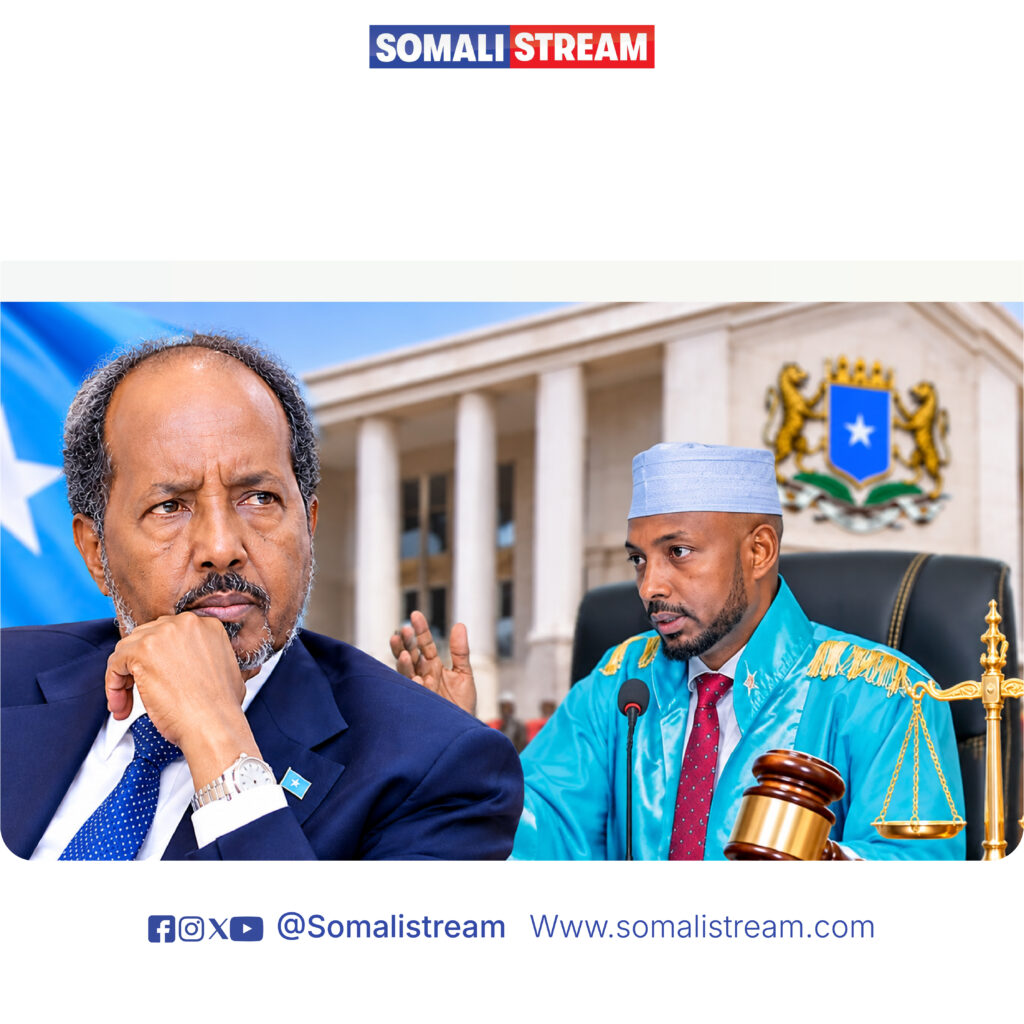
Villa Somalia names Baashe Yuusuf Axmed’s successor, but the Supreme Court declares his dismissal unconstitutional, exposing a deepening confrontation over presidential powers, judicial independence and the country’s contested constitution.
Somalia has been plunged into a major constitutional confrontation after President Hassan Sheikh Mohamud removed the country’s chief justice and appointed a successor, prompting the Supreme Court to declare the decision null and void.
The dispute has exposed a fundamental disagreement over who has the constitutional authority to appoint and dismiss the head of Somalia’s judiciary, with the Supreme Court directly challenging the presidency’s interpretation of its powers.
In a statement issued on Wednesday, 4 November, Villa Somalia announced that President Hassan Sheikh had dismissed Supreme Court Chief Justice Dr Baashe Yuusuf Axmed and appointed lawyer Ibrahim Iidle Suleymaan to replace him.
The presidency justified the decision by citing complaints from judges, judicial employees and legal professionals, saying the concerns related to the need for a transparent and impartial justice system.
It described the change as part of a broader judicial reform programme intended to ensure Somali citizens have access to a reliable and transparent judiciary.
But the Supreme Court issued a sharply contrasting statement on Thursday, declaring the purported dismissal legally invalid and insisting that the president had no constitutional authority to remove its chief justice unilaterally.
Two institutions, two conflicting accounts
The competing statements present sharply different explanations for the removal.
Villa Somalia said the president had taken account of complaints from across the judicial profession and decided that comprehensive reforms were necessary.
It also said the president had wished the newly appointed chief justice success in carrying out his responsibilities, emphasising the importance of judicial independence, the rule of law and equal justice.
The Supreme Court, however, rejected the suggestion that complaints from judges provided grounds for Baashe’s removal.
It said there was no substance to the reported complaints and praised the outgoing chief justice’s record, citing improvements in judicial standards, transparency and efforts to combat corruption and favouritism.
More significantly, the court argued that the presidency had failed to follow the constitutional procedure governing the removal of the country’s most senior judicial official.
Supreme Court invokes constitutional safeguards
The court based its position on Articles 135 and 138 of the 2026 Constitution, which it cited as establishing a specific process for appointing and dismissing the Supreme Court chief justice.
Under its interpretation of Article 135, appointment requires a recommendation from the Supreme Judicial Council, approval by a majority of both parliamentary chambers and a subsequent presidential appointment decree.
Article 138(4), meanwhile, provides for the Supreme Judicial Council to initiate the removal process, with dismissal requiring a majority vote in a joint sitting of the Federal Parliament.
The court said these provisions left no room for the president to dismiss the chief justice through a unilateral presidential announcement.
It therefore declared the removal announced by Villa Somalia null and void.
The court also instructed President Hassan Sheikh to respect the constitution, safeguard judicial independence and uphold the supremacy of the law.
The constitutional dispute behind the confrontation
The timing of the dispute has added further political significance.
According to the Supreme Court, a constitutional case is already before it concerning the process used to amend the constitution, the president’s tenure and the terms of office of the federal government and both chambers of parliament.
The court suggested that the presidential announcement risked obstructing its ability to deliver justice in that sensitive constitutional proceeding.
It invoked the principles of separation of powers, judicial independence and the rule of law, arguing that the presidency’s action was inconsistent with constitutional safeguards.
The controversy is particularly consequential because the court is being asked to address questions that touch directly on the constitutional framework governing the country’s political leadership.
Ibrahim Iidle Suleymaan’s appointment raises further questions
The appointment of Ibrahim Iidle Suleymaan has introduced another unresolved issue: whether the incoming chief justice can assume the office while the Supreme Court maintains that the removal of his predecessor was legally invalid.
Villa Somalia has presented the appointment as part of its judicial reform agenda. The Supreme Court’s declaration, however, challenges the legal foundation of the entire process.
The competing positions leave Somalia facing an institutional dispute over the leadership of its highest court, the constitutional limits of presidential authority and the legitimacy of decisions taken by the executive.
A test of Somalia’s constitutional order
The immediate issue is whether Villa Somalia will recognise the Supreme Court’s declaration or maintain its position on the dismissal and replacement.
The two statements have established a direct institutional confrontation, with the presidency invoking judicial reform and complaints from legal professionals, while the Supreme Court insists that constitutional procedure cannot be bypassed, regardless of the justification offered.
At the centre of the dispute is a question with implications extending well beyond the tenure of one judge: whether the constitutional safeguards governing Somalia’s judiciary can be enforced when they conflict with a decision taken by the country’s highest political office.
For now, Somalia has two competing institutional positions over who should lead its Supreme Court — and no indication in the statements of an agreed resolution.
The constitutional battle over the country’s judiciary is now out in the open.
