


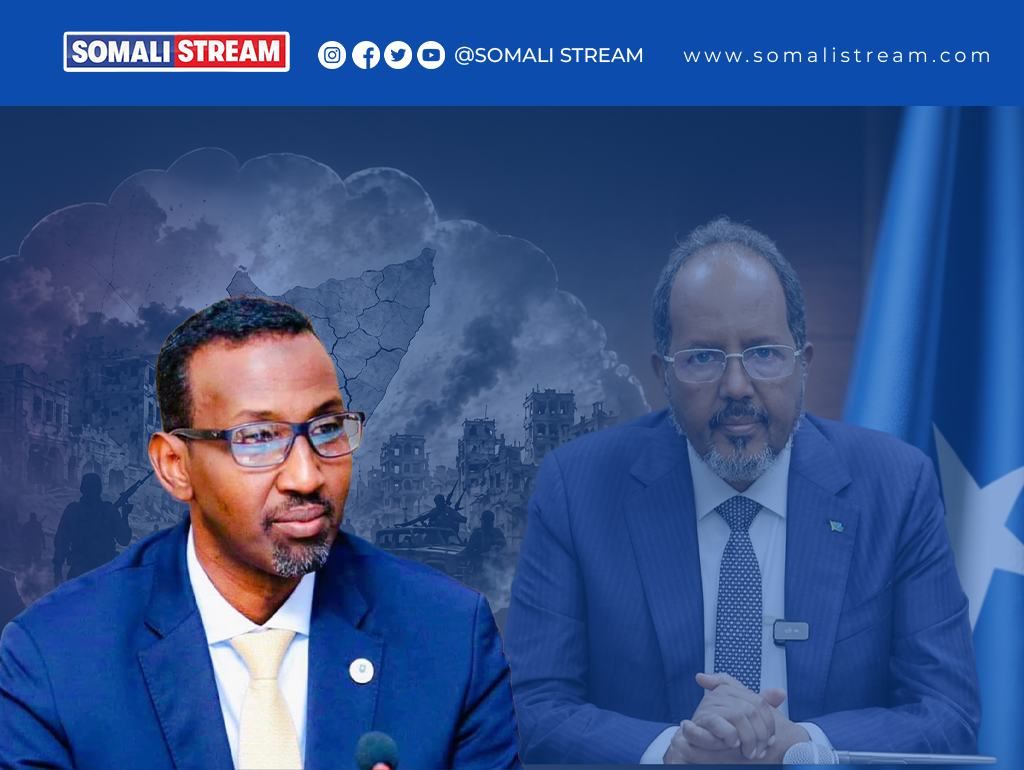
An Analysis of Political Retribution, Concentration of Power, Constitutional Disputes, and the Challenges Facing Somalia’s Federal System and National Unity.
Somalia is passing through a critical political period that has raised serious questions about the future of the Third Republic, the resilience of the federal system, and the preservation of national unity.
The Third Republic, which emerged from the process of rebuilding Somali statehood, embodied the hope that Somalia would move beyond a political culture in which power was concentrated in the hands of a few groups and instead establish a system of governance founded on political consensus, power-sharing, justice, and accountability.
However, during President Hassan Sheikh Mohamud’s second term, which began on 15 May 2022, political and constitutional disputes have intensified, raising growing concerns about the future of Somalia’s federal system and national unity.
The central question today is not merely whether President Hassan Sheikh Mohamud will succeed in advancing his political agenda, but whether the Third Republic can withstand the deepening divisions and escalating political disputes threatening its stability.
Political Retribution and the Legacy of Previous Elections
One of the principal accusations directed at President Hassan Sheikh Mohamud’s administration is that certain political and administrative decisions have been influenced by grievances stemming from the February 2017 presidential election, in which he failed to secure re-election, and the political contest surrounding his return to power in May 2022.
There have been allegations that politicians who did not support his candidacy, businesspeople who declined to contribute financially to his electoral campaign, and individuals associated with them subsequently faced political or economic pressure.
Nevertheless, the fundamental principle of statehood is clear: once elected, a president can no longer remain merely the leader of the political group that supported his campaign. He becomes the President of the Republic, entrusted with the responsibility of serving equally those who voted for him and those who did not.
An election should mark the end of political competition, not the beginning of a period of retaliation and political score-settling.
When national institutions are perceived as instruments for rewarding political supporters and punishing opponents, the impartiality of the state is undermined, and public confidence in government institutions is weakened.
Public Appointments: Power-Sharing or Concentration of Power?
Another source of growing concern is the way senior government officials have been appointed, particularly within the security, financial, judicial, and diplomatic institutions.
For many years, Somalia has operated under the 4.5 power-sharing formula, designed to safeguard political representation and maintain a degree of social balance until the country can transition toward a system based on equal citizenship, merit, and fair competition.
Although this arrangement has significant shortcomings, it has nevertheless formed part of the political settlement intended to restore public confidence and a shared sense of ownership in national institutions.
President Hassan Sheikh Mohamud’s administration has faced criticism over allegations that certain influential positions have become disproportionately concentrated among individuals closely associated with the President, whether through family ties, clan affiliation, or political loyalty.
The problem is not that an individual appointed to public office happens to be related to the President. The problem arises when personal relationships take precedence over competence, integrity, and the national interest.
A leader entrusted with the responsibility of governing an entire nation must demonstrate confidence in the competence and capabilities of citizens beyond his immediate family, political allies, or personal networks.
Modern statehood is not built upon a leader’s personal trust in selected individuals. It rests upon institutions capable of serving the public independently, impartially, and professionally.
Equally, the 4.5 formula must not become a justification for disregarding education, experience, and competence, just as the principle of merit must not be used as a pretext for discrimination or the denial of fair representation to segments of society.
Both principles must be carefully balanced while upholding justice, transparency, and the broader national interest.
Constitutional Disputes and the Growing Rift Between the Federal Government and Federal Member States
One of the most serious threats confronting Somalia’s Third Republic is the deteriorating relationship between the Federal Government and several Federal Member States.
On 31 March 2024, Puntland announced that it would suspend recognition of and cooperation with federal institutions following disagreements over the constitutional amendment process.
Jubaland has also entered a serious political dispute with the Federal Government, particularly concerning electoral arrangements, the constitutional powers of Federal Member States, and allegations of interference by federal authorities.
South West State has likewise experienced political tensions that led its administration to announce the suspension of cooperation with the Federal Government in March 2026.
Meanwhile, the political dispute between the Hirshabelle administration and sections of the population in the Hiiraan region, in which the Federal Government has been accused of playing a role, is rooted in longstanding disagreements over power-sharing, political representation, and the process through which Hirshabelle State was established.
Critics of that arrangement argue that the Hiiraan region has not received political representation and authority commensurate with its political and demographic significance. They further contend that previous agreements and commitments concerning the distribution of power and administrative positions have not been honored.
The Hirshabelle State dispute is therefore not merely a disagreement over political appointments. It reflects deeper political grievances that require a solution founded on dialogue, justice, and an inclusive political settlement.
Although the disputes involving the Federal Member States arise from different circumstances, they share one fundamental constitutional question: who has the authority to determine matters concerning the Constitution, elections, and the governance of Federal Member States?
A federal system cannot function effectively when the Federal Government unilaterally determines matters requiring constitutional consultation and political consensus. Equally, Federal Member States cannot claim autonomy beyond the limits established by the Constitution and the unity of the nation.
Federalism is a system founded on constitutional power-sharing, consultation, mutual respect, accountability, and shared national responsibility. When these principles are disregarded, political trust erodes, placing the stability of the federal system and the cohesion of the Third Republic at risk.
Federalism is an agreement to share power and responsibility, not a contest over who can exercise greater authority.
Without genuine political dialogue, these disputes could undermine institutional cooperation, national security, and the long-term future of Somalia’s federal system.
The Struggle for Power and the Threat to National Unity
The President of the Republic bears a constitutional responsibility to safeguard Somalia’s sovereignty, unity, and territorial integrity.
However, when domestic struggles for political power overshadow efforts toward national reconciliation, the country’s ability to confront external threats through a unified national position is weakened.
The Somaliland issue has long been a political challenge requiring a solution based on dialogue, national consensus, and sustained diplomatic engagement.
Recent developments concerning the recognition of Somaliland by foreign countries have heightened concerns about Somalia’s territorial integrity and national unity, as well as the potential emergence of new geopolitical rivalries in the Horn of Africa.
The Federal Government must address this issue through a unified national strategy while ensuring that internal political disputes do not undermine Somalia’s diplomatic position. A nation divided internally will struggle to speak with one voice internationally.
National unity cannot be preserved through patriotic speeches alone. It requires leadership capable of building trust, forging political consensus, and fostering a genuine sense of shared national ownership.
Somalia’s Third Republic: What Can Save It?
The threats confronting Somalia’s Third Republic are not insurmountable. However, overcoming them requires the country’s leadership to place the preservation of statehood above short-term political interests.
President Hassan Sheikh Mohamud must engage in genuine dialogue with political leaders and stakeholders who hold views different from those of his administration. He must also demonstrate through concrete actions his commitment to the principles of peace, unity, and political compromise that he has repeatedly advocated in public speeches.
True leadership is not measured merely by speeches and promises, but by the decisions taken and the ability to translate words into meaningful action.
Federal Member States and opposition leaders also bear a responsibility to resolve political disagreements through dialogue and to refrain from actions that could further undermine national cohesion.
Conclusion:
Statehood Is not the Private Property of any Individual or Political Group,
Somalia has endured state collapse, civil wars, and political fragmentation, experiences from which profound and painful lessons have been learned.
The most important lesson is that statehood must be regarded as a national inheritance that transcends the interests of individuals, families, clans, and political groups.
President Hassan Sheikh Mohamud now faces two paths: to prioritize a national political settlement capable of safeguarding the Third Republic, or to continue along a path of political confrontation that could endanger the legacy of statehood for which generations of Somalis have struggled and sacrificed.
History evaluates leaders based on the institutional strength, stability, and well-being of the nation they leave behind rather than the sheer length of their tenure.
Statehood is a national inheritance belonging to the entire people. No individual or political group has the right to transform it into private property.
The End
Amb. Ali Mohamed Mohamud (Cagabarur)
Diplomat and Political Analyst
Former Somali Ambassador to Uganda
Former Chargé d’Affaires at the Somali Embassy in Pakistan
