


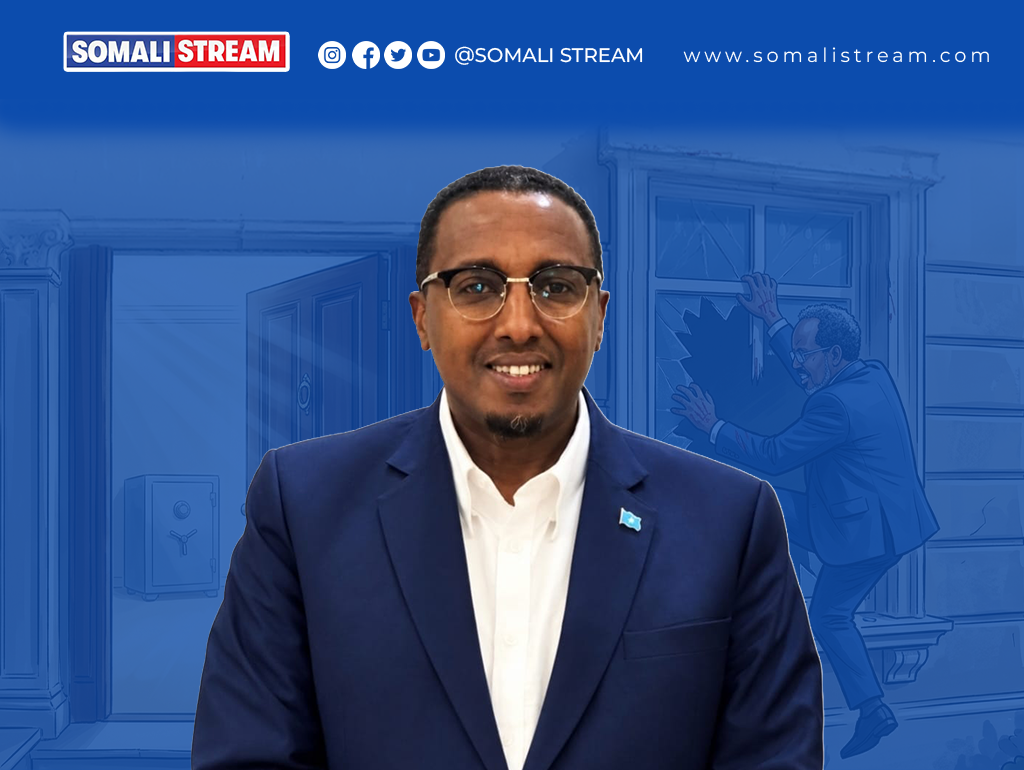
There is an old temptation among those who plan to bend the rules. Even when the front door is open, they would rather break a window and climb in. The house is the same, and the room they reach is the same, but they arrive with cut hands, a broken frame and neighbours who will never trust them again. Somali politics in the past three years has followed that pattern, and the cost has been paid not only by those inside the house but by the one who chose the window.
In January 2024, when Ethiopia’s port deal with Somaliland threatened Somalia’s territorial integrity, and again in December 2025, when Israel recognised Somaliland, the nation opened its front door to President Hassan Sheikh Mohamud. Each sovereignty crisis offered him something no constitutional amendment can manufacture: a country willing to stand behind him on a question larger than its quarrels. Each time, he chose the window instead. The tragedy is not only what this did to the country. It is what it did to his own ambition, because the door he ignored was the surest road to the consecutive term he wanted.
The First Open Door
The port deal was signed on 1 January 2024, and most Somalis saw it as a direct assault on their territorial integrity. The national response was remarkable. The government rejected the deal the next day, Parliament passed a law nullifying it, and every member state leader at the National Consultative Council stood with the Federal Government. Tens of thousands marched in the capital, and the Heritage Institute described the government’s response as “swift, popular, and unequivocal”.
Even Puntland, which had left the Council a year earlier in protest at the constitutional reforms, kept the door open. When President Hassan Sheikh Mohamud attended the inauguration of Puntland’s President, Said Abdullahi Deni, in Garowe on 25 January, the two men sat side by side in what observers called “a public display of reconciliation”, and a consultative forum in Garowe to settle the constitutional dispute was already on the table. According to Puntland’s President, President Hassan Sheikh Mohamud agreed to that dialogue while he was in Garowe, even assigning the Deputy Prime Minister to work on its agenda, and the immediate former president publicly welcomed it. In Garowe, President Hassan Sheikh Mohamud also promised that any constitutional changes would “only take effect with the election of the next government”. For a few weeks, Somalia was not a federation of rivals but a nation with one voice.
Within three months, that unity had been spent. The government soon objected to holding the forum in Garowe, and in March 2024 Parliament pushed through amendments to the first four chapters of the constitution without the agreement Puntland had sought. Former Presidents Sharif Sheikh Ahmed and Mohamed Abdullahi Farmaajo boycotted the vote and warned of “serious consequences” for “the unity and nationhood of the country”, and on 31 March Puntland withdrew its recognition of the Federal Government. The same leaders who had rallied to defend Somalia’s borders found themselves defending its constitution against their own government.
The Second Open Door
History rarely repeats such an opening. It repeated it for President Hassan Sheikh Mohamud in December 2025, with the recognition of Somaliland. Again the country rallied. On 27 December, he met former heads of state now in opposition, and his office declared that “the defense of the country’s unity and independence transcends politics”. It was the right sentence. It was also the moment to act on it.
The opposition asked for exactly that. By 28 January 2026, the Somali Future Council was calling on him to halt the constitutional amendment process altogether, and lawmakers from five member states warned that the changes were being pursued without consultation. The government pressed on. In March 2026, Parliament approved amendments that extended presidential and parliamentary terms from four to five years, and many Somalis remembered the promise made in Garowe two years earlier. In both sovereignty crises, the nation said that unity transcends politics, and in both the government answered with politics.
What a Crisis Offers a Leader
Political scientists have long understood what President Hassan Sheikh Mohamud overlooked. John Mueller (1973) described the rally round the flag effect: when a nation faces an outside threat, citizens and even opposition leaders set aside their differences and stand behind whoever leads the national response. But Mueller also showed that the rally is temporary. It is a loan of trust, not a gift, and it must be repaid with something lasting before it expires.
Chris Ansell, Arjen Boin and Paul ’t Hart (2014) put the choice plainly: crises “provide political elites with power chances and with acute threats to their legitimacy.” The same moment can raise a leader or expose him, depending on what he does with it. A leader who uses national solidarity to advance a disputed personal agenda does not only lose the moment. He teaches his rivals never to offer it again. That is what happened in Somalia. The opposition that sat with him in December 2025 now asks for international mediators before it will sit with him at all. When President Hassan Sheikh Mohamud invited it to a national consultative forum in the capital from 14 to 18 November 2026, the Somali Future Council refused to attend unless international mediators were present, arguing that the government cannot be trusted to referee a process it controls.
The Foundations He Could Have Laid
Imagine the other road. In January 2024, or again in December 2025, President Hassan Sheikh Mohamud could have announced that the constitutional amendments would wait, accepted the meeting Puntland offered in Garowe, and led a united front in defence of Somalia’s sovereignty as the president of all Somalis rather than the leader of one camp. He could have used that moment of national solidarity to lay the foundations no Somali leader had been able to lay.
The blueprint was his own. In January 2022, as a candidate, he wrote in Foreign Affairs that his predecessor had “systematically dismantled the democratic institutions,” that the National Consultative Council should “build consensus around an electoral process that is acceptable to all parties,” and that Somalia must show “that no one can stay in power beyond their constitutional term.” These were not the words of an outsider guessing at what the country needed. They were the plan of a man who had already served one term and knew exactly where the cracks lay.
With the country behind him, he could have turned those words into institutions. He could have established a Constitutional Court, which the 2012 constitution required within 60 days of the first Council of Ministers, formed under his own first government. Fourteen years and three presidencies later it has never been established, and its powers still rest with a Supreme Court appointed by presidential decree. Here was his chance to finish what his first government had left undone. He could have built an electoral commission whose members and selection process were agreed with the member states and the opposition, rather than the commission his government appointed. And he could have settled the electoral model by consensus before any vote was cast.
Steven Levitsky and Daniel Ziblatt (2018) call the habit that protects such foundations forbearance: leaders refraining from using every legal power they hold, so that their rivals can trust the rules. A president who had done this would have carried a mantle none of his rivals could match. The very consensus he spent three years resisting would very likely have carried him to the consecutive term he sought, through the front door and with the country’s respect rather than its suspicion.
Washington or Nixon
History offers two portraits of leaders who stood where he stood. George Washington was not required to leave office; nothing then limited a president’s terms. Yet in 1796 he stepped down, mindful of the precedent his conduct would set for those who followed. His greatness lies less in the battles he won than in the rules he chose to obey before anyone could make him.
Richard Nixon was a capable president, credited with bold initiatives that won lasting acclaim. But in June 1972, men employed by his re-election committee were arrested breaking into the opposition’s headquarters at the Watergate building. That November he won in a landslide. He never needed the break-in. Less than two years later he resigned. The front door was open, and his side chose the window. Few Somali leaders have held both portraits in their hands at once. The crises of 2024 and 2025 offered President Hassan Sheikh Mohamud the chance to be Washington at his best, the president who built Somalia’s rules. Instead, he chose to follow Nixon at his worst, and the choices that followed risk leaving him remembered for the ways he tried to get around them.
The Cost of the Shortcut
Shortcuts tempt those who trust their plans more than their partners. But in politics, the shortcut often blinds a leader to the clear path in front of him. The window gave President Hassan Sheikh Mohamud a constitution three member states reject, a five-year term the opposition disputes, and a capital where dialogue must now be guaranteed by outsiders.
The federation itself shows the cost. Of Somalia’s five federal member states, only Galmudug still stands with him without a rupture. Puntland withdrew its recognition of the Federal Government on 31 March 2024, the day after the first amendments passed. Jubaland suspended ties with the Federal Government in November 2024. South West’s President, Abdiaziz Hassan Mohamed Laftagareen, rejected the constitutional changes and severed cooperation in March 2026, and when federal troops entered Baidoa on 30 March, he left the city rather than fight. In October, his forces took Qansaxdheere, Buurhakaba, Berdaale, Diinsoor and Awdiinle, after which the leader the JSP pushed in Baidoa conceded that “only Baidoa remains in our hands”. Hirshabelle is now divided too. After the state vote on 24 October, its own vice president refused to accept the result, and by 30 October there were reports of armed mobilisation in Beledweyne. Four of the five member states are now estranged from his government or split within, and of the federation he was elected to hold together, one state is left standing with him.
The front door would have given him something no amendment can provide: authority that others accept. Consensus was never his enemy. It was his best ally, offered in 2024 and again in 2025, and refused both times. Leaders who break windows may reach the room they wanted, but they never hold it in peace. They are remembered not for the house they entered, but for the window they broke.
Awale Kullane is a Somali diplomat and political analyst who writes on institutions and political leadership in the Horn of Africa. He has served as Somalia’s Ambassador to China and to Sweden, as Deputy Head of Mission at Somalia’s Permanent Mission to the United Nations in New York, and as Chargé d’Affaires in Washington, DC. Find him at www.linkedin.com/in/awale-kullane-2632a5388
