


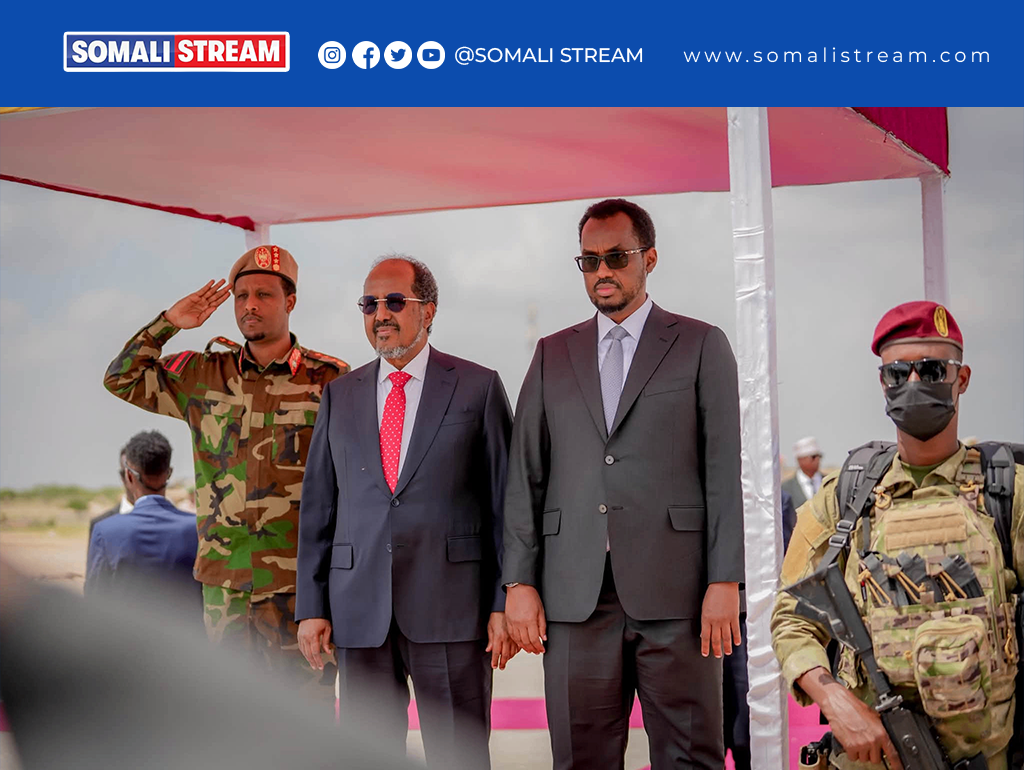
Galmudug’s newly elected leader, Liibaan Ahmed Hassan, has formally assumed office as senior Somali federal officials and regional state presidents arrive in Dhusamareb for his official inauguration, marking a significant moment for the regional administration as it embarks on a new political chapter focused on security, reconciliation, unity and development.
Liibaan formally took office during a handover ceremony at the Galmudug presidential palace, receiving the leadership from outgoing president Ahmed Abdi Karie in a transition he described as an important milestone in the region’s political and institutional development.
Elected on 22 October 2026, Liibaan will lead the administration alongside his deputy, Abdiwali Ibrahim Adan, following a leadership vote that the new president said represented a historic moment for the people of Galmudug.
Senior Somali federal officials and leaders from across the country’s regional administrations have begun arriving in Dhusamareb for the inauguration celebrations of Galmudug’s newly elected leadership.
Galmudug President Liibaan Ahmed Hassan welcomed Prime Minister Hamza Abdi Barre and a high-level delegation from the Federal Government of Somalia, who travelled to the regional capital to attend the ceremony.
Deputy Prime Minister Salah Ahmed Jama also arrived at the head of a federal delegation, while Banadir Regional Governor and Mogadishu Mayor Hassan Mohamed Hussein was among the senior officials welcomed by the Galmudug leader.
Several federal member state presidents have also arrived, including South West President Adan Mohamed Nur, Hirshabelle President Ali Abdullahi Hussein, widely known as Ali Gudlawe, and North Eastern State President Abdulkadir Aw-Ali Firdhiye.
Their participation brings together senior representatives of Somalia’s federal government and regional administrations for the inauguration, highlighting the national political significance of the leadership transition in Galmudug.
Liibaan said his administration would prioritise strengthening security, intensifying the fight against Al-Shabaab and working towards restoring government control in areas where the group remains active.
He also placed particular emphasis on reconciliation, recognising the importance of bringing communities together, resolving local disputes and strengthening the social cohesion needed to sustain peace and stability.
The new administration, he said, would be guided by consultation, justice, transparency and accountability, with public needs placed at the centre of government decision-making.
Liibaan also pledged to strengthen state institutions, improve essential services and pursue development programmes that respond to the needs and aspirations of Galmudug’s population.
His stated priorities reflect a broader ambition to build a stable and effective regional administration capable of delivering security, opportunity and improved living conditions for its people.
In his inaugural remarks, Liibaan expressed appreciation to his predecessor, Ahmed Abdi Karie, for overseeing the transfer of power and acknowledged his contributions during his time in office.
He highlighted Karie’s efforts in strengthening regional institutions, supporting political stability and advancing the development of governance structures across Galmudug.
The new president also expressed hope that his predecessor would continue contributing to the region’s stability and development, signalling the importance of cooperation beyond the transfer of political leadership.
The recognition of the outgoing administration underscored Liibaan’s message of continuity, institutional cooperation and the need to build on existing foundations as Galmudug enters a new political chapter.
Liibaan called on residents, traditional elders, community leaders and other sections of society to unite behind efforts to improve security, strengthen reconciliation and advance development.
He said delivering on his administration’s priorities would require a collective effort between the government and the people, stressing that lasting progress could not be achieved through government action alone.
He also urged the public to support regional institutions and work together towards common goals, including peace, stability and economic development.
As Liibaan begins his tenure, expectations will centre on his administration’s ability to translate its commitments into tangible improvements in security, governance and public services.
For the people of Galmudug, the new leadership brings an opportunity to strengthen political unity, consolidate state institutions and pursue a future built around peace, reconciliation and sustainable development.
