


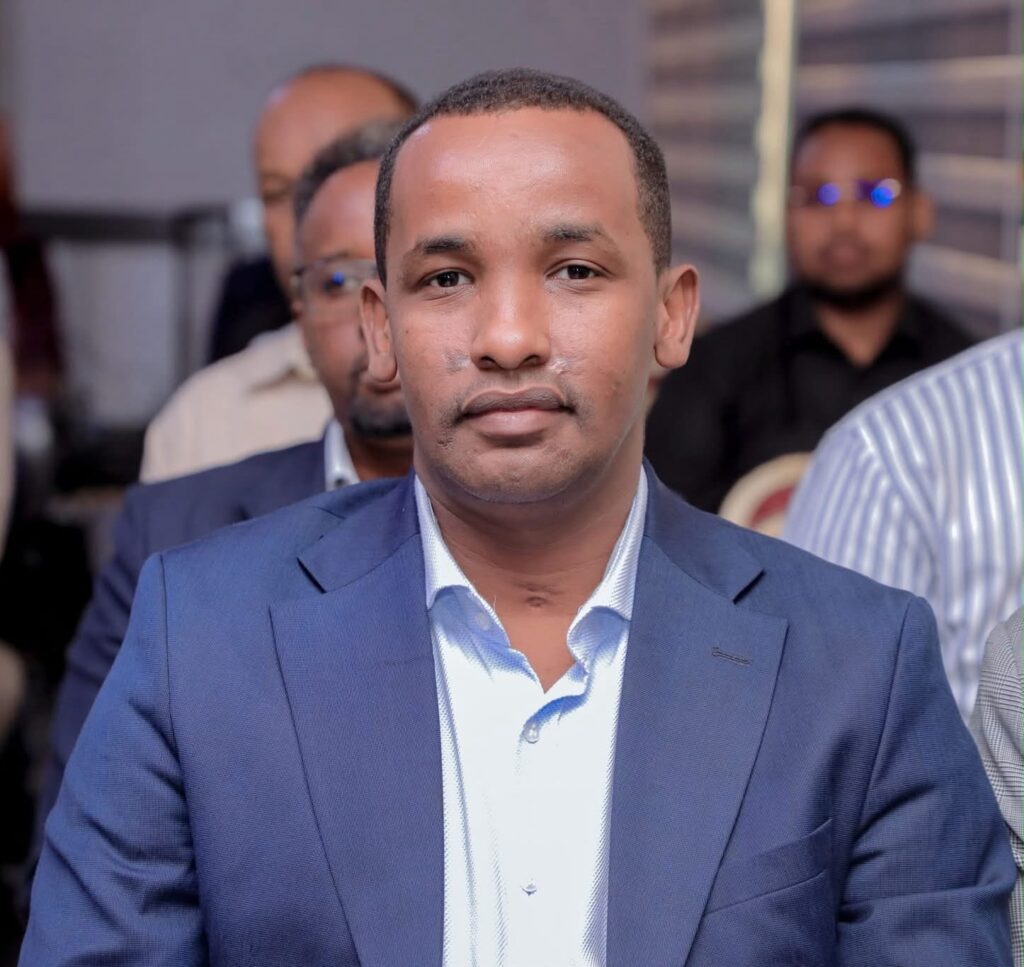
By: Mohamed Mahmud Allaale
As the AI boom splits Silicon Valley and topples the founder of Nvidia, the real prize is moving from computer chips back to the natural resources in theground. Somalia sits on that ground, if it can stop fighting itself long enough to claim it.
If A.I works, we’re finished. If it doesn’t work, we’re still finished.
I first heard that argument from an American finance commentator, and I laughed. Then I followed the money, and the laughter stopped.
Start with failure. American companies have poured hundreds of billions of dollars, much of it borrowed, into data centres, chips and power plants, betting that AI will one day earn trillions. If the bet fails, that money never comes back. Debts sour, a stock market propped up by a handful of tech giants falls, and governments do what they always do in a crash. They print money.
Now take success. If AI does everything its builders promise, it replaces millions of clerks, analysts, coders and call-centre workers. Roughly half of America’s federal revenue comes from taxes on people’s income. Fewer salaries mean fewer taxes, while the bills keep rising. The gap gets filled the same way. They print money.
Now give me a minute, and let me paint you a picture of how Somalia wins in this. Because it is not all doom. For Africa, a continent the world has long treated as a quarry rather than a partner, this may be the opening we have waited a century for.
Two roads, one destination. When paper money loses trust, the world runs to what cannot be printed: oil, gas, copper, rare minerals. Things you dig out of the earth or pull from beneath the sea.
Things like Somalia’s oil.
A war over who gets paid
An AI model is a giant file of numbers. Training it costs hundreds of millions of dollars. Copying it costs almost nothing. That one fact has split the industry in two.
On one side stand the closed labs: OpenAI, the owner of ChatGPT, and Anthropic, the maker of Claude. They keep their models locked on their own servers and sell access by subscription. Their trillion-dollar bet only pays if AI stays scarce and expensive.
On the other side stands open AI: models published for anyone to download, run and change for free. Its biggest American champion was Nvidia, and the reason is simple. Nvidia does not sell AI. It sells the chips AI runs on. A free model brings more builders. More builders create more AI systems. More systems need more data centres, and every data centre is filled with Nvidia chips. Every free model is a customer factory. Nvidia was not giving AI away out of charity. It was manufacturing buyers.
The fall of the customer-maker
This summer, Nvidia’s founder Jensen Huang fought Washington to stop it banning open AI, including Chinese open AI. He was winning.
Then, in October, the New York Times reported that US intelligence believed Alice Huang, an executive at Megaspeed, a Singapore firm that had bought more than $4.8 billion of Nvidia chips in two years, was gathering information for Beijing. On November 8, Nvidia’s board opened an investigation and Huang admitted an affair. On November 11, after 33 years at the helm, he resigned. The board says it has no reason to believe secrets were compromised. Beijing calls the story a smear.
Whether the spy story is true or not, China wins. If it is true, Chinese intelligence reached the most important man in American AI. If it is false, America removed its own champion of open AI and did China’s work for it. Either way, the loudest American voice for cheap, open AI is gone, and the world will keep downloading free AI. Increasingly, from China.
China gives away the code and keeps the ground
Blocked from America’s best chips, China learned to do more with less, then gave the results away. When DeepSeek released a cheaply trained model for free in January 2025, Nvidia lost close to $600 billion in market value in a single day. Today Chinese models are among the most downloaded open models on earth.
The generosity is a business model. Alibaba gives away its Qwen models and rents out the cloud to run them. Chinese labs tune their models for Chinese chips. Every developer in Lagos, Jakarta or Mogadishu who builds on them becomes a future customer. It is Nvidia’s customer factory, aimed at Nvidia.
The deeper play is the trap I began with. Beijing understands that AI hurts whoever bets the most on it, whether it succeeds or fails, and America has bet the most. By making good AI free, China ensures those subscriptions never repay what they cost.
Meanwhile, China keeps its own bet on things that cannot be copied. It accounts for roughly 70 percent of global rare earth mining and nearly 90 percent of their processing. Code becomes cheap. Whoever holds the ground wins.
What lies beneath us
Stand on Lido Beach at dusk and look east. The Indian Ocean turns to beaten copper, the air tastes of salt and grilled fish, and somewhere past the horizon lies the reason the world will keep coming back to us.
In April, the Turkish drillship Çağrı Bey arrived off Mogadishu to begin Somalia’s first offshore drilling campaign, after seismic ships had mapped three blocks of our seabed. Its drill can reach 12,000 metres down. Industry estimates suggest the Somali basin may hold more than 30 billion barrels of oil, un-risked. Drilling will tell us what is real. A second agreement has opened about 16,000 square kilometres of land blocks.
Under our soil, the President has said uranium, lithium and cobalt deposits have been confirmed: the metals that power batteries and reactors. Above it, we have the longest coastline in mainland Africa, around ten hours of sunshine a day, and winds that could generate an estimated 30,000 to 40,000 megawatts. A few years ago, our entire installed power capacity was about 131 megawatts. We import diesel to light a country built for wind and sun.
Oil, gas, critical minerals, sun, wind, and a coast on one of the busiest shipping lanes on earth. In the world that is coming, those are not only assets but outstanding leverage.
Rich countries are rarely allowed to be strong
Leverage is dangerous when you are divided. Ask Congo.
In 1965, Mobutu Sese Seko seized power with American support and ruled for 32 years. Zaire was rich in minerals and useful against Soviet influence, so the money flowed while he looted. Conservative estimates put his fortune at over $5 billion, about half his country’s foreign debt. Everyone knew. Nobody stopped paying.
Then in 1989 the Berlin Wall fell. In November 1990, the US Congress cut aid to Zaire, and by the end of 1991 the Soviet Union was gone. Mobutu said it himself: he was the latest victim of the Cold War, no longer needed. Congo was abandoned to collapse and war. It is still called a failed state, though it is one of the richest places on earth and the world’s leading source of cobalt.
We lived our own version. Siad Barre was armed first by Moscow, then by Washington, because of where we sit. When the Cold War ended, the money ended. Barre fell in January 1991. We were dropped, and then we were labelled.
Who pays for our quarrels
The label “failed state” is not neutral. A country called failed is a country whose resources can be bought cheaply and whose leaders can be bought one by one.
And our politics have been bought. The International Crisis Group documented how the 2017 Gulf rivalry spilled into Somalia, with competing foreign capitals backing rival factions in Mogadishu and the federal states. Years earlier, an Associated Press investigation found Somali politicians returning from abroad with briefcases of cash, and a government watchdog could not account for more than $70 million of it.
Let us call it what it is. Much of our political bickering is not ours. It is financed from outside, by those who profit from a Somalia that never stands up. Every time we fight over a seat, someone else is negotiating over our sea.
The harder truth is this: foreign money only buys what Somali hands agree to sell.
What we must do now
Most Somalis alive today are under 30. They did not start our civil war, and they should not inherit its habits. The resources beneath us are theirs, and the choices we make in the next few years will decide whether they inherit a fortune or a fight.
Five things we cannot afford to ignore
Our elders say gacmo wada jir bay wax ku gooyaan: hands that work together get the job done. No foreign capital can divide hands that refuse to let go of each other.
If AI works, the world comes looking for oil, minerals and clean power. If it fails, the world comes looking for the same things. Either way, it comes to our shore.
We have been called a failed state for thirty years. Look in the mirror again. A country holding what the future needs has not failed. It simply has not yet decided to win. Its our time to win.
Mohamed Mahmud Allaale is The Communications Director at Somalia’s Ministry of Foreign Affairs and International Cooperation and a former international broadcast journalist. The views expressed here are his own.Twitter @mohamedmahmud