


By: Abdullahi Yabarow & Ali Adan
President Hassan Sheikh Mohamud says constitutional reform and one-person, one-vote elections will return political power to ordinary Somalis. His opponents see something more troubling: an incumbent reshaping the constitutional and electoral system in which he intends to compete.
The most dangerous moment for a democracy does not always arrive with soldiers at the presidential palace. Sometimes, there are ballots. There are political parties, campaign posters and television cameras. Citizens stand in line outside polling stations. Officials celebrate democracy, while government supporters point to public participation as evidence that political power is finally being returned to ordinary people. Yet beneath that democratic imagery lies a more consequential question: Can the government actually lose?
That question increasingly defines Somalia’s constitutional confrontation under President Hassan Sheikh Mohamud. Mohamud presents his political project as an attempt to move Somalia beyond decades of indirect, clan-dominated elections toward a system in which citizens choose their representatives directly. The argument carries considerable democratic appeal. For generations, ordinary Somalis have largely watched from the sidelines as politicians, clan representatives, delegates and power brokers negotiated national leadership. One-person, one-vote promises to change that. But Mohamud’s opponents argue that the real political transformation is occurring somewhere less visible: in the constitutional and institutional architecture surrounding the ballot. Their objection is not necessarily to universal suffrage. It is to who writes the rules before citizens vote.
Somalia’s 2012 Provisional Federal Constitution was always intended to be completed. Important questions concerning federalism, political institutions, elections and the distribution of authority remained unresolved. Every government that followed therefore inherited both a responsibility to complete the constitutional settlement and an opportunity to influence its final shape. Under Mohamud, that process accelerated. In March 2024, Somalia’s Parliament approved major constitutional amendments as the government pursued a broader transformation of the country’s political and electoral system. Mohamud’s administration has defended the changes as necessary to replace an indirect electoral arrangement widely criticised for corruption, elite bargaining and limited public participation. There is merit to that argument. Somalia cannot remain indefinitely dependent on a system in which a relatively small political class exercises disproportionate influence over who governs. Universal suffrage could represent one of the most significant democratic achievements in the country’s modern history. But replacing an undemocratic system does not automatically produce a competitive democracy. The deeper question is who designs its replacement.
Electoral laws determine who can compete. Political-party regulations determine how organisations enter the contest. Electoral institutions administer registration, voting and counting. Constitutional provisions determine where political authority resides. Federal arrangements determine how power is divided between Mogadishu and the Federal Member States. Individually, these questions can appear technical. Together, they constitute the architecture of political competition. That is the foundation of the opposition’s case against Mohamud: the incumbent is not simply competing within an established political system. His government has played a central role in constructing the system in which it intends to compete. In sporting terms, the accusation is straightforward. One of the teams is helping write the rules.
The Power of the Voter
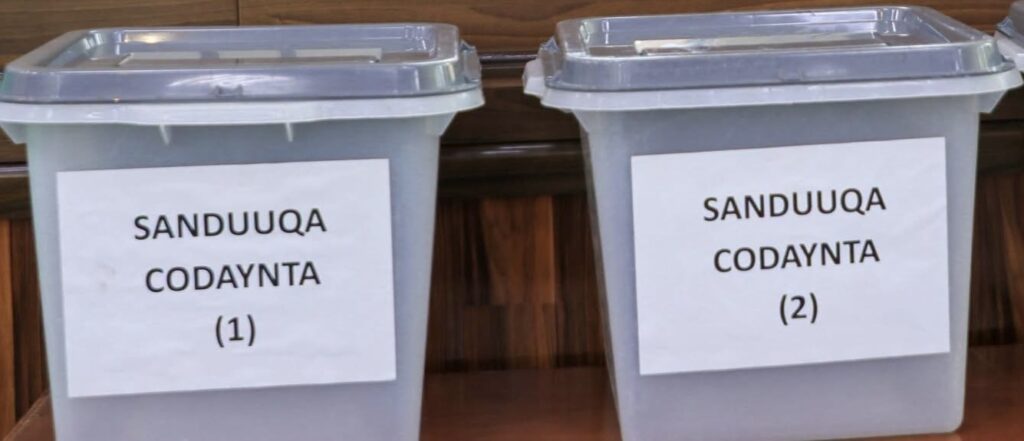
Mohamud nevertheless possesses a political argument far more powerful than constitutional clauses: the voter. Imagine the images produced by the National Independent Electoral and Boundaries Commission of Somalia (NIEB)–citizens carrying voter cards, political parties campaigning across the country, women and men lining up outside polling stations,and ballots being counted before television cameras. After decades without national universal suffrage, those images would carry genuine historical significance. They would also carry enormous political power. The photograph becomes the argument. The government can point to citizens standing in line and ask its critics a simple question: How can giving Somalis the right to vote be undemocratic?
But that question confuses two different components of democracy. Political participation is one. Political competition is another. A country can expand participation while weakening competition. More citizens can acquire ballots while political institutions become more centralised. More parties can campaign while the rules surrounding those parties become less impartial. Democracy therefore cannot be measured solely by whether citizens are permitted to vote. The more important test is whether their votes can change who governs. Can opposition parties organise freely? Are electoral rules predictable and applied equally? Are the institutions administering elections sufficiently independent? Can disputed results be challenged credibly? And if voters choose the opposition, can power actually change hands? That distinction creates a difficult political problem for Mohamud’s opponents.
The Opposition’s Trap
If opposition leaders participate in elections conducted under rules they consider unfair, they risk legitimising the system they distrust. Their candidates will register. Their supporters will campaign. Their names will appear on ballots. If they subsequently lose, the government can argue that the opposition accepted the election and failed to win. Participation becomes evidence of legitimacy. Boycotting the process may be even more dangerous. If opposition parties refuse to participate, the government can proceed while portraying its opponents as politicians unwilling to accept direct democracy. The complicated argument over institutional independence then becomes something much simpler: The government wants citizens to vote. The opposition refuses to participate. Whether that characterisation accurately reflects the opposition’s position matters less than its political effectiveness.
Participate, and the opposition risks legitimising a system it distrusts. Boycott, and it risks removing itself from the contest. Former Hirshabelle President Mohamed Abdi Waare has described such political predicaments with the Somali expression “Shidanaaba Shidan”, damned if you do, damned if you don’t. The trap is therefore not merely electoral. It is rhetorical. Mohamud has successfully associated his electoral project with the broader principle of democracy itself. As a result, questioning the government’s particular model can easily be portrayed as questioning one-person, one-vote. The political debate subtly shifts from “Who controls the election?” to “Who supports the voter?” That shift may be the government’s greatest strategic advantage.
When Constitutions Become Instruments of Power
Modern democratic erosion does not always require soldiers or suspended constitutions. Governments can use legal mechanisms to reshape political competition and concentrate power. In Russia, 2020 constitutional amendments reset Vladimir Putin’s presidential term count, allowing him to seek additional terms. In Türkiye, a 2017 referendum replaced the parliamentary system with an executive presidency, significantly strengthening presidential authority.
Somalia is neither Russia nor Türkiye, and constitutional reform is not inherently authoritarian. But their experiences offer a narrower warning: constitutions can be legally rewritten in ways that alter the balance of political power and weaken constraints on incumbents. This is the concern behind the debate over a potential “constitutional coup” in Somalia.
The Hassan Sheikh Test
There is a simple way to examine the system Mohamud is constructing. Remove Mohamud from the equation. Imagine that Villa Somalia tomorrow is occupied by the political leader his supporters distrust most. Give that president the same constitutional authority. Give that administration influence over the same electoral architecture. Allow it to operate under the same political rules. Then ask those currently defending the reforms: Would they still trust the system? Would they accept the same distribution of power? Would they consider the electoral institutions sufficiently independent? Would they confidently enter an election believing their candidate could defeat the incumbent?
A durable constitution should survive that test. Constitutions are not designed merely for leaders we trust. Their greater purpose is to constrain leaders we do not. If constitutional powers appear acceptable when exercised by an ally but dangerous when transferred to an opponent, the problem is not merely political. It is constitutional.
A Constitutional Coup?
Has Hassan Sheikh Mohamud committed a constitutional coup? Not in the traditional sense of tanks in the streets or power seized by force. The more consequential argument is that power can also be consolidated through the rules themselves: by reshaping the constitutional framework, electoral institutions and terms of political competition while the incumbent remains a beneficiary of the system being created.
No single reform establishes authoritarianism. The concern is cumulative. When constitutional changes alter the balance of political authority, electoral institutions face questions about their independence, and the governing political force exercises significant influence over the rules under which it competes, the existence of direct elections is no longer sufficient evidence of competitive democracy. A ballot matters only if the system surrounding it allows that ballot to remove those in power.
That is what makes Somalia’s experiment so consequential. One-person, one-vote may give Somalis a historic democratic right, but if the architecture surrounding that right systematically advantages the incumbent, universal suffrage risks becoming not a restraint on political consolidation, but its source of legitimacy.
The early political pattern makes that question harder to dismiss. Elections in South West State, Banadir and Galmudug have been dominated by Hassan Sheikh Mohamud’s Justice and Solidarity Party (JSP). That alone does not prove that the contests were predetermined. But when the political force associated with the president helps shape the rules and repeatedly emerges dominant, the burden increasingly falls on the system to demonstrate that defeat remains genuinely possible.
And that returns Somalia to the question with which this analysis began. Who writes the rules? Who controls the scoreboard? And, above all, can the government actually lose?
Because democracy is not proven when a government successfully organises an election. It is proven when the government that organized it can lose.
Abdullahi Yabarow is a UK-based legal scholar specializing in constitutional law, governance reform, accountability, and state-building in fragile states. Ali Adan is a political analyst with expertise in risk management.
