


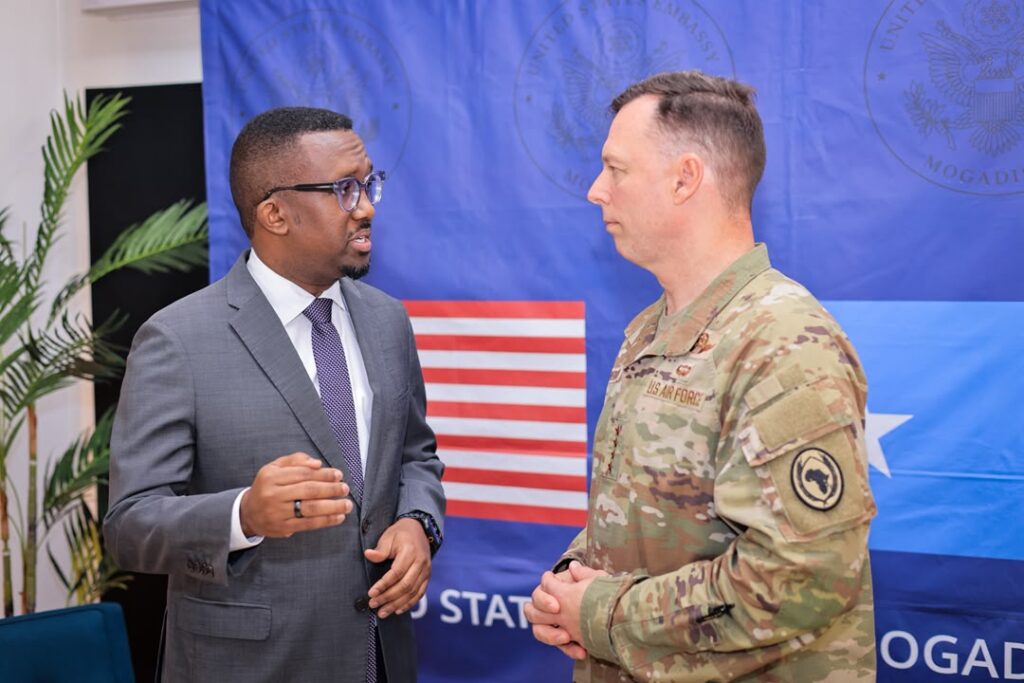
Omar Faruk Osman, Secretary-General of the National Union of Somali Journalists (NUSOJ), spoke General Dagvin R.M. Anderson, the Commander of U.S. Africa Command (AFRICOM). The full transcript is presented below:
Omar Faruk Osman: General Dagvin Anderson, welcome back to Mogadishu. Thank you, and we are very happy to have you because we wanted to have discussions which are very important, especially the U.S.-Somalia partnership, the security situation in Somalia, and as well as a lot of important questions that are on the mind of many Somalis today.
And I’ll start with the first question:
As a top US military person for Africa that is now (visiting)in Somalia, what is your assessment of the security situation in Somalia and in the wider region of the Horn of Africa?
General Dagvin Anderson: It’s a very interesting topic because we have seen some limited success in places in Somalia. We have seen Al-Shabaab pushed back away from Mogadishu, but we’ve also seen that Al-Shabaab is very resilient and continues to exist.
We’ve also seen some limited success in the Golis Mountains with ISIS, where we have been able to work with the local forces there and keep them isolated and in the caves.
The broader region, there’s a lot of turbulence. Sudan is a tragedy, and seeing how that’s going, it’s not a military solution. It’s going to take the people of Sudan to decide to stop fighting and external actors to actually assist them in coming together.
So there’s a lot of issues within the region that could create instability. The key to this, though, is continuing to build on the progress that’s been made, to continue to focus on the fight against the terrorists, so that there can be stability, there can be investment, and that will lead to prosperity.
So all of this, security and prosperity, are intertwined.
Omar Faruk Osman: You have now described the security landscape in the region, which is having an impact as well on Somalia and the entire region.
But how do you see, as the top U.S. military officer for Africa, the importance of Somalia for the U.S. strategy in the region and the entire continent?
General Dagvin Anderson: Somalia sits on key terrain. The Horn of Africa is critically important to the commerce of the world. The waterways to the north and the entrance to much of East Africa is Somalia. So that alone makes it important.
The stability here is equally important, and we saw what happened when there was instability in Somalia previously. The piracy created impacts to international commerce. Just the human tragedy that was occurring here created migration and displaced persons that then went to other countries.
All of that creates instability, and that doesn’t allow the development, the growth and the prosperity that the people of Somalia deserve.
So focusing on that alone is important, and that creates stability across multiple nations in the Horn, which leads to prosperity for all.
So for us, it’s important to continue to drive towards that and to help Somalia move that way. But ultimately, it’s got to be Somalia that takes care of Somalia, and that is the Somali leadership and the Somali people who need to build that security and prosperity.
Omar Faruk Osman: And certainly there have been discussions recently about the U.S.-Somalia partnership in different areas, and there are a lot of speculations saying that the U.S. is pulling out of Somalia.
Is that true? Because many Somalis legitimately have concerns that the U.S. is turning its back on them.
General Dagvin Anderson: So, interesting you say that because I would say the United States has not turned its back on Somalia. We’ve been committed here for several years. We have engaged, I think, very constructively.
The United States, and I was part of this previously when I was here, helped build the Danab, one of the most capable forces on the continent. I am very proud of our engagement in building that counterterrorism force, and we have completed that. We have built that force, and it is here and it’s ready to be used for counterterrorism.
But now it’s up to Somalia to sustain that force, to continue that force, to build it and continue to make it effective going into the future and use it as it was designed to counter terrorism.
So I don’t think we are turning our backs on Somalia, but there are people in Washington and other parts of the country who say, “We’ve been here for several years. At what point does Somalia become independent and take care of these issues?”
Some people are weary of this because we’ve been dealing with terrorism in other parts of the world for many years, and they want to see Somalia take this on and move forward.
There’s also many other issues around the world that the U.S. is involved in, security issues that we have to pay attention to as well. So at some point people are asking, “When is Somalia going to take charge of this and when can we turn it over to them?”
So I don’t think we’ve turned our backs on Somalia by any means. If Somalia steps up and the government steps up and takes the lead on this, we will continue to be there because there is mutual interest.
But if we can’t see that, and the political instability and the political infighting continue, then it’s going to be very hard for us to continue to stay engaged.
Omar Faruk Osman: Well, you said about sustainability, and you mentioned the commitments that you have in other parts of the world. There are conflicts in Ukraine. There are conflicts in the Middle East, and that takes me to the next question.
How are the resources that have been allocated for Africa, or the resources that Africa has been receiving, being affected by other conflicts because of the competing priorities and commitments that exist in other parts of the world?
Because when you talk about sustainability, you also don’t need to bail out and say, “Look, you Somalis are not sustaining this operation, so we pull out.”
So how are those resources that were meant for AFRICOM to work in Somalia and the wider region being affected by these other conflicts?
General Dagvin Anderson: So you’re right. There are many other pressures for these resources, and we have looked at where they might be applied in other theatres for other issues.
The reason we have been able to maintain these resources here in AFRICOM is that they’ve been continuing to fight terrorism, that we’ve been able to continue to focus them on ISIS in the north, and that we’ve been able to continue to focus that fight together with our partners on Al-Shabaab.
As long as we can continue to show progress against the mutual threat, which is terrorism, that is al-Qaeda and that is ISIS, then those resources I can justify and continue to use here.
But if those resources are used elsewhere for other things and not for the terrorist fight, then I will have a hard time justifying keeping them here because of so many other demands.
I believe in this mission, and I believe in standing here with you to counter terrorism, but we have to see that progress.
Omar Faruk Osman: And when it comes to the point of progress, it’s not only the military side. It’s also about politics. It’s about governance. It’s about how we run our country and how we deal with the domestic issues.
We also know that political dysfunction has a bearing on insecurity, with the persistence of terrorist groups getting space, or breathing space, to continue their operations.
Don’t you think so?
General Dagvin Anderson: Yes, and I think you bring up some really good points there.
I was here active with the Special Operations Command from 2019 to 2021, and we worked with the Somali National Army and the Danab to move down the Lower Shabelle River to make progress, taking territory all the way down to Mubaarak.
I come back to AFRICOM as the commander, and we’re retaking the same territory again.
This is what causes the frustration, because that territory was lost because somewhere the focus on terrorism was not there and was elsewhere.
So being able to take that territory, that’s part of the security.
But what you said is then you have to be able to hold the territory, to bring governance, to bring justice and to bring the stability necessary to allow prosperity to take place.
All of that goes hand in hand.
From the military, we help with the security piece. We need Somalia to bring the governance. We need Somalia to create the stability to allow the prosperity.
And if that is the case, if we can have that stability, the United States is very interested in investing.
This is what we do. We have one of the world’s greatest economies, and we are willing to partner and invest where there is stability and prosperity.
We can help build the security, but ultimately it has to be the host nation, the partner, that takes that and creates that independence.
But that then opens the door to other partnership and economic growth.
Omar Faruk Osman: And like you said, political stability is very key when Somalis get their act together and address critical issues.
But there is also an important question.
The U.S. operation has different areas of intervention across the country, and the U.S. supports Somalia with airstrikes.
What about the reports of civilians being killed or injured in those operations?
General Dagvin Anderson: We take this very seriously.
We take great effort with our intelligence, our targeting and our understanding to avoid harm to civilians.
I don’t think there’s any nation in the world that does more and puts more resources into how we do this to mitigate civilian harm and civilian casualties.
We take this very seriously. Any credible instance, we will investigate.
There have been times when we have made mistakes and we have provided reparations.
But we also understand that we are taking great care in order to help another nation.
Ultimately, where are the civilian casualties coming from here? And how many civilian casualties have Al-Shabaab created, or ISIS?
It’s thousands.
And they are the ones that we need to look at. How are they harming the civilians, and not just in who they’ve killed, but what is the future that they have stopped or they have not allowed to develop?
So I understand the concern. I understand that that gets in the news about airstrikes, but I can assure you that we, as U.S. forces, take that very seriously.
Omar Faruk Osman: Has there been cases where AFRICOM has investigated when such kinds of allegations have emerged, and has there been accountability?
General Dagvin Anderson: Yes, I have mentioned that already.
We have done that, and we do that when there’s a credible case.
But also understand that Al-Shabaab is very willing to make false accusations, and they do this almost every single time.
So we do investigate it, but we make sure that it is credible.
Omar Faruk Osman: I would like to ask about Somaliland. You and other AFRICOM officials have visited Somaliland several times. Does the U.S. have a plan to build a base there in Somaliland?
General Dagvin Anderson: There’s no plans to build a base in Somaliland.
Omar Faruk Osman: Will the U.S. recognise Somaliland? Because this is one of the questions that many Somalis are asking themselves.
General Dagvin Anderson: U.S. policy is, and remains, the sovereignty and territorial integrity of the Federal Republic of Somalia. That has not changed.
Omar Faruk Osman: General Anderson, you are being watched by millions of Somalis inside Somalia and outside the country. What is your message to them? What would you tell them today, as the top commander of the U.S. for Africa, who is visiting Mogadishu?
General Dagvin Anderson: I think my message is that we are committed to helping nations become more prosperous and secure, but we need a willing partner that is willing to focus on our mutual interests.
The people of Somalia deserve prosperity and stability. They deserve that security.
But I can only bring a piece of it. It has to be with the leadership of the Government of Somalia.
And when we can do that, and we can focus on the common threat, we can work together and create that prosperity.
But ultimately, it has to be the people of Somalia who want it, the Government of Somalia who wants it, and then they can provide that.
The United States has, and will continue to, help those who are willing to help themselves.
Omar Faruk Osman: General Anderson, thank you very much for joining us. We appreciate the opportunity to talk to you and to give this message to the people of Somalia.
General Dagvin Anderson: I very much appreciate it, and I very much appreciate the opportunity to talk with you.
I have been committed here for several years, and it is important to me personally.
But ultimately, we have to do what’s right for each of our nations, and ultimately I want to see success for both.
Thank you. I appreciate it.