


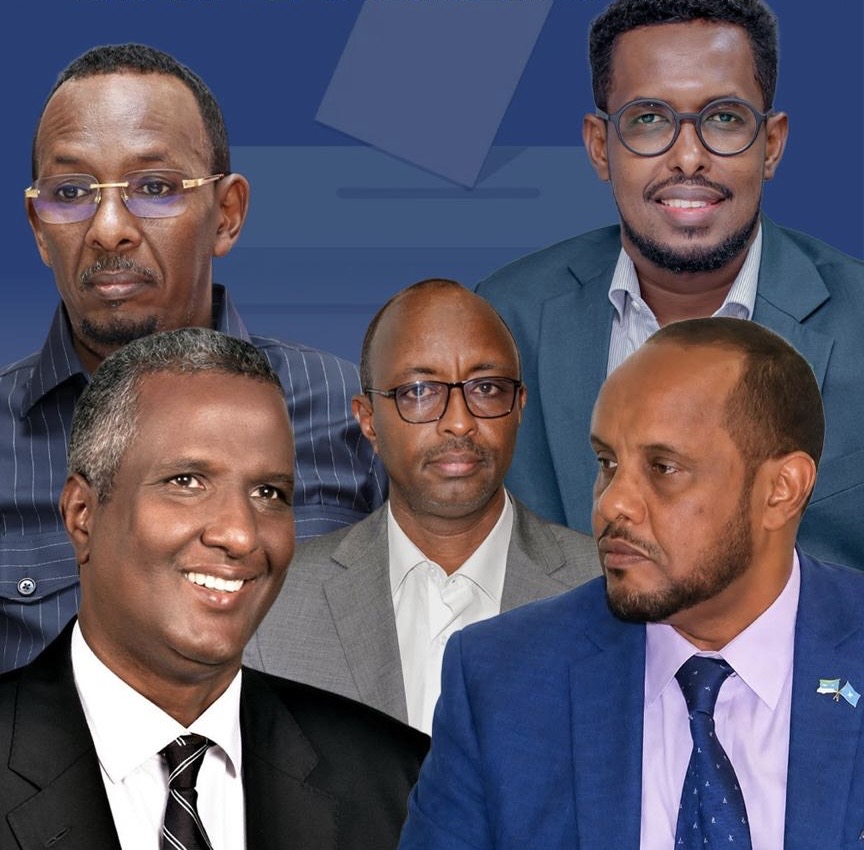
Somalia’s political landscape took a significant turn this week after the Somalia Future Council (Golaha Mustaqbalka Soomaaliyeed) formally approved and submitted a comprehensive Transitional Direct Elections Model to key international partners, including the United Kingdom, the United States, the European Union, and the United Nations.
The move represents the most concrete alternative yet to the electoral framework currently being advanced by the Federal Government led by President Hassan Sheikh Mohamud and signals a determined push by opposition leaders to steer the country toward a negotiated electoral settlement.
In a statement issued on June 20, the Council announced that it had endorsed a transitional direct election model designed to “overcome the current political deadlock, deliver an inclusive electoral process, and establish an election that enjoys broad agreement, legitimacy, and public confidence.”
According to the Council, the proposal is rooted in political compromise and reflects a willingness to prioritize national stability over partisan interests at a time when Somalia faces growing political uncertainty over the direction of its electoral process.
“The decision of the Somalia Future Council is based on political compromise and consideration for the Somali people, who are eager to see a swift resolution to the electoral dispute,” the statement said.
A direct vote with traditional safeguards
One of the most notable features of the proposed model is its attempt to reconcile two competing political realities: the long-standing demand for one-person-one-vote elections and the preservation of Somalia’s clan-based power-sharing formula.
The Council stated that the proposed framework would allow Somali citizens to directly elect their representatives while maintaining the 4.5 clan representation arrangement during the transitional period.
By combining direct voting with existing political safeguards, the proposal seeks to bridge the gap between those advocating rapid democratization and stakeholders concerned about maintaining political balance and stability during a sensitive transition.
Challenge to the Federal Government
The proposal also represents a direct challenge to the Federal Government’s current electoral roadmap.
While the Council has consistently rejected aspects of the government’s electoral framework, including its calls for a reconstituted Electoral Commission and a broader overhaul of the political party registration system, its latest initiative appears designed to shift the political debate from confrontation to negotiation.
The Council accused President Hassan Sheikh Mohamud’s administration of pursuing a unilateral electoral process whose outcome has effectively been predetermined.
It called for an immediate halt to what it described as “one-sided elections” in order to create space for genuine political dialogue on a consensual direct electoral model.
“The Council emphasizes the need to stop unilateral elections whose outcomes have already been predetermined by a President whose mandate has expired, in order to facilitate meaningful discussions on a direct election framework that can ensure the Somali people’s vote becomes the true foundation of political legitimacy,” the statement said.
A Strategic political calculation
The submission of the proposal to Somalia’s principal international partners has been viewed as a calculated diplomatic and political maneuver.
Rather than merely opposing the government’s electoral plans, the Council has now presented an alternative roadmap that places direct elections at the center of future negotiations.
The strategy potentially increases pressure on both domestic and international stakeholders to engage with the opposition’s proposals while complicating any efforts to advance a contested electoral process without broader political consensus.
The Council indicated that the full details, implementation mechanisms, and guiding principles of the Transitional Direct Elections Model will be unveiled once formal political negotiations begin on resolving the electoral dispute and managing Somalia’s political transition.
A new phase in Somalia’s electoral debate
The announcement marks a new phase in Somalia’s ongoing debate over how to transition from indirect elections toward a more democratic and representative system.
For years, successive administrations have pledged to deliver direct elections, yet political disagreements, security concerns, and institutional weaknesses have repeatedly delayed implementation.
The Somalia Future Council’s proposal seeks to position itself as a middle ground—offering citizens the opportunity to directly elect their representatives while preserving political arrangements deemed necessary to maintain stability during the transition.
Whether the proposal becomes the basis for a national compromise remains uncertain.
What is clear, however, is that Somalia’s electoral conversation is entering a more consequential stage, with competing visions now being formally placed before both domestic actors and the international community.
As political negotiations intensify, the question facing Somalia is no longer whether the country should move toward direct elections, but under what framework, through what consensus, and with whose legitimacy.