


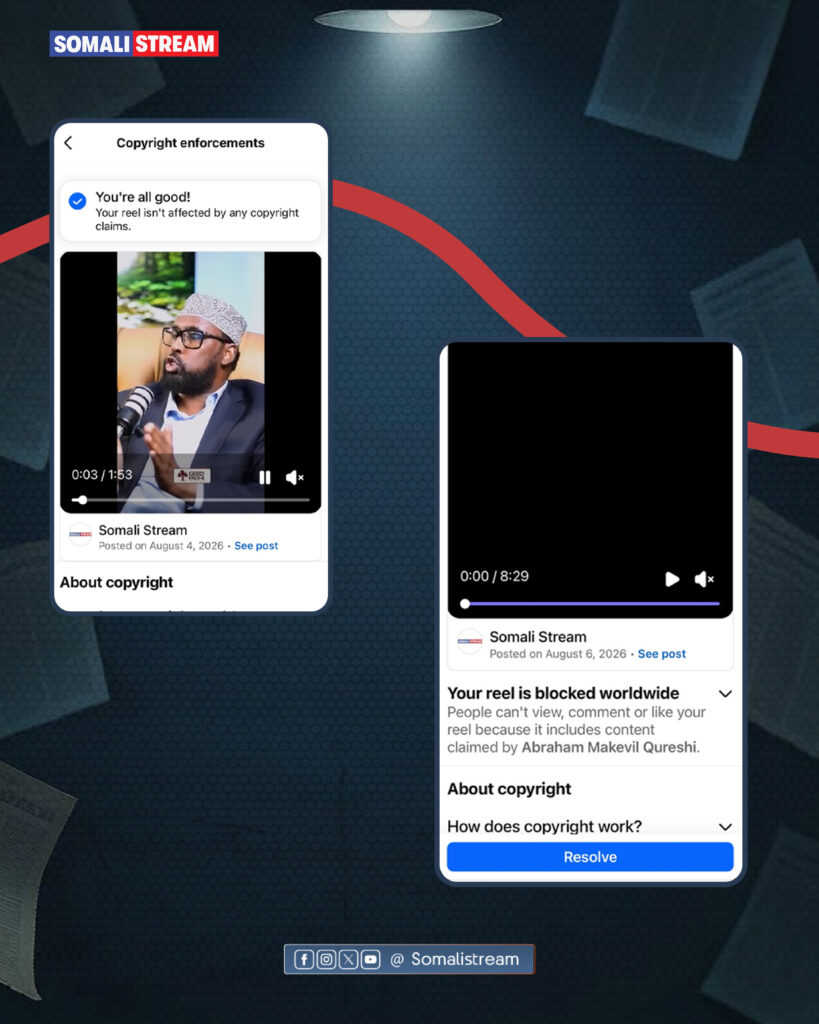
Somali Stream has raised concerns over a series of repeated copyright claims and related restrictions affecting the news organization’s original editorial content on Meta platforms, saying the incidents are disrupting the distribution of its journalism.
In a statement, Somali Stream said content produced, edited and published by its newsroom had repeatedly been subjected to copyright claims by third parties, requiring the organisation to establish ownership of work it says is original.
The media organisation said it respects legitimate copyright protections and the rights of other publishers, but warned that the misuse or erroneous application of copyright enforcement mechanisms can place independent newsrooms at a disadvantage.
The claims have become a particular concern because Facebook and other Meta platforms are important channels through which Somali Stream reaches its audience.
Somali Stream said repeated restrictions and removals had affected the visibility and circulation of its content. While the organisation said it was not yet attributing every fluctuation in reach to deliberate action without evidence, it said the recurrence of the incidents had raised serious questions.
“We do have our own suspicions given the obvious patterns emerging,” Somali Stream said.
The organisation said it was particularly concerned by what it described as frequent claims against its original work, including cases where those making the claims did not appear to have legitimate rights to the material.
According to Somali Stream, the repeated disputes have created an additional burden for its newsroom, requiring journalists and editors to spend time demonstrating ownership of their own reporting instead of producing journalism.
Somali Stream calls for greater transparency
Somali Stream called for greater transparency in Meta’s copyright-enforcement systems, including meaningful human review of disputed claims and effective avenues for publishers to appeal enforcement decisions.
It also called for content and any resulting restrictions to be restored promptly when claims are found to have been made incorrectly.
The organisation stressed that it was not seeking preferential treatment.
Rather, it said independent media should receive fair and transparent treatment under systems that increasingly determine which journalism reaches the public.
“Digital platforms now play a central role in determining how quality and citizen journalism reaches the public,” Somali Stream said, arguing that this influence carries a responsibility to ensure legitimate editorial work is not unnecessarily restricted by opaque or erroneous enforcement.
Somali Stream said it was documenting the incidents and would continue to defend the ownership, integrity and distribution of its original journalism while respecting the intellectual-property rights of others.
The dispute highlights a wider challenge for independent Somali media, which increasingly rely on social-media platforms as primary distribution channels. Decisions made through platform moderation and copyright systems can have a direct impact on the reach of news organisations and, consequently, on public access to information.
For Somali Stream, the issue is therefore not simply about individual copyright claims. It concerns the ability of an independent newsroom to publish, distribute and reach its audience without facing repeated restrictions through mechanisms that it says are not operating transparently or accurately.
