


By: Aden Mohamed Ismail
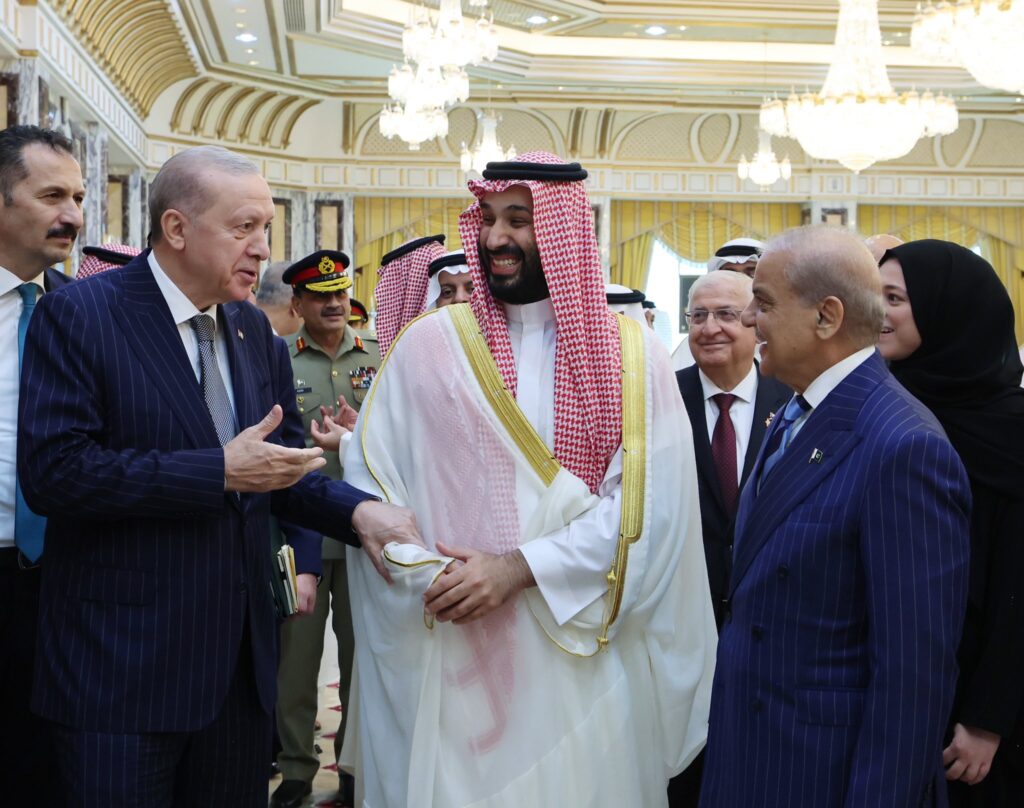
The collective defence pact signed in Mecca on 7 August 2026 by Saudi Arabia, Turkey, and Pakistan could mark a significant shift in the Middle East’s power configuration and to some degree the world if it morphs into a fully operational military alliance with expanded membership.
Regionally, it awakens latent forces. Since the decline of militant Arab nationalism, the Middle East’s geopolitical scene has been an almost exclusive theatre for Israel and Iran pursuing perpendicular hegemonic ambitions. Meanwhile, Turkey, Saudi Arabia, and Egypt, as other powers of matching or exceeding clout, each had their own priorities and limitations that prevented them from openly confronting or allying with either side.
Turkey devoted energy to acceding to the European socio-economic community and displayed an almost nonchalant attitude toward the tumultuous regional currents stirred by Iran and Israel, both relatively reciprocating this. Saudi Arabia, for its part, pursued the contradictory foreign policy of exporting the violent cult of Wahhabism while maintaining close security and economic ties with the West, a posture that placed it in a gray zone vis-à-vis Israel but in a hostile milieu with Iran.
The death of Nasser, the architect of Egypt as the flag bearer of Arab national cause in the Middle East and foremost anti-imperialist global figure followed by Sadat’s accord with Israel, demoted Cairo from regional leader to an among-equals actor. Other regional states are too insignificant to seek revisionist or hegemonic aspirations, limiting themselves to economic leverage and diplomatic brokerage, while great powers have opportunistically been fishing in the troubled waters.
While this has been the Middle East’s geopolitical landscape for many decades, October 7, Israel’s genocidal onslaught in Palestine, aggression against Iran, and declarations of “Greater Israel” grand ambitions, unavoidably putting it in sequential confrontation with each potential regional rival, have changed the calculations of the principal states in the region and its immediate environs.
The means through which Israel seeks to achieve its end goal of absolute regional dominance is unlikely to be continued reliance on the West where its reservoirs of sympathy are strained nor act alone but through the floated Hexagon alliance. This prompts opponents to mimic its initiative, making the Agreement a reflexive response than an aspirational project. Its potency is therefore likely to depend on Israel’s subsequent moves unless an immutable will of pan-Islamic solidarity enables the Mecca bloc to seize and sustain the initiative.
This foundational weakness is compounded by divergent threat perceptions among its signatories: Saudi Arabia’s principal threat is Iran not Israel, Turkey’s focus is on Israel not Iran, and Pakistan has fewer incentives to confront either Iran or Israel. While there are reasonable grounds for cultivating a solid common ground in the future, the Mecca Agreement’s current lack of strategic clarity should inform decisions on further membership, particularly by states whose security priorities do not neatly correspond with those of its founding members.
Considerations for Somalia
The guiding principle for membership in any military pact is the extent to which it can collectively deter a common armed threat. In the absence of mutual threat, any purported alliance becomes a flimsy arrangement that serves little purpose beyond political signalling. Somalia, for its part, faces the two strategic threats of Salafi-jihadism and Ethiopian regional imperialism as existential threats, with separatism constituting a third challenge albeit one with a comprador dimension.
Salafi-jihadism is largely absent from the priorities of the Mecca Agreement’s signatories while Ethiopian regional imperialism may be downplayed or even find unwitting accommodation among some of them. The closest point of convergence with Somalia appears to be countering Israel’s outreach to Somaliland which puts Somalia in relative lockstep with Turkey, even though the latter is driven less by wholehearted concern for Somali unity than by its objective of containing Israel’s regional influence.
Even with Turkey, it is unnecessary for Somalia to conflate its objective of securing national unity with zero-sum geopolitical alignments, much less antagonize Somaliland to the point of placing Mogadishu and Hargeisa in irreconcilably hostile proxy camps.
Nonetheless, despite the inherent defects of the Mecca Agreement and the absence of a clear point of convergence, Somalia should not be a mere bystander in the rapidly evolving security dynamics of the Middle East as its historic socio-political flank. Rather, it should find a way of grafting its strategic concerns onto the pact’s collective-security logic through thoughtful courtship.
One avenue would be to assess whether Somalia’s prospective accession to the Mecca Agreement could provide a degree of deterrence against a future Ethiopian military foothold in northern Somali waters, a possibility made more salient by Ethiopia’s pursuit of maritime access. Although the existing power asymmetry makes a formal extension of a hard security umbrella for fragile Somalia difficult, the latter’s exclusion could nevertheless leave the pact with a strategic blind spot along the Gulf of Aden and the approaches to the Red Sea. This gives Mogadishu some bargaining leverage.
Rather than seeking a charitable security umbrella, Somalia can frame its membership as mutually beneficial while extracting credible commitments against overlapping threats that endanger both the regional interests of the signatories and Somalia’s. More incisively, grafting the specter of Ethiopia into the pact’s collective-defence aligns with shared strategic concerns.
For Somalia, it provides an immediate, albeit temporary, respite against a growingly disadvantageous regional geopolitical dynamic and reduces the burden of confronting two strategic threats simultaneously. It would allow Mogadishu to navigate the burgeoning Ethiopian–Somaliland–Israeli alignment without pushing itself into outright confrontation with Israel or antagonizing Somaliland to the detriment of Somali social cohesion.
Despite the overhyped “peacemaker” in post-Cold War Somalia, Ethiopia has always been a bridgehead for global imperialist intrusion into the Horn at the expense of the Somali nation and is currently positioning itself as the spine linking the emerging pro-Zionist regional order with its Somali surrogates seeking Somalia’s fragmentation. It is a protégé for the former and a moral capstone for the latter. Somalia using the Mecca pact as a deterrent tool against Ethiopia could disrupt the coherence of this triad by targeting its node.
For the pact’s signatories, Ethiopia under Abiye Ahmed and perhaps his successors is animated by an ancient Christian nationalism which Foreign Policy described in 2022 as a mission to “unify Ethiopia and restore its divine glory.” Ethiopia’s present territorial unity is grounded in the post-colonial Westphalian African state system and there is no lurking threat to its integrity.
The unity invoked here which is directly proportional to the divine glory implies the restoration of an ancient Habesha territorial reach encompassing modern-day Eritreans, Ethiopian Tigrays and the Amhara, which since the advent of European colonialism split between hinterland Habesha consisting of mainly Amhara and Tigray Ethiopians. The latter two expanded into the South to seal borders of modern-day Ethiopia through conquests while littoral Eritrea retained the organic geography of ancient Habesha—an Afro-Asiatic Semitic group with Jewish heritage.
Even though Abiye himself is not a Habesha by descent but from the conquered and half-Muslim Cushitic Oromo, his political rhetoric frequently draws upon the imperial legacies of Semitic Habesha in an attempt to revive a Christian grandeur whose apogee reaches back to the Greco-Roman era. The most prominent episode in this historical memory is the sixth-century Aksumite King Kaleb invasion of Yemen followed by Abraha’s expedition to Mecca, an episode narrated in the Islamic scripture.
After possibly annexing Eritrea to restore the buried guardrails of that Judeo-Christian Habesha, with Northern Somalia potentially being next target given its comparable religious significance as an entrepôt of Somali Islam and proximity to Arabia, it cannot be ruled out that Abiye or his successors seek to retrace those ancient Christian steps. And, it is here that he finds common cause with Netanyahu and other hardline Zionists in Israel pursuing similar messianic ambitions in the Middle East.
Ethiopia’s closeness to Israel should therefore not be interpreted by the signatories of the Mecca Agreement solely through a geopolitical lens but also through its potential religious dimensions. In this sense, Somalia alongside Eritrea, with its interest in national self-preservation over divine obsession, are the natural allies in containing not just Israel’s geopolitical aggrandizement in the Horn but its apocalyptic project that seeks to use Ethiopia as one of its important pawns in the proposed Hexagon alliance.
On Salafi-jihadism, Somalia can leverage each of the founding members. Turkey and Pakistan offer military, intelligence, and counterterrorism expertise, while Saudi Arabia has the doctrinal leverage to directly or indirectly influence the political contours of jihadist groups and could help facilitate dialogue with Al-Shabaab, provided that this does not become a carte blanche for its takeover.
Though it is tempting to compare Somalia with Afghanistan, its decentralized clan structure, deeply rooted ethno-Sufi spiritual traditions, libertarian social psychology and a latent nationalist attitude that sees Salafi-Jihadi rule of globalist disposition as subsuming of the essence of Somaliness — make the formation of an islamist state considerably more difficult.
Also, unlike socially and externally insulated societies where such a regime can exercise radically conservative tighter control over political and social life, Somali society’s dense global connections would make such a closed-in system unsustainable. Even if Somalia falls, it would impose unbearable costs on all actors with a stake in the region, including another cycle of Somali conflict.
The world in the Middle East and the Horn of Africa context is experiencing a strange déjà vu of alliances forming in ways reminiscent of the decades preceding World War I in Europe. The Mecca Agreement is one such development despite initial shortcomings. Somalia should approach it neither with the innocent hype of pan-Islamic solidarity or “Islamic NATO” nor with passivity. Its value should instead be judged instrumentally.
As leverage, Somalia’s geography, resources and manpower gives it strategic value that should compel pursue membership from a position of calculated bargaining, seeking concrete security guarantees while avoiding unnecessary entanglement in conflicts far afield. The objective should not be to become a mere nominal ally but to make Somalia’s strategic location indispensable to the emerging reorganization of global power relations and, in the process, incrementally strengthen its own capacities to ultimately stand alone.
