


By Dr. Saad Awale
A festival banned, then reinstated, set off deadly riots in a Somaliland city few outsiders have heard of. What is actually at stake is control of the last unclaimed coastline on the Gulf of Aden.
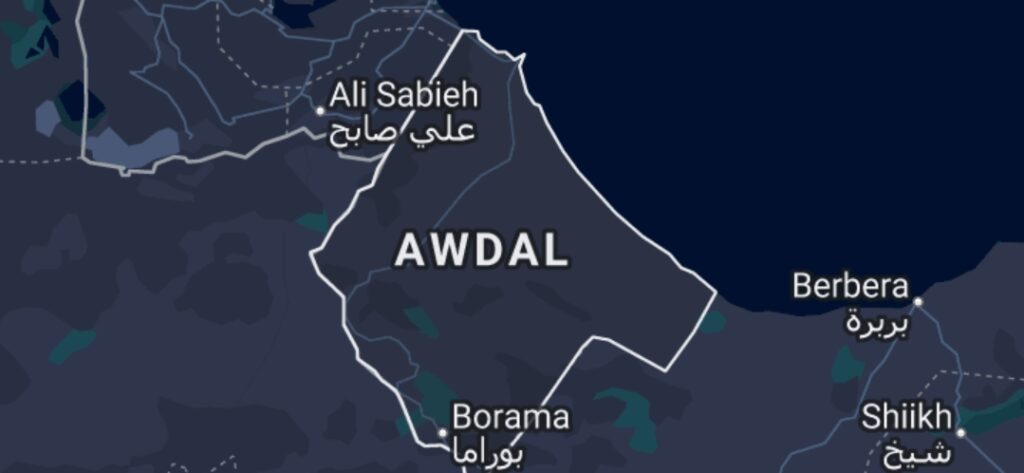
Nineteen people are dead in Borama, a Somaliland city that rarely makes international news, after a customary festival that the government first banned and then reinstated. On its face, this looks like a local flare up in a corner of the Horn of Africa the world can safely ignore. It is not. The dispute over Xeer Ciise, a ceremony tied to the Issa clan, has exposed something far more consequential: Somaliland, the self-declared republic that has governed itself since 1991, does not fully control Awdal, its western region bordering Djibouti and Ethiopia. Competing nations have begun to recognize the opportunity in a region that has quietly become one of the most contested stretches of water on Earth.
For most of the thirty five years since Somaliland declared its unrecognized independence in 1991, Awdal, the western region bordering Djibouti and Ethiopia, sat on the republic’s periphery. The Issa and Gadabuursi communities who share it lived side by side, bound by kinship networks that reach into Djibouti and Ethiopia, with little friction to speak of. That tranquility is gone, and what replaces it will not stay confined to Somaliland’s internal politics. Awdal happens to sit precisely where two rival regional security architectures are now colliding: the Mecca defense bloc, which binds Somalia and Djibouti together, and the emerging “Hexagon” bloc forming around Israel, toward which Somaliland is drifting.
A dispute over who owns a customary ceremony is never really about the ceremony. It is about who gets to write the map.
The proximate trigger was mundane enough to be almost absurd: a set of “supplementary maps” promoting the Xeer Ciise festival, which many Gadabuursi observers believe erase their own recognized presence along the Zeila-Lughaya corridor. This was not a simple cartographic slip. The maps advance a narrative, depicting a cohesive Issa territory stretching from Djibouti into Somaliland as far as Bulahar, and recasting Issa customary institutions as border-transcending governing bodies. That framing does real work: it hands Djibouti and Ethiopia’s traditional and political leadership a culturally grounded pretext to take an interest in what happens inside Awdal.
THE CORRIDOR EVERYONE NEEDS
This fits a pattern regional specialists know well. Djibouti’s foreign policy is often described, accurately, as a survival strategy for a small state wedged against a far larger neighbour. That anxiety is not paranoia; it is arithmetic. Landlocked Ethiopia routes an estimated 90 to 97 percent of its foreign trade through the Port of Djibouti, a dependence that researchers treat as one of Addis Ababa’s most serious national security vulnerabilities and one of Djibouti’s most valuable sources of leverage.¹ Ethiopia has repeatedly tried to loosen that grip: reviving talks over access to Eritrea’s Assab and Massawa, courting Djibouti’s Tadjourah region, buying into Somaliland’s port of Berbera, and signing a 2024 memorandum of understanding with Somaliland that drew public condemnation from Djiboutian officials.² Every one of those overtures has stalled or been stalemated.
That history is what makes the Zeila-Lughaya corridor, alongside Berbera, so strategically valuable. It lies near Ethiopia’s densely populated highlands and, unlike Djibouti’s effective monopoly, is one of the few genuine alternatives Somaliland can offer. That is exactly the threat Djibouti fears most: any serious Ethiopian engagement with Awdal and other coastal areas in Somaliland chips away at the near-monopoly that has underwritten Djibouti’s economy for a generation. Seen in that light, the sudden urgency around Xeer Ciise looks far less like cultural preservation and far more like geopolitical manoeuvring — an attempt to harden Somaliland’s territorial claim, secure diplomatic recognition, box out Ethiopia’s search for an alternative coastline, and discourage Israel from holding a foothold on Somaliland’s shore.
WHERE EVERY RIVALRY CONVERGES
Awdal is the one place where at least three regional contests now overlap. There is the long-simmering Ethiopia-Djibouti trade rivalry. There is the accelerating competition for the Red Sea and the Gulf of Aden, in which the UAE already holds a stake in Berbera, Israel has been deepening ties with Somaliland since recognizing its sovereignty late last year,³ and a new defence pact linking Saudi Arabia, Turkey and Pakistan has strengthened Mogadishu’s hand and reshaped the strategic picture around Somaliland. There is Egypt, quietly building influence through investments in Eritrean and Djiboutian ports. And there is the unresolved question of Somaliland’s sovereignty, sharpened by a more assertive Mogadishu since the 2023 Las Anod conflict. Awdal is the only patch of ground where all of these pressures meet, which is precisely why a quarrel over a customary ceremony escalated into deadly violence within days.⁴
What should worry Hargeisa most is not that outside powers are circling. A coastline this valuable, this contested, and this lightly governed was always going to attract attention; pretending otherwise would be its own failure of judgment. What should worry Hargeisa is that its government appears to have been caught flat-footed by something entirely predictable. A state that cannot say with confidence who controls security in one of its own regions has already conceded part of the argument to whichever outside actor moves first and most decisively. Sovereignty that exists on paper but not on the ground is an invitation, not a deterrent.
Hargeisa now faces a choice it can no longer defer: treat Awdal as an unruly periphery to be pacified, or as the strategic asset it is. It cannot credibly pursue the second without first doing the harder work of the first. That means real, verifiable security guarantees in Awdal Region and a governance arrangement that gives the Issa, Gadabuursi, and Isaaq communities an equitable stake in the Somaliland share of power, rather than a set of competing grievances to be managed by whoever shouts loudest.
Stabilization alone will not be enough. Somaliland’s government should begin treating Zeila as a strategic asset in its own right, not a neglected periphery to be visited only when it catches fire. If Berbera is Somaliland’s commercial port, Zeila is its geopolitical port. Given how badly Ethiopia needs an alternative outlet to the sea, Hargeisa is under no obligation to hand that leverage to Djibouti or to anyone else on someone else’s terms. It should commission independent demographic surveys and heritage documentation for Awdal now, before the cartographic argument is settled by default in someone else’s favour. And it should resist the temptation to align fully with either the Mecca defence bloc or Israel’s emerging bloc, keeping channels open to both and letting neither dictate its terms.
Awdal’s importance was never really about a festival. It is about who decides the future of the last open coastline on a stretch of the Gulf of Aden where nearly everything else has already been claimed. Somaliland has been slow to grasp how high the stakes have become. Its rivals, and its patrons, have not. The nineteen dead in Borama are a preview, not a conclusion, of what happens when a fragile government mistakes a geopolitical fault line for a matter of local order — and the next reckoning will not wait for a festival to set it off.
Dr. Awale is a retired physician and healthcare services administrator. He writes about governance and state-building in the Horn of Africa.
NOTES AND SOURCES
- Africa Intelligence and multiple Ethiopian and Djiboutian officials have put Ethiopia’s trade dependence on the Port of Djibouti in the 90-97 percent range for more than two decades; see Institute of Foreign Affairs (Ethiopia) data cited in “Ethiopia, Djibouti Agree to Deepen Cooperation at Doraleh Port Amid Shifting Red Sea Geopolitics,” AllAfrica/Addis Standard, February 2026; and U.S. International Trade Administration, “Ethiopia Country Commercial Guide: Customs Regulations,” trade.gov.
- “2024 Ethiopia-Somaliland Memorandum of Understanding,” background summarized in reporting by Al Jazeera, the BBC, and the Council on Foreign Relations, “New Deals Open Old Wounds in the Horn of Africa,” January 2024; on Ethiopia’s 19 percent stake in Berbera port, see Gulf News, “Ethiopia Acquires 19% Stake in DP World Berbera Port.”
- Reutersand Al Jazeera reported Isrel’s recognition of Somaliland on December 26-27, 2025; see also AllAfrica/RFI, “The Risky Calculations behind Israel’s Recognition of Somaliland,” January 2026.
- On the December 2025 Borama unrest over Xeer Ciise, see Wikipedia, “2025 Borama Protests” (compiling Human Rights Council and news-agency reporting); Geeska, “Somaliland’s Western Fault Line,” December 2025; and Somali Guardian, “Calm Returns to Borama After Deadly Protests as Somaliland Blames Outside Actors,” December 2025.