


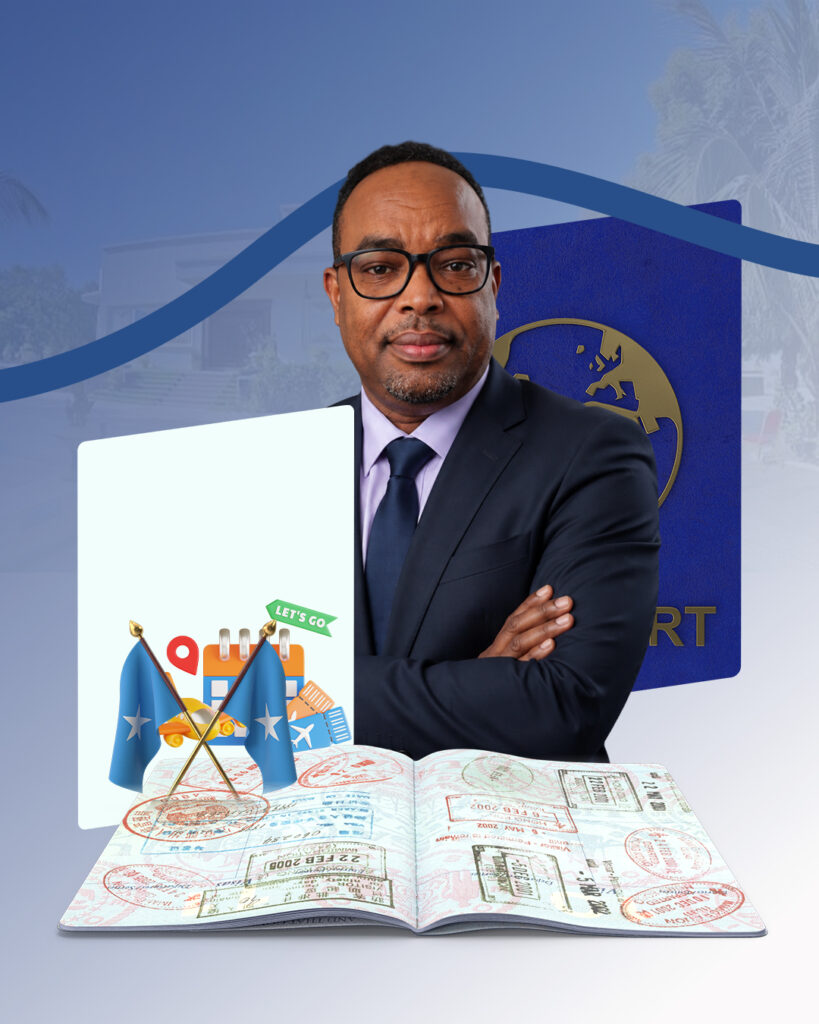
By: Hussein Mohamed Yusuf
In a recent article, “Kenya’s Borders Should Build, Not Burn, Soft Power,” published in The Standard, Abdikarim M. Dahiye makes a compelling case for viewing borders not merely as lines of separation, but as instruments of regional cooperation, economic integration and soft power. His argument is timely.
But it also opens a more difficult question for Somalia: how should a sovereign state reconcile the rights of dual citizens with the demands of high public office, particularly when an official holds the citizenship and legal protection of another state? The question is not about the Somali diaspora. Nor is it an argument against dual citizenship.
It is about public trust, institutional integrity and the nature of allegiance at the highest levels of government.
Beyond the passport question
Somalis have lived, traded and intermarried across the territories of present-day Somalia, Kenya, Ethiopia and Djibouti for generations. Borders divided communities whose economic, cultural and pastoral relationships long predated the modern state. That reality makes cross-border cooperation essential.
Kenya and Somalia share interests in trade, security, migration, pastoral mobility, infrastructure and the management of border communities. The same is true, in different ways, of Somalia’s relations with Ethiopia and Djibouti.
A Somali citizen who acquires another nationality is not, by that fact alone, disloyal to Somalia. Millions of Somalis obtained foreign citizenship after fleeing war, persecution and economic collapse. Many have returned with education, professional expertise, investment capital and international networks that Somalia urgently needs. The diaspora is one of Somalia’s greatest national assets.The question is therefore narrower, and more consequential. Should the people entrusted with the most sensitive powers of the Somali state simultaneously owe a formal legal relationship to another state?
A passport is more than a travel document. Citizenship can confer rights, legal protections and obligations. For a private citizen, multiple nationalities may be entirely unproblematic. For a minister, senior diplomat, intelligence officer, defence official or head of government, however, the situation becomes more complex.
The issue is not necessarily actual divided loyalty. It is the possibility, and sometimes simply the perception, of competing obligations.
When citizenship meets state power
Imagine a Somali minister negotiating with a neighboring government on a matter involving territory, security, trade or migration. If that minister also holds the passport of the state across the negotiating table, questions are inevitable. Which legal and political relationship takes precedence?
Would the minister receive protection from that foreign state if political circumstances in Somalia deteriorated? Could the official be subject to obligations arising from the second citizenship? Would the public have sufficient information to assess potential conflicts of interest? These are legitimate questions in any modern system of public administration.
They become particularly sensitive when the second nationality belongs to a neighbouring country with which Somalia has unresolved political, security or economic interests.
This does not mean that a dual national cannot represent Somalia faithfully. It means that the state should not leave questions of potential conflict entirely to personal assurances. Good governance is built on institutions, not assumptions about individual character.
The problem of the “exit option”
There is another dimension that receives less attention.
Many Somali officials have spouses, children, homes, businesses, permanent residence or financial interests outside the country. None of these circumstances constitutes evidence of corruption or divided loyalty. But they can create what might be described as an “exit-option” problem.
The ordinary Somali citizen has limited ability to escape the consequences of government failure. If public schools deteriorate, hospitals collapse, insecurity rises or the economy contracts, most citizens remain exposed to those conditions.
A senior official with an established life abroad may have a very different risk profile. If political protection disappears, an administration falls or security deteriorates, that official may have somewhere else to go.
This distinction matters because accountability is partly a function of shared consequences. A government leader whose family depends on Somalia’s schools, hospitals, security services and economy experiences institutional failure differently from one whose family can access those systems elsewhere.
A minister whose children attend Somali schools has a direct personal stake in their quality. An official whose family receives healthcare abroad may encounter the weaknesses of the Somali health system differently. A politician whose wealth and long-term residence are secured overseas may experience economic instability through a different lens from the citizen whose entire livelihood is tied to the domestic economy. None of this proves misconduct.
But it raises an important question about the social contract between political elites and citizens. Somalia’s crisis is much bigger than passports. Foreign citizenship did not cause Somalia’s state collapse.
The country’s political and institutional crisis has been shaped by decades of armed conflict, authoritarian rule, clan competition, corruption, external intervention, terrorism, weak institutions and prolonged political uncertainty.
It would therefore be simplistic to present dual citizenship as the explanation for Somalia’s difficulties. Yet the availability of an alternative legal, financial or geographic home can reinforce a political culture in which public office is treated as temporary rather than custodial.
That distinction is important. A state cannot be rebuilt if political leaders regard government primarily as a short-term platform for influence, wealth accumulation or political advancement.
Public office should be understood as a stewardship of institutions that must outlive the officeholder. What does the Constitution say? Somalia’s constitutional framework recognises the reality of the diaspora.
Article 8 of the 2012 Provisional Constitution states that a Somali citizen cannot be deprived of Somali citizenship simply because he or she becomes a citizen of another country.
That protection is understandable given Somalia’s history and the enormous contribution of its diaspora.
But there is an important distinction between the right to citizenship and eligibility for particular offices of state.
A person may have a legitimate right to retain Somali citizenship while the state may, through properly enacted law, establish additional eligibility, disclosure or conflict-of-interest requirements for positions involving sovereignty, national security and executive power. That is a policy question worth debating openly rather than treating dual nationality as either inherently patriotic or inherently suspect.
A case for stronger disclosure
Somalia does not necessarily need to begin by prohibiting dual citizens from public life.
A more proportionate starting point would be comprehensive disclosure.
Senior officials could be required to declare: all citizenships and passports; permanent-residence rights; significant overseas property; business interests; foreign government appointments or affiliations; substantial financial assets held abroad; and relevant interests held by spouses or dependent children.
Such a system should be independently verifiable and governed by clear privacy safeguards.
The objective would not be to criminalise diaspora connections or punish families living abroad. It would be to give citizens sufficient information to evaluate potential conflicts surrounding those who exercise public authority.
For the most sensitive offices; the presidency, premiership, senior cabinet positions, intelligence leadership, senior military command and key diplomatic posts; Somalia could then consider whether additional requirements are justified. If restrictions are introduced, they should be prospective, transparent and universally applied. They must not become a mechanism for excluding diaspora professionals, targeting political opponents or discriminating against particular communities.
Somalia needs its diaspora
The country needs diaspora doctors, engineers, academics, entrepreneurs, diplomats, lawyers, investors and technical specialists. International experience is an asset to a state rebuilding its institutions. But the closer an office is to sovereignty, defence, intelligence, diplomacy and the exercise of executive power, the stronger the case for heightened standards of allegiance, disclosure and accountability.
Neighbors must also respect institutions
The responsibility does not rest solely with Somali officials. Kenya, Ethiopia and Djibouti have legitimate national interests in maintaining stable relations with Somalia. They can pursue those interests through diplomacy, trade, education, infrastructure, cultural exchange and security cooperation.
But regional soft power should be built through institutions, not personal political dependency.
A neighbouring state strengthens Somalia when it engages the Somali government through formal diplomatic channels and supports durable institutions.
It weakens institutional sovereignty when personal relationships with individual politicians become more consequential than relations between states. This is particularly important in a region where political networks, commercial interests, security partnerships and cross-border communities frequently overlap.
Somalia needs institutional diplomacy, not passport diplomacy
There is also a subtler problem. Diplomacy is not governed solely by formal law. It is shaped by credibility and perception. Even where a dual-national Somali official is legally entitled to hold office and is demonstrably loyal to Somalia, the appearance of competing obligations can complicate negotiations.
A Somali representative should not be placed in a position where citizens reasonably wonder whether his or her interests might diverge from those of the state. This is especially important in negotiations involving borders, maritime rights, security arrangements, natural resources or trade. Sovereign equality requires confidence that each side is negotiating on behalf of its own state.
Leaders must share the country’s risks
Ultimately, the deeper issue is not passports. It is shared national risk. A political leader who asks citizens to believe in Somalia must also demonstrate confidence in Somalia’s future.
That means investing in institutions that he or she would trust for their own families: schools worth sending children to, hospitals worth relying upon, security institutions worth depending on and an economy capable of sustaining a dignified life after political office.
The contrast is stark when ordinary citizens have nowhere else to go while some political leaders retain the ability to leave whenever the political or security environment becomes difficult.
That asymmetry can erode public trust.
Citizens are entitled to ask whether those who govern them regard Somalia as a permanent national home or as a temporary political workplace.
From political office to national stewardship
Somalia’s challenge is therefore not to eliminate its diaspora or stigmatise dual citizenship. It is to establish a political culture in which public office is a national trust rather than a personal opportunity.
Foreign citizenship does not automatically make a Somali official disloyal. Likewise, a Somali-only passport does not guarantee integrity, patriotism or competence.
The decisive question is whether Somalia has institutions strong enough to identify and manage conflicts of interest regardless of who occupies office.
That requires disclosure, enforceable ethics rules, independent oversight and clear standards for the most sensitive positions. It also requires a change in political culture.
A minister should not regard office as an opportunity to accumulate enough wealth to secure a future abroad. A parliamentarian should not view state institutions as temporary instruments of political competition. A senior security official should not be able to place personal interests beyond meaningful public scrutiny.
The objective should be a state in which political leaders have as much confidence in Somalia’s future as the citizens they govern are expected to have. Borders can build soft power, but sovereignty must remain at the centre.
Abdikarim M. Dahiye is right to argue that borders can become instruments of cooperation rather than division. But the success of that vision depends on something deeper than border management: institutional confidence between sovereign states.
Somalia needs strong relations with its neighbours. It needs trade, security cooperation, investment, regional integration and people-to-people ties.
It also needs political leaders whose primary institutional responsibility is unmistakable.
Foreign citizenship is not the cause of Somalia’s long crisis, and surrendering foreign passports will not suddenly produce honest or competent government.
But neither should Somalia ignore the governance questions that arise when officials entrusted with sovereign authority maintain substantial legal, financial or personal ties to another state.
The answer is not isolation. It is clear rules, full disclosure, institutional accountability and a stronger conception of public service.
Somalia cannot rebuild a credible state by asking its citizens to carry all the risks of national failure while some of its leaders retain permanent exit options.
The ultimate test of leadership is therefore not which passport an official carries.
It is whether that official is prepared to share the country’s risks, defend its institutional interests and remain committed to building a Somalia in which there is nowhere better to return to, because home itself has been rebuilt.
Hussien Mohamed Yusuf is a Climate Change and Environmental Sustainability Professional based in Nairobi, Kenya. He can be reached at hussienm4@gmail.com
