


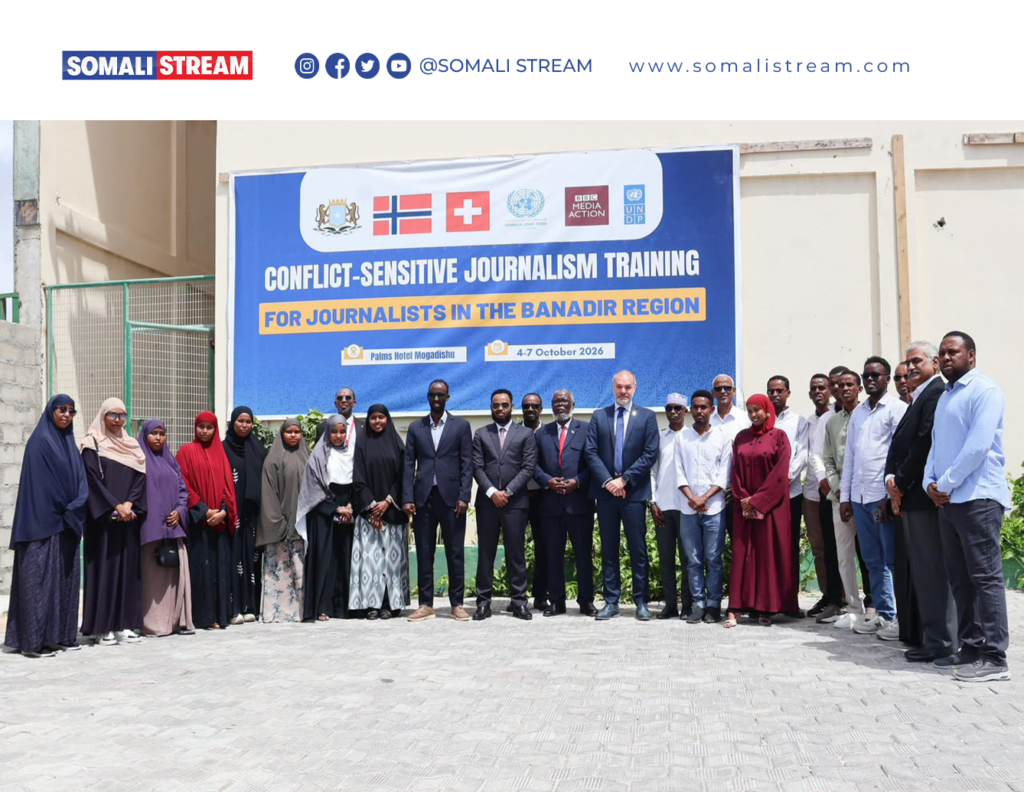
UNDP Somalia, in partnership with BBC Media Action, has launched a new initiative to strengthen conflict-sensitive journalism and support Somali journalists to produce accurate, balanced and public-interest media content that contributes to social cohesion, trust and peacebuilding.
The initiative kicked off today with a four-day training for journalists from Banadir and Hirshabelle, and it will be followed by a second cohort from 11–14 October.
The wider 12-month initiative will support 120 journalists from media organizations across Somalia through a training, mentoring, content production support, and professional learning networks. It will cover conflict-sensitive reporting, conflict analysis, media ethics, fact-checking and verification, misinformation and disinformation, gender-sensitive and inclusive reporting, journalist safety, and the role of media in peacebuilding and social cohesion.
Journalists will also be introduced to the UNDP-supported Somalia Conflict Navigator—hosted in the Ministry of Interior, Federal Affairs and Reconciliation (MoIFAR) and supporting all Federal Member States—as a tool to strengthen their understanding of conflict dynamics and inform responsible reporting.
“Independent, accurate and responsible journalism plays a vital role in strengthening public trust and social cohesion and resilience against fake news and misinformation,” said Christophoros Politis, Resident Representative, UNDP Somalia. “Through this partnership with BBC Media Action, we are equipping Somali journalists with practical skills to verify information, report accurately on complex issues and provide communities with trusted information that can contribute to peacebuilding across Somalia.”
Addressing the kick-off Mohamed Gaas, Deputy Country Director of BBC Media Action Somalia said, “This training is not only about reporting on sensitive conflict-related issues. It is about helping journalists understand how the media can inform the public responsibly, strengthen trust, and support social cohesion and peacebuilding,” said Mohamed Gaas, Deputy Country Director of BBC Media Action Somalia.
Emphasizing the importance of responsible reporting in Somalia’s context, Abdullahi Hayir Duale, Director General of the Ministry of Information, Culture and Tourism said, “Journalists carry a unique responsibility in shaping public understanding of complex issues. This training will help participants report on conflict accurately, responsibly and with greater awareness of the impact their reporting can have.”
“The information journalists share influences how communities understand and respond to events. By strengthening conflict-sensitive reporting and verification practices, we can help ensure that media contributes to reconciliation, social cohesion and lasting peace in Somalia,” said Abdulkadir Ali, Director General of the Ministry of Interior, Federal Affairs and Reconciliation.
The initiative is being supported through UNDP’s Statebuilding and Reconciliation Support Programme (SRSP), funded by Switzerland and Norway through the Somalia Joint Fund (SJF) and jointly steered by the Ministry of Interior, Federal Affairs and Reconciliation (MOIFAR). It forms part of wider efforts to strengthen inclusive state-building, reconciliation and peacebuilding by enhancing the capacity of Somali media to contribute to informed public dialogue and social cohesion. The initiative also supports Somalia’s wider reconciliation and state-building efforts by encouraging professional standards and ethical reporting practices.
By strengthening the skills, networks and professional practices of Somali journalists, the initiative is expected help foster more informed public discourse and enhance the media’s contribution to peacebuilding and social cohesion across Somalia.
