


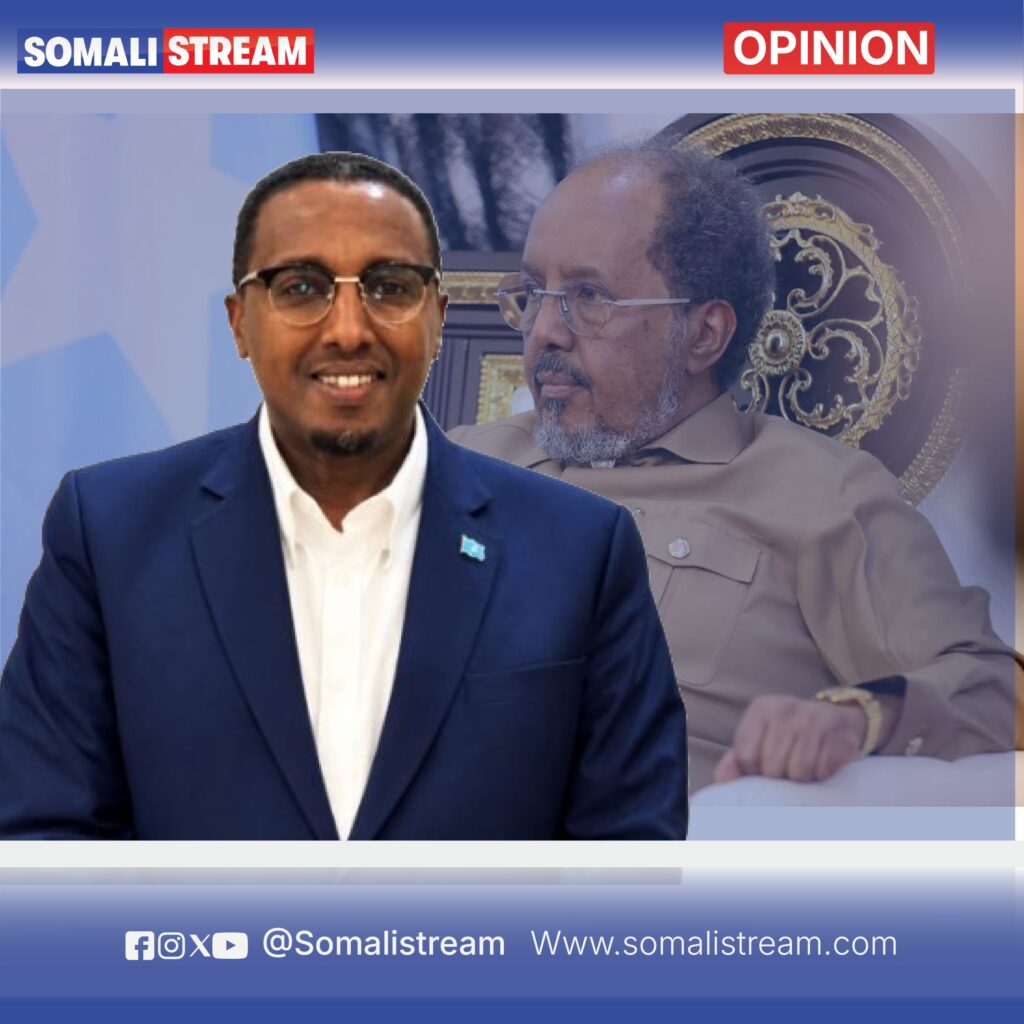
Power that has run out of time always reaches for the gavel, hoping the clatter of fresh decrees will drown out the ticking of the clock. True authority never needs such noisy theatre; it sits comfortably on public consent and speaks in a calm voice. A political project whose mandate has already expired behaves like a tenant whose lease has ended yet keeps rearranging the furniture: it summons emergency sessions, rewrites the rules after the referee has blown the whistle, and mistakes the rustle of fresh cabinet paper for permanence. Stripped of its solemn ceremonial dress, Tuesday’s extraordinary cabinet vote in Mogadishu to overhaul Somalia’s electoral rules is nothing more than the last kick of a dying mule.
Watch the sequence that produced this spectacle. Twenty-four hours earlier in Entebbe, President Hassan Sheikh Mohamud had co-signed an eighteen-point joint communiqué in which Uganda insisted on writing domestic political unity and reconciliation into the official record. By Tuesday morning, Villa Somalia was scrambling to deny reports of Ugandan mediation, while opposition leaders welcomed President Yoweri Museveni’s planned visit to break the constitutional deadlock. Boxed in abroad and out of time at home, Hassan Sheikh’s government responded by rushing closed-list voting, a ten percent party threshold, and an indirect leadership selection tier through the cabinet. That reflex is not statecraft; it is panic dressed up in the robes of procedure.
Why Legal Paper Cannot Rescue Lapsed Authority
Political thinkers have long warned against confusing raw executive decrees with legitimate rule. Max Weber drew the classic line between naked institutional power and true authority, showing that a state governs durably only when citizens recognize its commands as rightful rather than imposed by procedural sleight of hand. Seymour Martin Lipset sharpened that lesson for fragile democracies: political institutions survive only when the rules of competition are accepted as fair by all major contenders, not rewritten unilaterally by one side in the final inning. Contributors to the Oxford Handbook of Political Leadership identify the exact trap that follows when consent evaporates at home: cornered leaders stage rapid institutional motion, collecting decrees, commissions and summits to project mastery to a domestic gallery even as their real authority drains away.
That scholarly diagnosis describes Mogadishu to the letter. On 5 November, a five-judge panel of the Supreme Court invalidated the administration’s earlier election extension, ruled that the mandates of both Parliament and the presidency had lapsed in April and May, and ordered political stakeholders to negotiate a consensual framework within thirty days. Sending sweeping new electoral rewrites to a parliament whose own term the nation’s highest court has already declared expired does not cure a legitimacy deficit. It compounds it, turning the lawbook itself into a prop for an expired mandate.
Three Signs of a Cornered Political Project
You do not need a law degree to spot when an administration is legislating for survival rather than consensus. Tuesday’s cabinet amendments display three classic symptoms.
First, rewriting the rules after the whistle has blown. In any constitutional order, an expired legislature cannot manufacture a fresh mandate for itself or the executive by changing the voting formula on the fly. When a government ignores a binding Supreme Court deadline for inclusive talks and instead drafts unilateral amendments, it signals that it fears an open contest under agreed rules.
Second, narrowing the gate while the house is divided. Introducing closed party lists, a steep ten percent threshold, and a handpicked tier of council electors is designed to shrink the political arena rather than widen it. Yet look at the federation Hassan Sheikh’s government actually presides over today. Of the five original Federal Member States he sat with in 2022, only Galmudug still stands whole beside Mogadishu. Two, Puntland and Jubaland, have walked out over the contested constitution. The other two are fractured and at war with themselves: in South West State, an elected president pushed out by federal forces still claims the office while loyalist forces recapture surrounding towns, and in Hirshabelle, the state is split in two between Jowhar and a mobilised Hiiraan. You cannot impose a centralized voting formula on a federation where four of the five founding states are either outside the room or divided in conflict.
Third, mistaking cabinet ink for national consensus. For three years, Somalia’s closest international partners have repeated one word to Mogadishu: consensus, consensus, consensus. Across joint statements issued through the United Nations mission in Somalia, Austria, Belgium, Canada, Finland, France, Germany, Ireland, Italy, the Netherlands, Norway, Poland, Portugal, Slovakia, Spain, Sweden, Switzerland and the United Kingdom, alongside the African Union, the Intergovernmental Authority on Development, the European Union, the United Nations and the United States, have all urged Somali leaders to build an inclusive electoral roadmap. None of it was heeded. Passing unilateral amendments in an executive room cannot erase three years of unheeded warnings from the world or three weeks of defiance against the Supreme Court.
Only One Table Can Rescue the Republic
Supporters of the administration argue that pushing new electoral laws through the cabinet keeps the state moving forward and prevents a vacuum. That defense turns constitutional state-building upside down. A vacuum is not filled by unilateral decrees issued past midnight; it is filled when rival leaders sit down, agree on fair rules, and submit themselves to the judgment of the Somali people.
The last kick of a dying mule may rattle the stable door, yet it cannot carry the rider a single mile down the road. Somalia’s constitutional crisis will not be solved by Tuesday’s cabinet ink, nor by rewriting rules inside a closed room. It will be solved only when Hassan Sheikh’s government steps off the stage of unilateral decrees and sits at one table with Somalia’s federal states and opposition.
Awale Ali Kullane is a Somali diplomat and political analyst who writes on institutions and political leadership in the Horn of Africa. Find him at www.linkedin.com/in/awale-kullane-2632a5388
