


A Diplomatic Reflection on Somalia’s Security Transition, Political Commitments, and National Accountability
Three and a half years have passed since the Entebbe Summit of 27 April 2023, when African Union troop-contributing countries gathered to discuss Somalia’s security transition and the planned withdrawal of the African Union Transition Mission in Somalia (ATMIS).
The summit represented an important diplomatic milestone. Yet its central commitment remains a matter of national concern: Somalia was expected to assume full responsibility for its security by December 2024, but international military support continued beyond that deadline.
This development warrants a serious examination of the original commitments, the circumstances that shaped subsequent decisions, and the institutional challenges that continue to affect Somalia’s security transition.
Such an examination does not diminish the importance of international partnerships. Rather, it reinforces the principles of political accountability, strategic consistency, and national responsibility.
From Diplomatic Consultations to the Entebbe Commitment
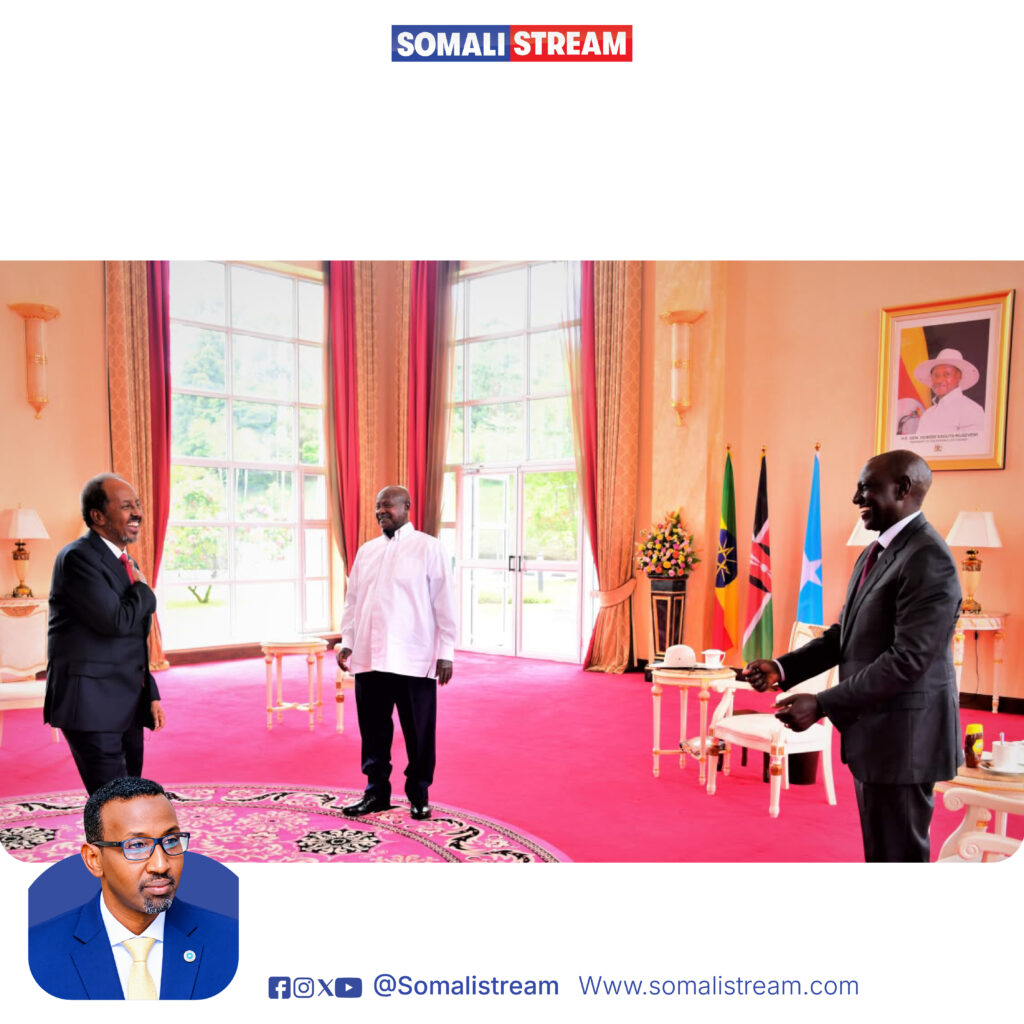
Following extensive diplomatic consultations, preparatory meetings were held in Kampala from 24 to 26 April 2023, culminating in the Heads of State and Government Summit at Entebbe on 27 April.
Hosted by Ugandan President Yoweri Kaguta Museveni, the summit brought together Somali President Hassan Sheikh Mohamud and leaders or senior representatives from Burundi, Djibouti, Kenya, and Ethiopia. Representatives of the African Union, United Nations, and IGAD also participated.
A central issue was the timetable for withdrawing ATMIS forces and transferring security responsibilities to Somali institutions.
The Federal Government maintained its commitment to completing the transition by 31 December 2024. Although evolving security conditions raised concerns about the feasibility of a fixed timetable, the final communiqué did not explicitly provide for an extension.
Paragraph 5 of the 26-paragraph communiqué reaffirmed the Somali Transition Plan, under which security responsibilities were to be transferred from ATMIS to the Federal Government by December 2024.
This commitment went beyond diplomatic language. It reflected political confidence that Somalia’s security institutions could develop the operational capacity necessary to assume national security responsibilities within the agreed timeframe.
From ATMIS to AUSSOM: The Question of Strategic Consistency
The subsequent evolution of Somalia’s security arrangements reveals a significant contrast between the expectations expressed in Entebbe and the realities that followed.
ATMIS formally concluded in December 2024, while its successor, the African Union Support and Stabilization Mission in Somalia (AUSSOM), commenced operations in January 2025. Although the two missions operate under different mandates, the establishment of AUSSOM confirmed the continuing need for international military assistance.
The central issue is therefore not simply the continued presence of foreign forces, but the gap between the original transition expectations and Somalia’s actual institutional readiness.
Was the December 2024 deadline based on an overly optimistic assessment of Somalia’s security capabilities, or did subsequent developments fundamentally alter the conditions under which the commitment was made?
Addressing this question requires an objective assessment of military preparedness, recruitment, training, equipment, logistics, financing, and operational effectiveness.
Governments must retain the flexibility to adjust national security strategies when circumstances change. Such adjustments are not inherently evidence of policy failure. However, significant changes to previously declared national commitments require transparent explanations and credible institutional assessments.
Without such accountability, strategic flexibility risks being perceived as inconsistency, weakening public confidence in national security planning.
National Security Requires Institutions, not Political Declarations
Somalia’s security transition cannot succeed through political declarations, withdrawal deadlines, or increases in troop numbers alone.
A sustainable national security system requires professional leadership, unified command structures, reliable intelligence, adequate equipment, effective logistics, operational coordination, and predictable financing.
Equally important is meaningful cooperation between the Federal Government and Federal Member States. National security responsibilities must be supported by institutional coordination, clearly defined mandates, and a shared strategic vision.
The challenge extends beyond replacing international troops with Somali personnel. It involves establishing institutions capable of independently sustaining security operations and responding effectively to evolving threats. Security sovereignty must therefore be treated as a long-term national undertaking rather than a political achievement associated with any administration.
Recognizing International Sacrifice While Demanding National Accountability
Uganda and other African Union troop-contributing countries have made significant sacrifices in supporting Somalia’s security, combating extremist groups, and helping restore state institutions. Their contributions deserve recognition, respect, and appreciation.
Nevertheless, acknowledging international sacrifices is entirely compatible with the Somali public’s right to expect a credible strategy for achieving national security self-reliance.
Somalia can maintain strong partnerships with friendly nations while progressively reducing its dependence on foreign military forces. International assistance should strengthen Somali security institutions rather than indefinitely substitute for the sovereign responsibilities of the Somali state.
The ultimate measure of successful international security cooperation is not how long foreign forces remain deployed, but how effectively their presence contributes to building capable, sustainable, and independently functioning Somali security institutions.
The Lesson of Entebbe: Commitments Must Be Measured by Results
The Entebbe Summit remains an important diplomatic milestone, but its historical significance must ultimately be assessed against the results achieved. The Federal Government should provide a transparent account of progress under the original transition plan, the obstacles that prevented its full implementation, and the reasons for subsequent policy adjustments.
More importantly, it should establish measurable milestones, realistic timelines, and clear institutional responsibilities for achieving national security self-reliance. Political commitments gain credibility when they are supported by realistic assessments, adequate resources, effective implementation, and accountability for results.
Somalia needs more than another timetable for the withdrawal of foreign forces. It needs a comprehensive national security strategy capable of translating political commitments into sustainable institutional achievements.
National security sovereignty is not a political promise to be proclaimed. It is a capacity to be built, a responsibility to be assumed, and an outcome to be demonstrated.
Ambassador Ali Mohamed Cagabarur is a career diplomat and former Somali ambassador to Uganda. The views expressed in this article are his own and do not reflect those of Somali Stream.
