


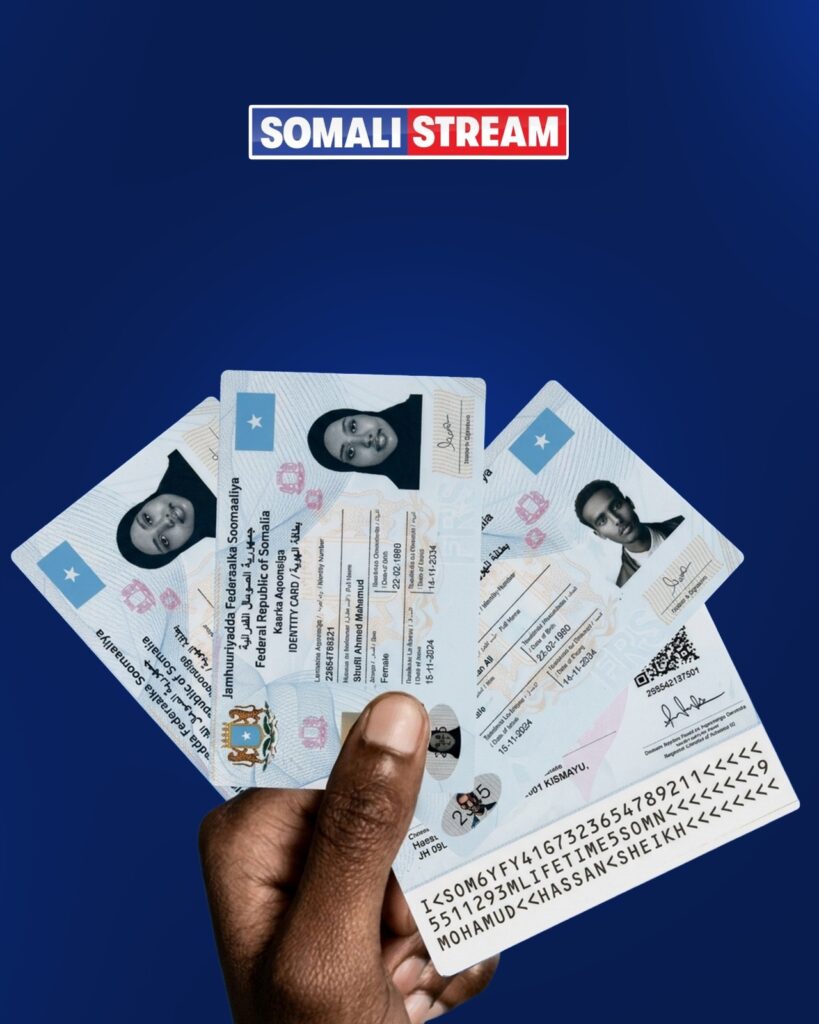
Somalia’s Federal Government is moving to link its government payroll system with the country’s national identification database, a step authorities say will help verify employees, improve the accuracy of salary records and strengthen controls over public spending.
The Office of the Accountant General said in a letter dated Aug. 29 that the first phase of the integration would begin with a pilot involving five government institutions from Oct. 1, 2026. The system will then be gradually extended to other federal ministries, agencies and government offices, with full implementation targeted by Dec. 31, 2027.
The plan will connect the government’s Payroll/SFMIS system with the National Identification and Registration Authority (NIRA), allowing employee records to be checked against a national identity system.
Under the new arrangement, government institutions have been instructed to review and verify the information of employees currently listed on their payrolls. Staff who do not yet have a national identification number have been urged to register with NIRA as soon as possible.
The Accountant General’s Office has warned that once the integrated system becomes fully operational, employees whose identities cannot be verified through the national identification system could face disruptions to their salary payments.
The move is part of a broader effort by Somalia to strengthen public financial management and introduce tighter controls over the government wage bill. The Federal Government has in recent years sought to consolidate employee compensation through the government’s financial management system and strengthen oversight of changes to payroll records.
A government wage-bill analysis published by the Ministry of Finance said the SFMIS payroll system assigns a unique employee number to each government employee and that payments are made against those employee records. It also said the Ministry of Finance has authority over payroll changes that have financial implications.
The International Monetary Fund has similarly noted that Somalia has been working to strengthen payroll controls, including restricting financially significant changes to payroll entries to the Ministry of Finance and integrating employee compensation into a single payroll within SFMIS.
The proposed link to NIRA adds another layer of identity verification to that system.
NIRA, established under Somalia’s Identification and Registration Act of 2023, is responsible for maintaining the country’s national identification system and issuing unique National Identification Numbers to citizens and legal residents. Its system uses biographical and biometric information, including fingerprints and facial recognition, to establish and verify individual identities.
The authority has been developing the national ID system as a foundation for digital government and service delivery. NIRA says the identification system is intended to support identity verification across sectors including government services, banking, employment and social protection.
Its stated use cases specifically include employment verification and payroll and salary payments, with the national ID designed to allow employees to be registered in official payroll systems and their identities to be verified.
The integration also comes as Somalia seeks to expand the use of the national ID beyond a physical identification document. NIRA provides digital and physical credentials and has developed its Hubiye platform to allow authorised institutions to verify an individual’s identity against the national ID database.
In June, NIRA and the United Nations Development Programme launched a National ID and Public Service Integration Working Group, bringing together government institutions and service providers to accelerate the use of the national identification system across public and private services. The initiative was presented as part of Somalia’s broader digital transformation agenda and the objectives of the National Transformation Plan for 2025-2029.
For the government payroll, the intended effect is to create a stronger link between an employee’s identity and the salary record attached to that person. Officials say this could help identify inaccurate or duplicate records and ensure that public salaries are paid only to verified and eligible employees.
The reform could also strengthen the government’s ability to maintain an up-to-date picture of its workforce as ministries and agencies recruit, transfer, retire or remove employees from the payroll. However, implementation will depend on the quality and coverage of the national identification system, as well as the ability of government institutions to reconcile existing personnel records with NIRA data before the new verification requirements take effect.
NIRA says its registration system is designed to accommodate people who lack conventional identity documents through alternative verification procedures, while mobile registration units are intended to extend registration to remote communities and other groups that may face difficulties accessing fixed registration centres. The government has therefore urged ministries and agencies to complete employee data verification and national ID registration ahead of the implementation timetable to minimise the risk of delays or interruptions in salary payments.
The initial five-institution pilot beginning in October is expected to provide the government with an opportunity to identify technical and administrative problems before the system is expanded nationwide.
If completed as planned, the integration would represent a further step in Somalia’s efforts to build a more centralised and verifiable public payroll system, while linking the management of government employees more closely to the country’s emerging national digital identity infrastructure.