


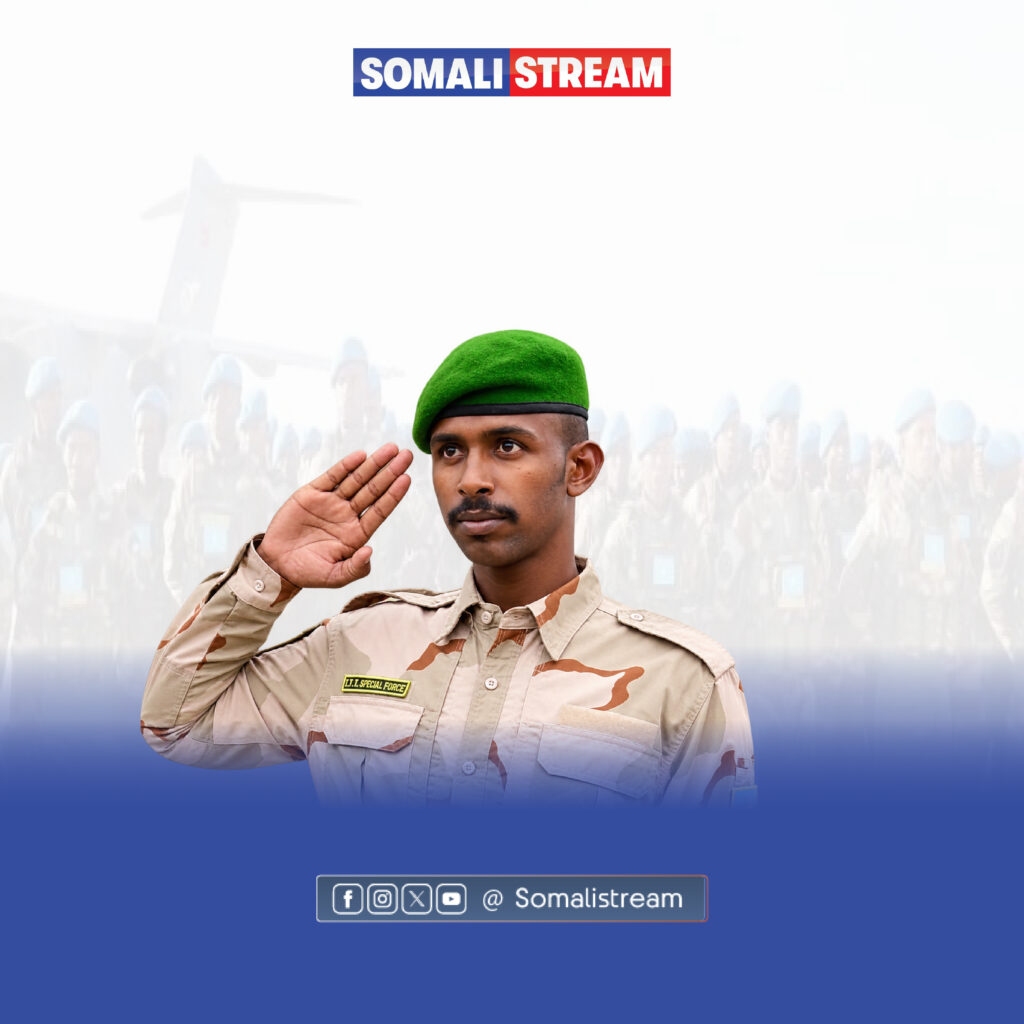
Somali President Hassan Sheikh Mohamud has appointed Colonel Mohamed Abdulqadir “Shariif” as commander of the Somali Navy and Coastal Defence Forces, replacing Brigadier General Abdiwahab Omar, in a further change to the senior leadership of Somalia’s armed forces.
Sharif brings a combination of university education in Yemen and specialist military training in Eritrea, including instruction in naval operations, navigation, seamanship, military communications and command management, according to the professional profile provided for this report.
Born in Mogadishu, Shariif completed his secondary education at Khalid Bin Walid Secondary School in Aden, Yemen, in the 2013–2014 academic year.
He subsequently earned a bachelor’s degree in Languages and Literature from the University of Aden in 2017–2018.
His military training at Eritrea’s Ras Hamas Naval Academy covered a broad range of subjects relevant to naval service, including officer training, military leadership, force management, maritime navigation, map reading and GPS systems.
His listed coursework also includes military communications, special forces training, foundational military instruction and weapons familiarisation.
The breadth of the reported curriculum gives Shariif an educational foundation spanning maritime operations, personnel leadership and military communications as he takes command of a service tasked with protecting Somalia’s territorial waters and coastal interests.
His listed language skills include Somali, Arabic, English and Tigrinya, a combination that could support professional communication in the Horn of Africa’s multilingual military and security environment.
The appointment comes as Somalia continues to rebuild its armed forces and strengthen command structures across its principal military services.
The Navy faces the long-term task of developing personnel, operational readiness and the institutional capabilities required to safeguard one of the country’s most strategically important national assets: its coastline.
Eritrea-trained leadership across the armed forces
Shariif’s appointment follows the elevation of another Eritrea-trained officer to a senior military command.
Brigadier General Abdirisaq Mohamud Haji, known as “Qaloombi,” formally assumed command of the Somali Air Force on March 7, 2026.
The appointments place reported Eritrean military training in the professional backgrounds of officers leading two of Somalia’s principal services.
Their commands have distinct responsibilities: the Navy focuses on maritime and coastal defence, while the Air Force is responsible for air operations and associated military capabilities.
The changes form part of a wider series of senior appointments under Mohamud. In January 2026, Somalia’s Council of Ministers appointed Brigadier General Ibrahim Mohamed Mahamud as commander of the Somali National Army, replacing General Odowaa Yusuf Raage.
In November 2024, Mohamud appointed Brigadier General Sahal Cabdullaahi Cumar, widely known as “Jeneraal Khaalid,” as commander of the Somali Ground Forces, replacing General Dayah Abdi Abdulle.
Taken together, the appointments span the Army’s overall command, its ground forces, the Air Force and the Navy, reflecting a continuing series of changes in Somalia’s senior military hierarchy.
The challenge ahead for the Navy
Shariif assumes command at a time when developing an effective naval service requires sustained attention to specialist training, command discipline, equipment, communications and operational support.
The Somali Navy’s responsibilities include contributing to the protection of territorial waters, coastal security and national maritime interests. Delivering those objectives will depend on translating personnel training and leadership into institutional capacity and operational preparedness.
His reported background in naval studies and military management provides a foundation relevant to those responsibilities. The extent to which that preparation translates into operational results will depend on the resources available to the service, its personnel and the broader defence structure.
For Somalia, the appointment marks another step in the continuing effort to develop a professional military establishment capable of defending the country on land, at sea and in the air.