


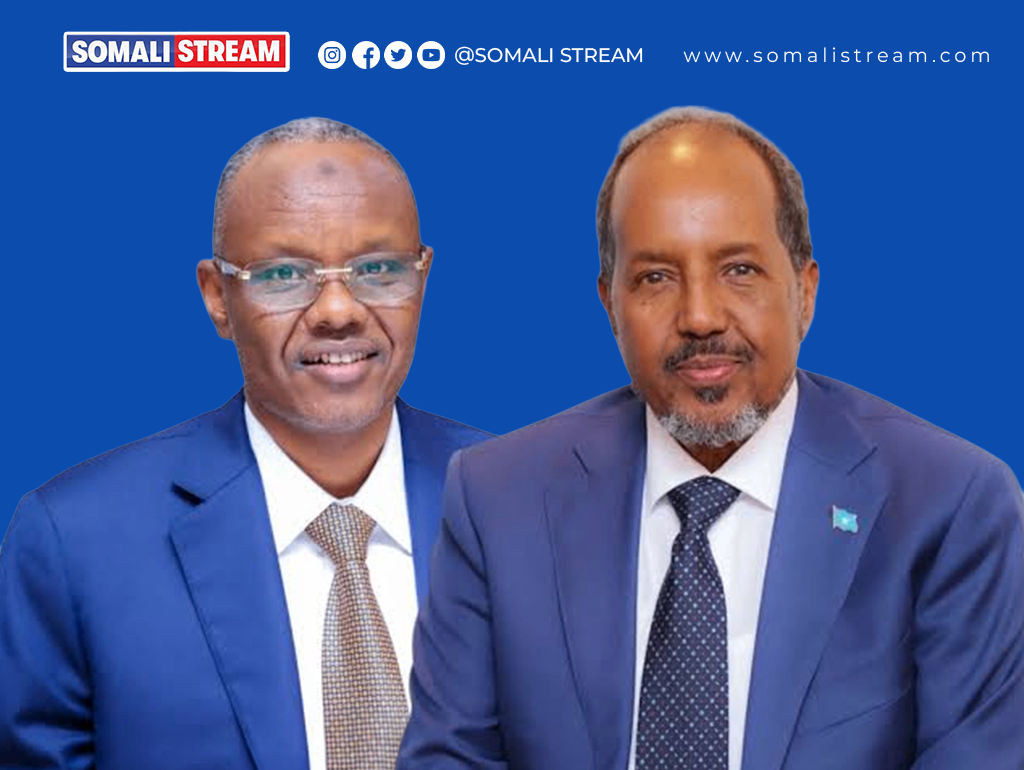
Abdiaziz Hassan Mohamed Laftagareen, the self-declared president of South West State, has issued a blistering open letter accusing Somali President Hassan Sheikh Mohamud of pursuing a campaign of political coercion against his administration, using military force to influence regional leadership and attempting to impose an electoral settlement without the consent of rival political actors.
The letter, dated 20 October and addressed to the Somali people, opposition groups, the international community and what Laftagareen describes as politicians of sound judgement, offers a forceful account of the confrontation that has deepened divisions between Mogadishu and South West State.
Its allegations are grave. Laftagareen claims that federal forces were deployed to Baidoa to overthrow his administration after he rejected the federal government’s proposed constitutional amendments and electoral model.
He further alleges that military operations involved cooperation with Al-Shabaab and accuses the federal leadership of using clan politics, intimidation and disinformation to weaken his political position.
At the heart of Laftagareen’s argument is a fundamental question confronting Somalia’s federal system: who has the authority to determine when regional leaders leave office and how their successors are elected?
For Laftagareen, the answer must be negotiated among Somali political stakeholders, not dictated by the presidency in Mogadishu.
From political ally to outspoken adversary
Laftagareen’s letter is particularly striking because he presents his confrontation with Hassan Sheikh as the culmination of a political relationship that once appeared cooperative.
He says he worked with the president for three years to prevent further fragmentation of the federal system, particularly after Puntland and Jubaland withdrew from cooperation with the federal government.
During that period, Laftagareen writes, Hassan Sheikh praised his efforts to bring federal member states and the federal government together. He also says he served as deputy chairman of the Justice and Solidarity Party.
The relationship, according to Laftagareen, deteriorated as disagreements emerged over constitutional amendments and the proposed electoral framework.
He accuses the president of pursuing unilateral constitutional changes and designing an electoral model that failed to secure the agreement of the country’s principal political stakeholders.
Laftagareen says he repeatedly urged Hassan Sheikh to abandon that approach and seek a negotiated settlement. Over time, he writes, he came to believe that the president intended to remain in power indefinitely.
The election dispute that became a struggle for power
The immediate breakdown, according to Laftagareen, followed the expiry of his regional mandate.
He says he repeatedly called for elections in South West State but that Hassan Sheikh insisted he, alongside the presidents of Galmudug and Hirshabelle, should remain in office until the federal president decided when elections would take place.
Laftagareen portrays that position as an attempt to place the regional electoral calendar under the control of the federal presidency.
He says he refused to remain in office without what he considered a legitimate mandate, rejected the proposed constitutional changes and announced that South West State would hold its own election.
His account alleges that the federal government responded by deploying troops to Baidoa in an effort to remove his administration.
The dispute illustrates a wider structural problem in Somalia’s federal system. Where there is no broadly accepted agreement on electoral rules, disputes over timing, eligibility and the authority to organise elections can become contests over the legitimacy of government itself.
Laftagareen’s letter demands that the electoral process in South West State be settled through inclusive dialogue and an outcome accepted by all sides.
That demand goes to the heart of the crisis. A process imposed through force may establish immediate control, but it cannot by itself guarantee political acceptance or a durable settlement.
Grave allegations over Baidoa and military intervention
The most serious passages of the letter concern the use of military force.
Laftagareen describes the operation against his administration as a politically motivated assault on South West State and its people.
He also claims that an arrangement involving money and weapons was reached with Al-Shabaab to facilitate the removal of his government.
Al-Shabaab accusations and the battle over the narrative
Laftagareen also accuses the federal government of portraying Darwish forces- regional security personnel, as Al-Shabaab fighters in order to justify attacks against them.
He questions why, if the federal government is genuinely focused on defeating Al-Shabaab, it has not pursued comparable military action against the group in areas he identifies in Lower Shabelle, around Afgoye, and in Jowhar and Balad.
A separate front: journalists, disinformation and press freedom
Laftagareen’s letter extends beyond military and constitutional disputes to accuse the federal government of suppressing reporting on South West State.
He claims that journalists were sanctioned for accurately covering events in the region and that individuals associated with the federal government circulated an artificially altered image purporting to show an Al-Shabaab leader alongside his political team in Diinsoor.
According to Laftagareen, the image was subsequently debunked.
The allegations raise concerns about the potential use of digital manipulation to influence public perceptions during a political crisis. But the provenance of the image, the circumstances in which it circulated and the identity of those responsible would need to be established independently before responsibility could be assigned.
The wider issue is nonetheless important.
An appeal to the opposition and international community
Laftagareen demands an immediate end to military operations, the withdrawal of federal forces from South West State and an end to threats against civilians. He also calls for an end to the intimidation of journalists, an inclusive electoral settlement and greater involvement by Somali opposition groups.
His appeal to the international community is direct: press for an end to military operations and support a return to dialogue.
Most controversially, he calls on Hassan Sheikh to step aside before the crisis deepens.
The demand is unlikely to be accepted by the presidency without significant political pressure, and it does not itself provide a mechanism for resolving the country’s constitutional disputes. But it is designed to place the federal government under greater scrutiny and encourage opponents of its policies to coordinate their positions.
The international community faces a difficult balancing act. External partners have security and political interests in Somalia, including cooperation against Al-Shabaab and support for functioning federal institutions. They also have an interest in preventing political disputes from escalating into armed confrontation.
