


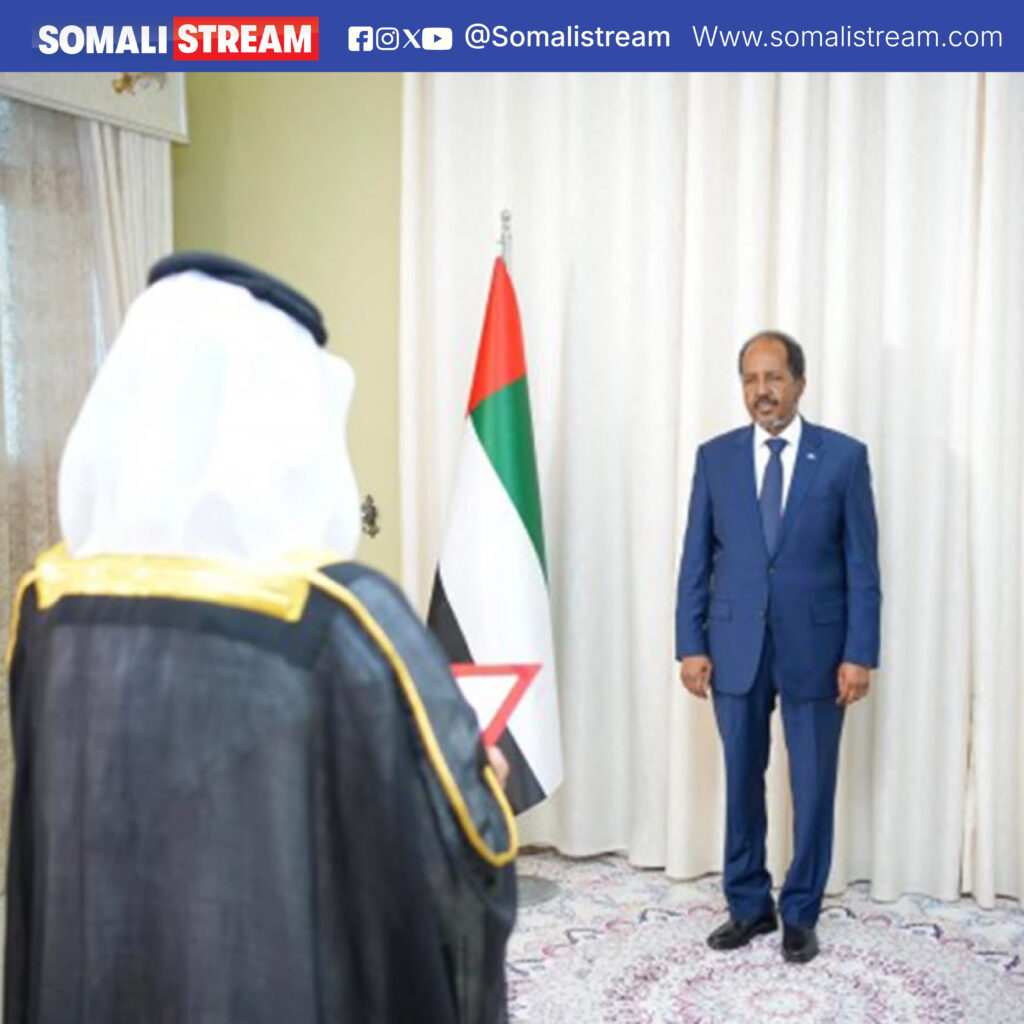
A relationship once publicly celebrated through presidential visits, diplomatic courtesies and promises of brotherhood has plunged into one of its most serious crises, with Somalia ordering the United Arab Emirates’ ambassador out of Mogadishu within 72 hours and accusing Abu Dhabi of interfering in its internal affairs.
The dramatic decision, announced following a Federal Cabinet meeting chaired by Prime Minister Hamza Abdi Barre, marks a sharp turn in relations between the two countries, with Mogadishu now threatening further action against Emirati interests and warning anyone cooperating with what it describes as an assault on Somali sovereignty.
At the centre of the confrontation is President Hassan Sheikh Mohamud’s government, which has moved from publicly praising Emirati assistance and welcoming its diplomatic representatives to openly challenging Abu Dhabi’s conduct in Somalia.
The escalation unfolded through a series of increasingly forceful government statements, culminating in the decision to recall Somalia’s ambassador to the UAE for consultations and give the Emirati ambassador in Mogadishu 72 hours to leave the country.
In a statement issued by Somalia’s Ministry of Foreign Affairs and International Cooperation on Wednesday, 18 November 2026, Mogadishu accused the UAE government of continued interference in the country’s internal affairs, warning that its actions undermined Somalia’s sovereignty, territorial integrity and national unity.
The ministry’s statement followed a national address delivered a day earlier by President Hassan Sheikh, who outlined the government’s position on the dispute.
Somalia rejected what it described as foreign engagement and parallel security arrangements operating outside the authority of the Federal Government, insisting that Mogadishu remains the country’s sole authority for conducting foreign relations.
“Somalia calls on the UAE to conduct its relations with Somalia exclusively through the Federal Government, in line with the UN Charter and international law,” the ministry declared.
The government was careful to distinguish its confrontation with Abu Dhabi from the historical relationship between the two peoples, stressing that its objections were directed at the policies of the Emirati government, not the longstanding friendship between Somalis and Emiratis.
But the diplomatic language of friendship was rapidly giving way to a much harder message.
From presidential embraces to a 72-hour expulsion order
The Federal Cabinet’s decision marked a decisive escalation.
Information Minister Abdifatah Qasim announced that ministers had reviewed a report concerning what the government described as the extent of Emirati interference in Somalia before adopting a series of measures.
The Ministry of Foreign Affairs and International Cooperation was instructed to recall Somalia’s ambassador to the UAE for consultations with national leaders. At the same time, the Emirati ambassador in Mogadishu was ordered to return to his country within 72 hours.
The cabinet went further, directing the Foreign Ministry to share Somalia’s allegations with foreign governments and international organisations, effectively taking the confrontation beyond the bilateral relationship and onto the wider diplomatic stage.
It also warned individuals and entities cooperating with the UAE in what Mogadishu characterised as actions against Somalia that they could face appropriate measures.
The government pledged to pursue all available lawful avenues to defend the country’s sovereignty, territorial integrity, national unity and internal security, while calling on Somali citizens and community leaders to unite in defence of national interests.
The language was unmistakably confrontational. Mogadishu was no longer simply expressing diplomatic displeasure; it was signalling a willingness to challenge the UAE’s activities and relationships inside Somalia.
When Hassan Sheikh was welcoming Abu Dhabi
Perhaps the most striking dimension of the unfolding crisis is the contrast with President Hassan Sheikh’s own diplomatic engagements with the UAE.
Abu Dhabi was not an unfamiliar destination for the Somali president. In fact, the UAE was the first country he visited on an official trip after returning to office in 2022.
On 20 June 2022, shortly after his re-election, Hassan Sheikh arrived in Abu Dhabi on an official visit, where he was received by Sheikh Shakhboot bin Nahyan bin Mubarak Al Nahyan, the UAE Minister of State, alongside other Emirati officials.
The visit signalled the importance Mogadishu attached to relations with Abu Dhabi at the beginning of Hassan Sheikh’s new administration.
The relationship continued to receive high-level attention.
On 10 March 2025, UAE President Sheikh Mohamed bin Zayed Al Nahyan welcomed Hassan Sheikh to Abu Dhabi during another working visit.
The meeting was attended by senior Emirati figures, including Sheikh Mansour bin Zayed Al Nahyan, Vice President, Deputy Prime Minister and Chairman of the Presidential Court, and Sheikh Hamdan bin Mohammed bin Rashid Al Maktoum, Crown Prince of Dubai, Deputy Prime Minister and Minister of Defence.
During that visit, Hassan Sheikh publicly commended the UAE’s continued support for Somalia’s development, highlighting its contribution to the Somali people’s aspirations for growth, stability and prosperity.
Those expressions of appreciation now stand in sharp contrast to Mogadishu’s latest accusations against the Emirati government.
The diplomatic reversal raises a fundamental question: what happened between the two governments to transform a relationship marked by presidential visits and public expressions of gratitude into an open confrontation over sovereignty and national security?
The ambassador at the centre of the diplomatic rupture
The Emirati ambassador now ordered to leave Somalia is Ahmed Juma Al-Rumaithi, who presented his diplomatic credentials to President Hassan Sheikh Mohamud on 13 November 2022.
The ceremony took place at the Presidential Palace in Mogadishu, where the Somali president formally received the credentials of the UAE’s newly appointed representative.
According to the Somali presidency’s announcement at the time, Al-Rumaithi conveyed greetings and a message from UAE President Sheikh Mohamed bin Zayed Al Nahyan, expressing respect for Somalia’s sovereignty and a commitment to strengthening the longstanding relationship between the two countries.
The ambassador also pledged to work towards advancing diplomatic relations and thanked the Somali government and people for the warm reception.
Hassan Sheikh congratulated him on his appointment and expressed hope that he would successfully represent his country and contribute to strengthening the historic ties between the two nations.
Four years later, that same diplomatic relationship has reached a point where Mogadishu has ordered the Emirati envoy to leave its territory.
The contrast is striking: an ambassador welcomed at the presidential palace with messages of friendship is now at the centre of a diplomatic expulsion order issued by the same administration.
The battle over sovereignty and security arrangements
Beyond the diplomatic drama, the substance of Somalia’s accusations points towards a deeper dispute over political authority, security cooperation and foreign influence.
At the heart of Mogadishu’s objections is its rejection of foreign engagement and security arrangements that bypass the Federal Government.
The Somali administration maintains that foreign governments must conduct their dealings with the country through its federal institutions rather than establishing parallel relationships with actors outside their authority.
This position touches on one of Somalia’s most sensitive political questions: the balance of power between the Federal Government and regional administrations, and the extent to which external governments can maintain independent political, commercial and security relationships within the country.
The UAE has maintained significant commercial and security interests in the Horn of Africa. Its engagement in Somalia and the wider region has long been part of a broader strategic presence extending across the Red Sea, Gulf of Aden and Indian Ocean.
However, the precise arrangements and activities behind the latest Somali accusations require further examination, including the positions of the regional administrations and other actors involved.
Mogadishu has so far presented its case in terms of national sovereignty and constitutional authority. It has not, in the statements provided, publicly detailed every incident or arrangement underpinning its allegations.
Taking the confrontation beyond Mogadishu
Somalia’s decision to involve foreign governments and international organisations suggests that the dispute could extend well beyond the immediate diplomatic fallout.
By instructing its Foreign Ministry to circulate its allegations internationally, Mogadishu is seeking to establish its position before international partners and underline what it considers a violation of the principles of state sovereignty and non-interference.
The government has also invoked the United Nations Charter and international law, framing the dispute as more than a disagreement over bilateral cooperation.
For the UAE, the expulsion order represents a serious diplomatic setback in a country where it has cultivated political, commercial and security relationships.
For Somalia, the challenge will be translating its declaration of sovereignty into a coherent policy that protects federal authority without triggering further instability or damaging relationships with other regional partners.
The consequences could extend into the wider Horn of Africa, where competing strategic interests, security partnerships and access to critical maritime routes have made relations between regional and international actors increasingly consequential.
The central question is no longer whether relations between Mogadishu and Abu Dhabi have deteriorated. They clearly have. The question is how far both governments are prepared to go, what specific actions triggered the rupture, and whether a diplomatic relationship once described in the language of brotherhood can survive a confrontation now being fought in the name of sovereignty.