


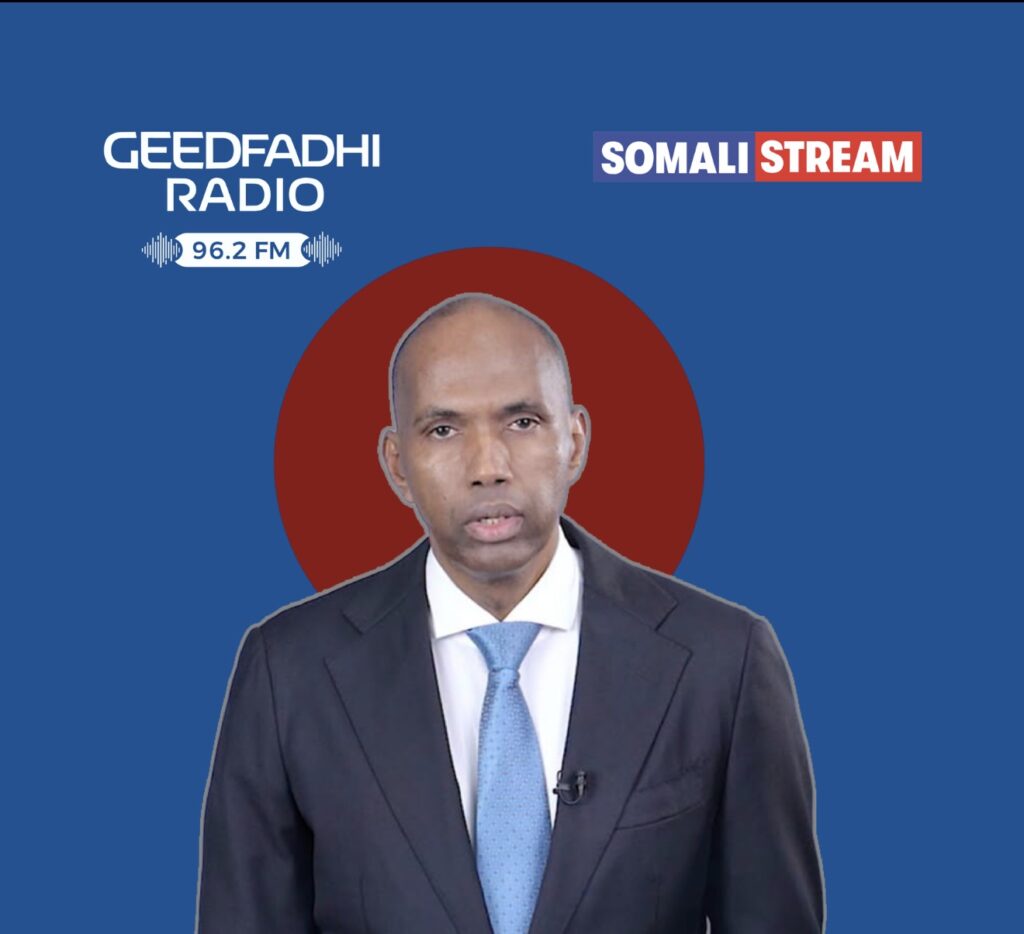
Former Somali Prime Minister and Presidential candidate Hassan Ali Khaire has condemned the revocation of Geedfadhi Radio’s broadcasting licence, warning that restrictions on independent media threaten accountability, democratic governance and the country’s prospects for an inclusive political transition.
In a statement, Khaire described a free press as fundamental to democratic governance, emphasising the media’s responsibility to scrutinise those in power, regardless of their political affiliations, amplify diverse perspectives and ensure that public debate remains open rather than controlled by those in authority.
He strongly criticised what he described as the suppression of media freedom, singling out the withdrawal of Geedfadhi Radio’s licence as a troubling development that raises questions about political tolerance and the government’s approach to independent journalism.
Khaire warned that targeting critical voices and using institutional authority to restrict dissent risk undermining the principles of accountability and democratic participation.
He further argued that the restrictions come at a particularly sensitive time for Somalia, as the country seeks an inclusive and credible political transition. Limiting media freedom and narrowing the space for dissent, he said, risk weakening dialogue, eroding public trust and undermining efforts to build political consensus.
“A political transition cannot be built by silencing those who question it,” Khaire said, stressing that meaningful political progress requires openness, accountability and respect for differing opinions.
Geedfadhi Radio Closure Fuels Concerns Over Press Freedom
Khaire’s condemnation adds to growing criticism of the federal government’s decision to revoke Geedfadhi Radio’s broadcasting licence, with opposition political figures and journalists’ organisations increasingly questioning the implications of the move for media independence in Somalia.
His remarks follow similar criticism from former President Sharif Sheikh Ahmed’s Himilo Qaran Party, which accused the government of intimidating independent media and restricting journalists’ ability to operate freely.
Former Prime Minister Abdi Farah Shirdon, a presidential candidate representing the Union of Haybad Qaran, has also expressed solidarity with the station, condemning restrictions on Somali media and demanding the immediate reinstatement of its broadcasting licence.
The National Union of Somali Journalists (NUSOJ) and Geedfadhi Radio have likewise challenged the ministry’s decision, with the station rejecting allegations of violating Somalia’s Media Law and indicating that it will pursue legal and administrative channels to contest the revocation.
The growing criticism has transformed the dispute into a broader debate over press freedom, government accountability and the role of independent journalism in Somalia’s political transition.
The controversy has also renewed questions about the use of government regulatory powers, the protection of critical reporting and the responsibility of public institutions to ensure that media organisations can operate without political interference.
As criticism mounts, the Geedfadhi Radio case is emerging as a significant test of Somalia’s commitment to media independence and the protection of freedom of expression.