


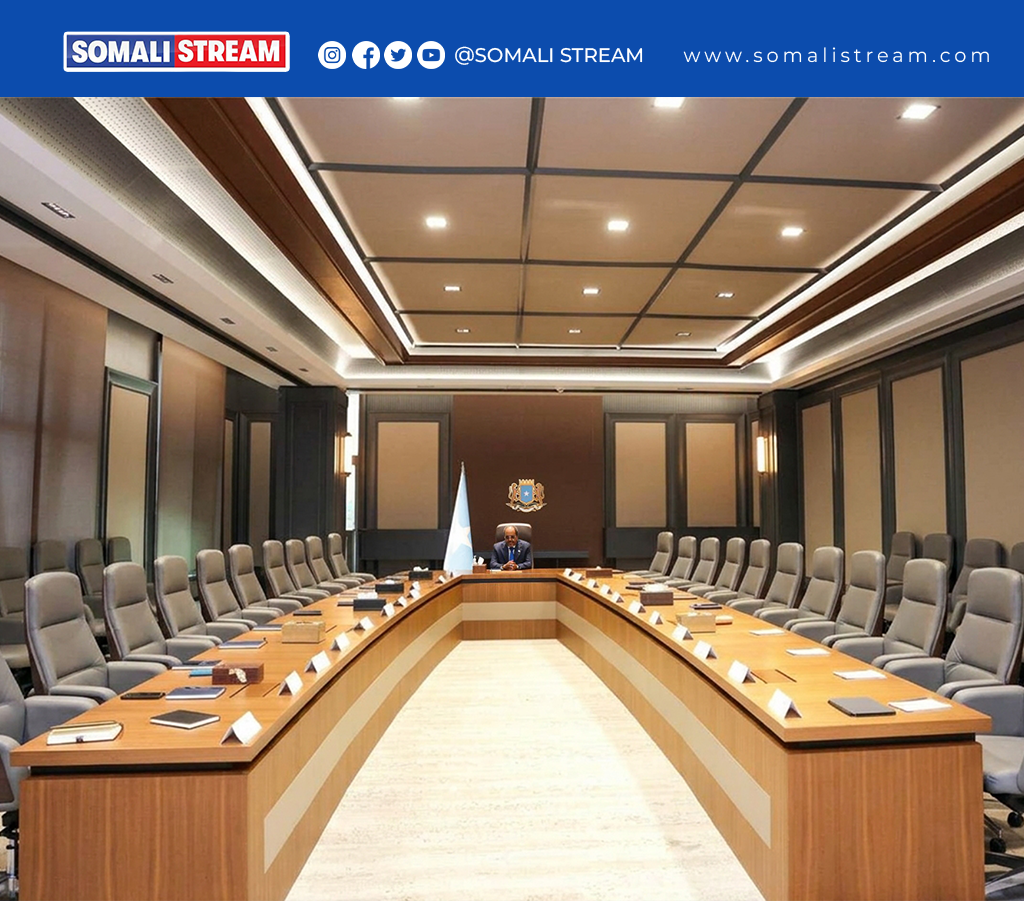
The chairs were available. The invitations had gone out. But the opposition did not show up.
For President Hassan Sheikh Mohamud, Saturday’s failed dialogue was more than an awkward diplomatic moment. It exposed the central contradiction of his presidency: a government seeking political legitimacy through negotiations with opponents who question its authority to convene them in the first place.
Villa Somalia insists the door remains open. Its opponents say the problem is not the door, but the terms of entry.
They argue that Hassan Sheikh’s constitutional mandate has expired and that his continued tenure, alongside the government’s contested electoral agenda, cannot be treated as an established political fact.
Any meaningful dialogue, they insist, must begin by addressing the legitimacy dispute rather than accepting the presidency’s preferred framework.
Behind the public invitations, however, a more complicated contest is taking shape. The presidency needs political participation to strengthen its domestic and international standing. The opposition is trying to deny it that endorsement. Puntland and Jubaland are consolidating their objections, while international partners are pressing for a negotiated way out.
The question is no longer simply why the parties are refusing to meet. It is what each side stands to gain by keeping the other waiting.
1. The invitation is part of the negotiation
Villa Somalia’s renewed invitation, less than a month after its previous attempt, is difficult to separate from the political and diplomatic pressures surrounding the presidency.
The government has two audiences: the Somali political establishment and its international partners.
At home, Hassan Sheikh needs opposition participation to give his electoral and constitutional agenda the appearance of national consent. Even a limited turnout could be presented as evidence that the process is inclusive and that disagreements are being resolved through dialogue.
The arithmetic is straightforward: a divided opposition is easier to negotiate with than a united one. Bringing some political figures into the room could weaken the collective position of those demanding fundamental changes before negotiations begin.
Abroad, the calculation is more pressing.
Villa Somalia faces growing questions about its relationship with federal member states, the sustainability of its security arrangements and the political conditions surrounding continued international support. Its disagreements with Puntland and Jubaland have added another layer of uncertainty to an already complicated security environment.
The administration is also navigating pressures surrounding American assistance, the departure of Ugandan troops and the financing of the African Union Support and Stabilization Mission in Somalia (AUSSOM).
For a government dependent on international financial and security partnerships, political instability carries a direct diplomatic cost.
Hassan Sheikh’s forthcoming engagement with European leaders in Brussels adds urgency to the exercise. He needs to demonstrate that Mogadishu remains capable of managing its domestic disputes and maintaining a functioning political process.
A dialogue attended by the principal opposition figures would strengthen that message. An empty negotiating table does the opposite.
There is also the budgetary dimension. Somalia continues to depend on external assistance to support government operations and security priorities. International partners have an interest in a political settlement that prevents institutional confrontation from undermining those investments.
The invitation, therefore, serves a purpose even if nobody accepts it: it allows Villa Somalia to demonstrate that it has formally offered dialogue.
But an invitation is not a settlement, and the appearance of openness is not the same as political agreement.
2. The divide-and-negotiate strategy
Hassan Sheikh does not necessarily need the entire opposition to secure a political advantage. He needs enough of it.
That distinction lies at the heart of Villa Somalia’s possible negotiating strategy.
Rather than abandoning its electoral roadmap, the presidency could seek selective amendments to provisions that have encountered resistance, particularly those complicating the government’s attempts to implement its proposed electoral arrangements across the federal system.
Such concessions would allow Hassan Sheikh to present himself as flexible without surrendering control over the broader political process.
The political benefit is obvious. If individual opposition figures agree to participate, the government can portray their attendance as evidence of progress. Those who remain outside risk being characterised as unwilling to compromise.
The dispute would then be reframed. Instead of answering questions about presidential legitimacy and the constitutional basis of its electoral agenda, Villa Somalia could shift attention to which opposition figures are prepared to negotiate.
This is the advantage of negotiating with fragments rather than confronting a united front.
But the opposition is making the strategy easier than it should be.
Its constituent groups have different ambitions, political alliances and priorities. Some are principally concerned with electoral guarantees; others want a broader renegotiation of federal power. A harder-line faction insists that the presidential mandate question must be resolved before any substantive negotiations can begin.
There is no sufficiently coherent alternative programme capable of holding these interests together.
That weakness gives the presidency room to manoeuvre. It also raises the possibility that individual political actors could accept limited concessions in exchange for participation, leaving the larger constitutional dispute unresolved.
The opposition faces a familiar political dilemma: negotiate separately and risk losing collective leverage, or remain united and risk allowing internal disagreements to deepen.
For Villa Somalia, that is precisely the kind of division that can turn a political confrontation into a manageable series of bilateral negotiations.
3. Garowe: The emergence of a regional counterweight
While Mogadishu is preoccupied with assembling a dialogue, another political conversation is taking shape in Garowe.
Jubaland President Ahmed Mohamed Islam, known as Ahmed Madobe, is expected to meet Puntland’s leadership, political figures and traditional stakeholders during his visit this week.
The timing is significant. Both administrations have rejected Hassan Sheikh’s proposed dialogue, and their objections increasingly extend beyond the details of the next election.
Their dispute with Villa Somalia concerns the architecture of federal power itself: who controls the constitutional process, how electoral arrangements are determined and where authority lies between the federal government and the member states.
Their position is that the country cannot negotiate an electoral settlement while leaving the underlying constitutional confrontation untouched.
In effect, they are rejecting the presidency’s attempt to determine both the venue and the terms of the negotiations.
Ahmed Madobe’s visit could provide an opportunity to translate that shared position into a more coordinated political strategy.
Puntland and Jubaland are not simply opposition factions in Mogadishu. They are federal administrations with their own political institutions, security structures and constituencies. Their coordination gives the dispute an institutional and territorial dimension that individual opposition politicians cannot replicate.
A common position from Garowe would complicate Villa Somalia’s efforts to present its electoral roadmap as a nationally accepted process.
But the emerging alignment also faces its own test. Opposition to Hassan Sheikh is a common denominator; it is not necessarily a complete political programme.
Can the two administrations agree on what should replace the current trajectory? Can they maintain a common position when negotiations eventually begin? And can they bring other political actors into a framework that extends beyond their immediate regional interests?
Those questions will determine whether Garowe becomes a centre of coordinated political engagement or another temporary meeting point for dissatisfied political actors.
4. The international dimension: Washington, London and Ankara
Somalia’s political confrontation is increasingly difficult for its international partners to ignore.
The United States, United Kingdom and Turkey have significant diplomatic, security and strategic interests in Somalia. Their immediate concern is to prevent the dispute between Villa Somalia, federal member states and opposition leaders from destabilising the country’s already fragile political and security environment.
Their preferred outcome is an agreed political framework that allows security cooperation and state-building efforts to continue without being consumed by an internal power struggle.
For Hassan Sheikh, however, international support comes with a difficult diplomatic equation.
He needs external partners to sustain financial and security assistance, but those partners also need evidence that the federal government can manage its political differences and maintain a credible national process.
A dialogue that excludes major political stakeholders cannot easily satisfy that requirement.
Diplomatic efforts are continuing, with the aim of establishing an agreed timetable for negotiations before the end of November.
Yet the underlying disagreement remains unresolved. Villa Somalia wants the opposition to enter negotiations within its proposed framework. Its opponents want that framework renegotiated before they participate.
This is where international diplomacy encounters its limits.
Foreign partners can facilitate meetings, apply diplomatic pressure and encourage compromise. They cannot manufacture political consent or settle Somalia’s constitutional disputes on behalf of its political actors.
Nor can they indefinitely substitute external support for domestic agreement.
5. The real contest is over who sets the rules
Saturday’s failed meeting is a symptom of a much larger political struggle.
Hassan Sheikh wants to retain control over the electoral process and the political timetable. His opponents want to challenge the legitimacy of that control. Puntland and Jubaland are contesting the federal government’s approach to constitutional and electoral authority, while the Mogadishu opposition remains divided over how far to push its demands.
Each side is attempting to shape the negotiating environment before substantive negotiations even begin. That is the real contest.
For Hassan Sheikh, participation would provide an opportunity to strengthen the political standing of his proposed process. For his opponents, staying away avoids granting that process an endorsement they believe it has not earned.
But neither strategy, by itself, resolves the country’s underlying institutional crisis.
The president could secure the attendance of selected opposition figures without achieving a national settlement. Puntland and Jubaland could strengthen their coordination without producing an agreed alternative. The opposition could continue withholding participation while its internal divisions erode its collective leverage.
Meanwhile, international partners face the prospect of sustaining a political and security architecture whose principal domestic stakeholders cannot agree on the rules governing it.
The danger is that Somalia’s political actors become increasingly invested in the advantages of confrontation, rather than the costs of prolonging it.
Hassan Sheikh is seeking legitimacy through dialogue. His opponents insist that legitimacy must be established before dialogue can begin.
Until those positions converge, the negotiating table will remain empty.
And the longer it does, the more Somalia’s political crisis becomes a struggle not merely over who governs, but over who has the authority to decide how the country is governed.
