


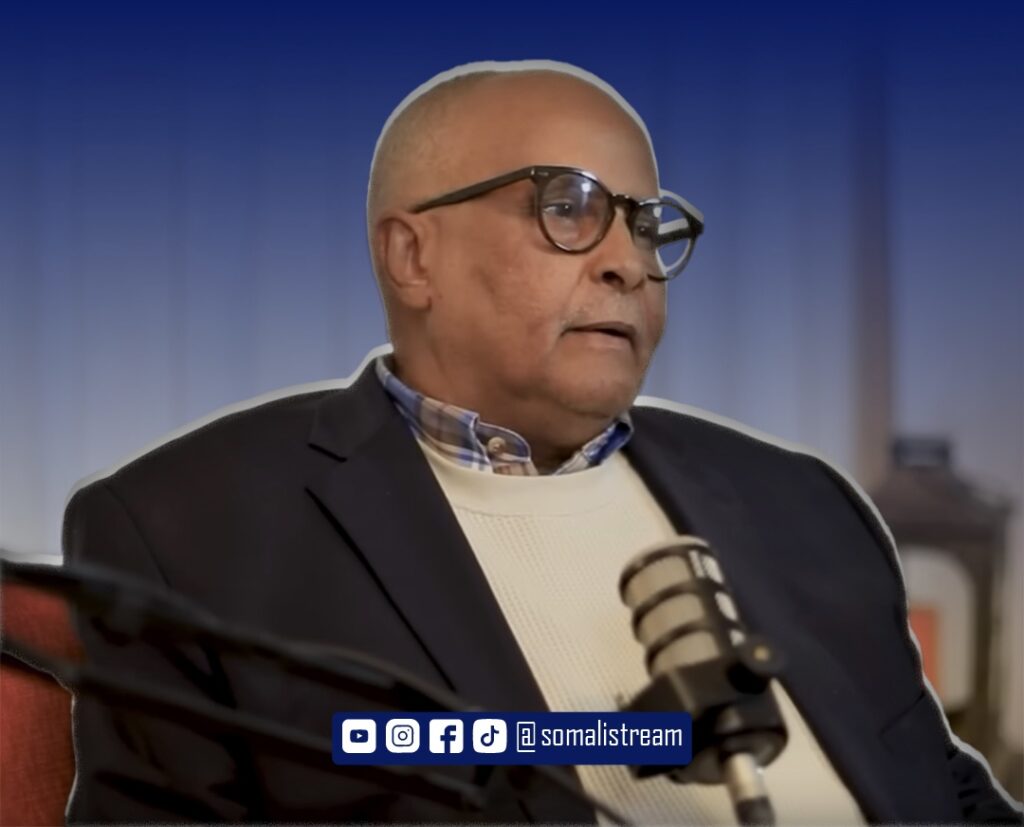
By: Abdirizak Mohamed Iris
Excellence has a habit of finding an ever-ready audience. It has the wherewithal to earn consistency, substance and insurmountable courage to engage with difficult questions.
Those rare qualities have more than propelled GEEDFADHI into becoming one of Somalia’s most influential, if not consequential, podcasts. This platform has brought forth an exceptional blend of thoughtful conversations with the Somali nation’s foremost policymakers, intellectuals and public figures.
The latest guest on Geedfadhi was among Somalia’s most distinguished statesmen, Dr Abdisalam Hadliye, currently a lawmaker at the East African Legislative Assembly, Former Presidential Envoy for East Africa and Former longtime Foreign Minister. Hadliye wears many hats, on top of the previously listed titles, he is also an economist and banker. Over a lifetime spanning public finance, diplomacy and governance, Hadliye has established himself as an accomplished public servant, helping in the reconstruction of Somalia at a much worser time. At the time he returned from the United States of America, where he had moved to at a young age for education. In the US, after his higher education he’d go on, to become, among many things the Chief of Staff at the Executive Office of the Mayor of the District of Columbia in Washington, D.C
Hosts Abdikarim Ali-Kaar and Abdinur Ahmed Mohamed, both former high level government communications (spokespersons for two of the last Somali presidents) and veteran media professionals, steer a weekly wide-ranging discussion that explores history, statecraft, diplomacy and nation-building.
Throughout the interview, Hadliye reflected on Somalia’s long post-independence journey, displayed passionate advocacy for renewing national unity and decried the country’s growing shortage of skilled professionals, recounted a defining episode from the DP World-Berbera Port negotiations. He emphasised the scope of responsibilities expected of a competent national leadership.
A Vision Anchored in National Unity
Reflecting on Somalia’s road to independence, Hadliye revisited the country’s colonial past, noting that southern Somalia had been administered by Italy while the northern regions were under British rule, a widely accepted delineation of colonial domination of Somalis, with whose input was never reflected.
He challenged the much circulated narrative that Somaliland, first existed as a fully independent state, before voluntarily joining the south, arguing such flawed historical record negates all the efforts (which was a precondition to independence) towards a collective journey to full independence on July 1st 1960.
Citing historical documents, he maintained that Somali leaders from northern regions reached a negotiated settlement together at the 1960 Lancaster House Conference in London before proceeding towards independence as a single nation. A key takeaway was his closeness to such history as a family relative of his was one of the signatories.
For Hadliye, history is not just about the linear progression of time, rather a subject of political memory upon which national identity and statehood are built. His argument, seemed to me, coincise and clear. Preserving Somalia’s unity requires a shared proper understanding of its very own past.
Somalia First
Perhaps the interview’s strongest theme was Hadliye’s strong belief that is, Somalia’s future will depend upon, more than anything, placing the national interest above the divisive political division. Bluntly asked whether Somalia could force a day in which it will fully overcome its internal fractures, the former foreign minister acknowledged the magnitude of the challenge but casting in his high inevitable hopes.
While recognising that recent geopolitical developments had indeed complicated the ever-critical situation of the state, he maintained that dialogue, political consensus and patient diplomacy remains the one sure way to a sustainable path forward.
Discussing Israel’s recognition of Somaliland in late 2025, Hadliye argued that the decision further complicated an already delicate political landscape. The former top diplomat took the opportunity to urge Somali leaders, both at home and across the diaspora, to unite in defence of the country’s sovereignty and territorial integrity through diplomacy rather than confrontation, insisting that lasting national cohesion cannot be achieved through any form of force.
His message was one of measured patriotism. He acknowledge Somalia’s collective restoration will not achieved through sheer unilateralism, but in the collective determination of its resilient people to safeguard the country’s unity and sovereignty.
Rebuilding a Nation Begins with Individual Commitment
Moving beyond politics, Hadliye identified what he regards as Somalia’s most pressing long-term challenge, the colossal loss of human capital. He lamented on the devastating consequences of the civil war, arguing that the conflict prompted a brain drain due to the mass exodus of educated Somalis whose expertise would have been indispensable to rebuilding state institutions.
“After the civil war erupted, it is estimated that nearly two million people fled the country. These were majorly the people who could read and write.” According to Hadliye, the departure of skilled professionals weakened institutions across every sector, leaving Somalia to rebuild without sufficient technical expertise it so needed.
Drawing upon his own experience helping restore the Central Bank of Somalia, he recalled being compelled to recruit international specialists because qualified local professionals were simply too few. His broader message extended well beyond economics. Strong institutions, effective governance and sustainable development, he argued, depend ultimately on major investment in education, professional training and capable public service.
Even if national unity were achieved tomorrow, he observed, rebuilding the country’s military, infrastructure and technological capacity would require decades of sustained commitment and international partnership.
Principle Before Politics
The interview also revisited one of the defining episodes of Hadliye’s ministerial career, negotiations surrounding DP World’s proposed investment in the Port of Berbera. The project promised significant economic opportunities for the region. As Somalia’s Foreign Minister, Hadliye found himself representing his country’s national interests during tense discussions with the Dubai-based ports operator.
He recalled travelling to Dubai with optimism, viewing the assignment not just as any other official business but as a deeply personal responsibility. Having spent a great deal of his childhood in Berbera, he regarded its development as inseparable from Somalia’s national future.
According to Hadliye, the negotiations took an unexpected turn when he was allegedly asked by DP World Chief Executive Sultan Ahmed bin Sulayem to sign documentation without first conducting a thorough review of the documents in question. Hadliye said he refused to comply.
For him, the firm decision was a simple principle that guided his public service. No agreement should supersede accountability, transparency or Somalia’s sovereign interests.
Whether discussing diplomacy, economic reform or national reconciliation, the soft-spoken Hadliye consistently returned to one central idea, that public office carries a duty to place country before convenience and principle before political expediency.
The conversation offered more than a retrospective on one man’s long career. It provided an insight into a philosophy of governance rooted in institutional strength, responsible leadership and an enduring belief that Somalia’s greatest assets be it geography or natural resources, the people are what make it to be the place it is.
A Few Rooms to a State University
Over two decades ago, Dr. Abdisalam Hadliye met a seemingly nondescript middle-ages man running a modest college consisting of only a few rooms, within them were a handful of students were being taught limited skills. Dr. Mohamed Sheikh Hamud, as the man turned out to be, envisioned a far greater institution of higher learning than he had at the time. He laid out his plans for what the college could become, and Dr. Hadliye shared in those future plans. He helped secure the funding that would transform those few rooms into a far larger institution, setting in motion a long journey that would eventually see it grow into Puntland State University—today one of the leading universities in the country, with more than two decades of continuous educational progress. This lesser known episode laid bare a lore that set a poignant tone. In the imagination of those who dare to envision them, and then in the generosity of those willing to believe in that vision, thus Puntland State University was born!
This moving tell-it-all episode, brought back into the public eye through the prominence of Geedfadhi, drew considerable attention and eventually led Dr. Hadliye back to Garowe, where Puntland State University and President Dr. Hamud, at the sight of the outpouring newfound information, honoured him with its Lifetime Patron Award. A recognition befitting of the visionary helper that Dr. Hadliye is!
