


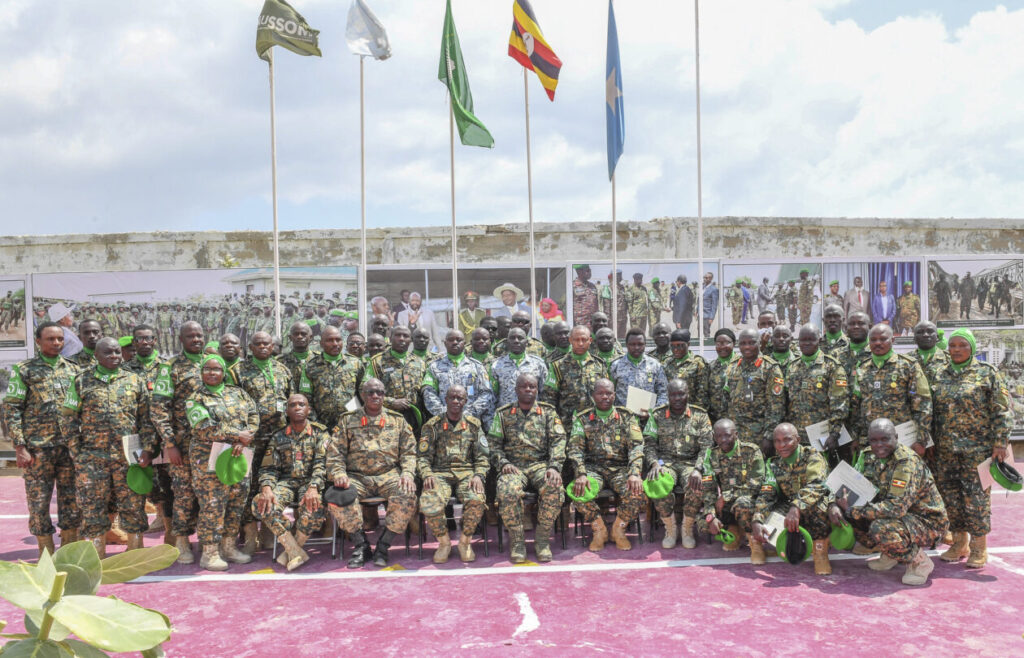
Uganda has commenced the withdrawal of some of its military personnel from Somalia, signalling the start of a major transition in a security partnership that has played a defining role in the country’s fight against Al-Shabaab for almost two decades.
The first reported movement of personnel took place on Friday, 30 October, when an aircraft registered in Kenya and chartered for Uganda transported 109 Ugandan soldiers from Mogadishu’s Aden Adde International Airport.
The flight is understood to be the first in the current phase of Uganda’s troop withdrawal, with additional movements expected in the coming days.
The decision follows a series of discussions between Ugandan President Yoweri Museveni and his Somali counterpart, Hassan Sheikh Mohamud. Museveni had reportedly communicated Kampala’s intention to withdraw part of its military contingent by 15 November.
President Mohamud travelled to Kampala on 26 October in an effort to discuss the matter, but the visit did not result in a change of Uganda’s position.
The development was also announced by Uganda’s Chief of Defence Forces, General Muhoozi Kainerugaba, who said Kampala was beginning to transfer security responsibilities to Somali forces following years of military operations in the country.
In a statement published on X, Kainerugaba said Uganda’s involvement had come at considerable human and material cost, adding that the responsibility for securing Somalia was now being handed back to its own people.
“After 20 years of a lot of blood and sacrifice, we are handing over security to our Somali brothers,” he said.
The withdrawal is expected to involve personnel serving under the African Union Support and Stabilisation Mission in Somalia (AUSSOM), as well as troops operating under a separate bilateral security arrangement between the two governments.
Further evacuations are reportedly anticipated by around 4 November, although the overall timetable and the eventual number of personnel to leave have not been fully established.
Uganda’s military involvement in Somalia is the culmination of a process that began long before the arrival of its first soldiers in 2007.
Kampala had expressed interest in contributing troops to an international intervention in Somalia as far back as 1992. However, uncertainty surrounding the proposed mission’s mandate and operational arrangements prevented the deployment from materialising.
The collapse of earlier international intervention efforts, particularly following the deadly confrontation involving American forces in Mogadishu, further complicated the prospects of a renewed military engagement.
The issue returned to the regional agenda following the Somali peace process and the establishment of the Transitional Federal Government in 2004.
Uganda was as one of the early supporters of an African-led peacekeeping deployment to Somalia. However, disagreements and delays surrounding the international arms embargo and the operational framework for the proposed mission postponed the intervention.
The security situation deteriorated further in 2006 as the Islamic Courts Union expanded its control over Mogadishu and large parts of southern and central Somalia. Following developments on the ground, the United Nations Security Council authorised the African Union operation in December that year.
Uganda subsequently took the lead in translating the proposed intervention into an operational deployment. In March 2007, Uganda’s first UPDF contingent arrived in Mogadishu under the African Union Mission in Somalia (AMISOM), establishing a military presence that would eventually become one of Africa’s longest-running peace support deployments.
A deployment shaped by sustained combat operations
The initial Ugandan contingent entered an exceptionally dangerous operating environment. Its arrival coincided with intense fighting in Mogadishu, where insurgent groups were using small arms, mortars, rocket-propelled grenades and improvised explosive devices against government positions and international forces.
The threats were not limited to direct engagements. Ugandan personnel also faced the dangers of landmines and roadside explosives, particularly along major transport corridors and routes connecting military installations.
The early deployment required a combination of force protection, mobility and offensive capabilities.
Uganda therefore committed several military formations, including infantry, mechanised and armoured elements. These were supported by protected personnel carriers, combat vehicles, transport trucks and tanks.
The deployment of T-55 main battle tanks and other armoured assets provided the contingent with additional firepower and protection during operations in hostile environments. Mechanised formations were particularly important in supporting infantry movements, conducting patrols and responding to attacks, while conventional infantry units provided the personnel required to secure positions and engage insurgent fighters.
This military configuration enabled the Ugandan contingent to operate beyond the traditional responsibilities associated with static peacekeeping.
Over time, its role evolved into direct participation in offensive operations alongside Somali government forces and other African Union contingents.
One of the most consequential developments came in August 2011, when Al-Shabaab lost its control over Mogadishu following sustained military pressure.
The group’s withdrawal from the capital significantly altered the conflict’s dynamics, although it did not eliminate its ability to conduct attacks or operate in other parts of the country.
In 2012, AMISOM expanded its operations beyond Mogadishu, targeting strategically important settlements and regional centres in southern and central Somalia.
The campaign helped extend government influence into areas previously controlled by insurgents, including parts of Lower Shabelle, Bay, Hiraan and Jubaland.
Military operations were accompanied by initiatives intended to weaken Al-Shabaab’s influence among local communities and encourage fighters to abandon the insurgency.
Uganda’s withdrawal and the changing AUSSOM structure
Uganda remains the largest military contributor to the African Union mission in Somalia, making its current withdrawal particularly consequential. The country has approximately 4,500 soldiers listed under AUSSOM’s approved troop contribution, within a mission authorised by the UN Security Council to deploy up to 11,826 uniformed personnel, including police officers. However, this is not the entirety of Uganda’s military presence in Somalia.
A separate contingent operates under a bilateral security agreement between Kampala and Mogadishu, signed towards the end of 2024.
Ugandan military sources have placed the size of this force at approximately 2,000 personnel, although other estimates reported in Kampala have suggested a higher figure. The existence of these two arrangements complicates the interpretation of the current withdrawal.
Troops deployed under AUSSOM operate within an African Union-led and internationally authorised framework, whereas the bilateral contingent is governed by security cooperation between the Ugandan and Somali governments.
Ugandan Defence Minister Kiryowa Kiwanuka indicated in August 2026 that Kampala intended to preserve its bilateral military cooperation with Mogadishu even if the multilateral mission ceased operating.
However, Kainerugaba’s latest announcement of a complete withdrawal raises questions about whether the bilateral arrangement will also be terminated or whether the two governments will negotiate a different security framework.
Uganda’s military presence has already undergone significant reductions in recent years. At its peak under AMISOM, the UPDF contingent numbered close to 6,000 personnel.
A subsequent reduction of approximately 2,000 troops in 2023 formed part of the broader restructuring associated with the transition from AMISOM to the African Union Transition Mission in Somalia (ATMIS).
The transition to AUSSOM introduced another phase in the international security architecture, but persistent financing difficulties have continued to undermine the mission’s long-term sustainability.
International funding concerns compound the transition
The Ugandan decision comes as international partners continue to debate how best to finance and sustain the African Union’s security operations in Somalia.
AUSSOM operates in an environment characterised by competing security priorities, resource limitations and uncertainty over the long-term commitment of external donors.
In September 2026, the United States agreed to give the United Nations an additional year to phase out its support for African peacekeepers in Somalia, providing temporary relief to a mission facing concerns over the possibility of an accelerated reduction in international assistance.
Nevertheless, the financial position of both AUSSOM and the United Nations Support Office in Somalia remains a concern.
The funding constraints affect essential operational requirements, including logistics, troop support, equipment maintenance and the ability to sustain military operations over extended periods.
Uganda has also taken an active role in consultations over the mission’s future. An extraordinary summit held in Kampala from 29 to 31 July brought together countries contributing troops to AUSSOM to examine possible arrangements for sustaining the operation.
The discussions involved Uganda, Somalia, Kenya, Burundi, Djibouti, Ethiopia and Egypt.
The latest withdrawal announcement is therefore unfolding against a wider debate about the future of African Union-led military operations and the extent to which regional governments can continue shouldering the financial and operational burden.
Somali forces face a demanding security handover
For Somalia, the departure of a major troop contributor represents a critical moment in the country’s efforts to assume greater responsibility for its own defence.
Somali security forces have made progress in expanding their operational responsibilities, but Al-Shabaab remains a formidable threat.
The group continues to possess the capability to conduct suicide bombings, complex assaults, targeted killings and attacks against military installations and civilian infrastructure.
Its ability to operate through dispersed networks also means that the loss of territorial control has not translated into the elimination of its insurgent capabilities.
The effectiveness of the handover will consequently depend on the readiness of Somali forces to maintain security in areas previously supported by Ugandan troops.
Particular attention will be required in protecting major urban centres, securing supply routes, maintaining territorial control and preventing insurgents from exploiting any gaps created by the departure of international personnel.
The transition will also require close coordination between the Somali government, remaining AUSSOM contingents and other international security partners.
Any disruption to operational coordination or logistical support could undermine previous gains and create opportunities for Al-Shabaab to intensify its activities.
Uganda’s withdrawal marks a turning point in a military relationship that began with a relatively modest deployment in 2007 and developed into a central component of international efforts to stabilise Somalia.
For Kampala, the decision represents a reassessment of a long-standing overseas military commitment after years of combat operations, casualties and substantial investment in the mission.
For Mogadishu, it is an important test of the country’s ability to take ownership of its security architecture after years of dependence on foreign military support.
The immediate challenge will be ensuring that the withdrawal does not create vulnerabilities that Al-Shabaab can exploit.
While the Ugandan contingent’s departure may signal the conclusion of its role within the current African Union security framework, the future of bilateral military cooperation remains an important outstanding question.
Ultimately, the success of the transition will not be measured simply by the number of foreign troops leaving Somalia, but by the ability of Somali forces to maintain the security gains achieved during nearly two decades of international military engagement.