


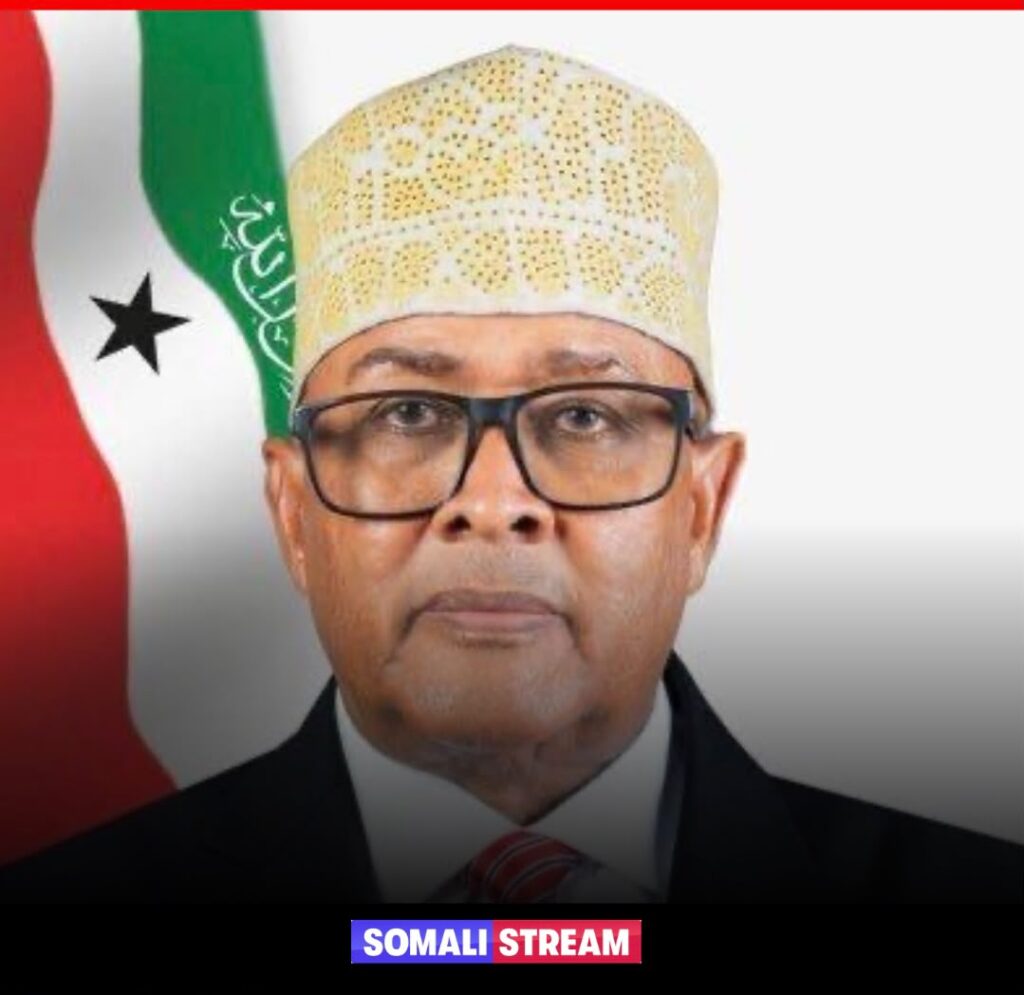
Somaliland President Abdirahman Mohamed Abdullahi ‘Cirro’ is preparing to take his administration’s campaign for international recognition from Washington to New York, as the diplomatic contest over the self-governing territory enters a potentially consequential new phase.
Following his engagements in Washington, Cirro is expected to turn his attention to New York, where he is seeking meetings with delegations attending the United Nations General Assembly.
Somaliland-linked lobbyists and advocacy groups are reportedly working to secure access for the president to the UN headquarters with, with the ultimate objective of positioning him to attend the high-level General Debate of world leaders.
If successful, the initiative would represent a significant escalation in Hargeisa’s international lobbying strategy. Rather than simply seeking bilateral recognition in foreign capitals, Somaliland would be attempting to place its president at the centre of the diplomatic theatre in which the question of its international status is ultimately likely to be contested.
Cirro’s political mandate gives the campaign additional weight. A former opposition leader of the Waddani party, he defeated the incumbent president, Muse Bihi Abdi, in Somaliland’s November 2024 presidential election, securing a peaceful transfer of power.
His administration has since sought to recast Somaliland’s recognition campaign around a combination of democratic credentials, strategic geography and the territory’s growing relevance to Red Sea security.
Somaliland has maintained de facto self-rule since declaring its independence from Somalia in 1991. For more than three decades, however, it remained without formal recognition from any UN member state. That diplomatic barrier was broken in December 2025, when Israel formally recognised Somaliland as an independent and sovereign state, becoming the first country to do so.
Israel’s recognition has also altered the strategic context in which Somaliland is lobbying Washington. On 6 January 2026, Israeli Foreign Minister Gideon Saar travelled to Hargeisa, where he met Cirro and announced plans to deepen bilateral relations in areas including agriculture, health and technology.
The visit was condemned by Somalia’s federal government, which characterised both Israel’s recognition and the ministerial visit as violations of Somalia’s sovereignty and territorial integrity.
Recognition by Israel has given Somaliland an important breakthrough, while simultaneously making the issue more difficult for other governments that must weigh relations with Somalia, the African Union and the wider Arab and Muslim world.
Washington remains the decisive prize
The United States remains the principal target of Somaliland’s diplomatic lobbying effort.
Hargeisa has long hoped that a Republican administration led by President Donald Trump might be more receptive to its case, particularly given Somaliland’s strategic location on the Gulf of Aden, its proximity to the Bab el-Mandeb maritime chokepoint and the growing importance of Berbera as a commercial and potentially strategic port.
Those calculations have intensified since Trump returned to office.
Somaliland supporters in Washington have increasingly sought to frame recognition not as a favour to Hargeisa but as a matter of American national interest , linking Somaliland to maritime security, counter-terrorism, trade, the Red Sea, China’s influence in the Horn of Africa and the future of US strategic access in the region.
Washington’s position therefore presents a paradox for Cirro. The strategic argument for closer US-Somaliland ties has gained visibility, but formal recognition remains a step beyond current American policy.
Somalia views any move towards the international legitimisation of Somaliland as a challenge to its territorial integrity. For Mogadishu, the prospect of Somaliland becoming a recognised state with expanding relations with Israel, the UAE and potentially the United States represents not merely a diplomatic setback but a fundamental alteration of the regional balance.
Somalia’s federal government is meanwhile attempting to prevent Somaliland’s diplomatic campaign from becoming a fait accompli. Mogadishu has consistently rejected Somaliland’s claim to independence and regards the territory as part of the Federal Republic of Somalia. Israel’s recognition has intensified that opposition, prompting Somalia to mobilise diplomatic support from regional and international partners.
It is against this backdrop that Cirro’s planned New York campaign assumes particular significance.
Mogadishu is meanwhile pursuing its own diplomatic efforts to counter Somaliland’s campaign. Somalia’s Foreign Minister is expected to travel to Djibouti on 15 September for a ministerial-level IGAD meeting before travelling to New York on 18 September, a day ahead of the opening of the UN General Assembly.
The current diplomatic contest represents a significant moment for Somaliland. Its strategy is increasingly focused not only on securing recognition, but on building political support in Washington and other influential capitals.
The Somaliland cause was previously presented to the United Nations in 1997 by the administration’s then foreign minister, Mahmoud Fagadhe. In an interview with the BBC Somali Service, Fagadhe said he had returned from the UN empty-handed.
Nearly three decades later, Cirro is seeking to take Somaliland’s case back to the centre of international diplomacy, this time with a considerably more ambitious political and lobbying campaign.
If Somaliland succeeds in placing its president inside the UN complex during the General Assembly’s high-level week, the symbolism would be considerable. Cirro would be able to present Somaliland directly to heads of government and foreign ministers at precisely the moment when international attention is concentrated on global diplomacy. It would also represent a remarkable progression from Somaliland’s earlier attempts to raise its case at the United Nations.