


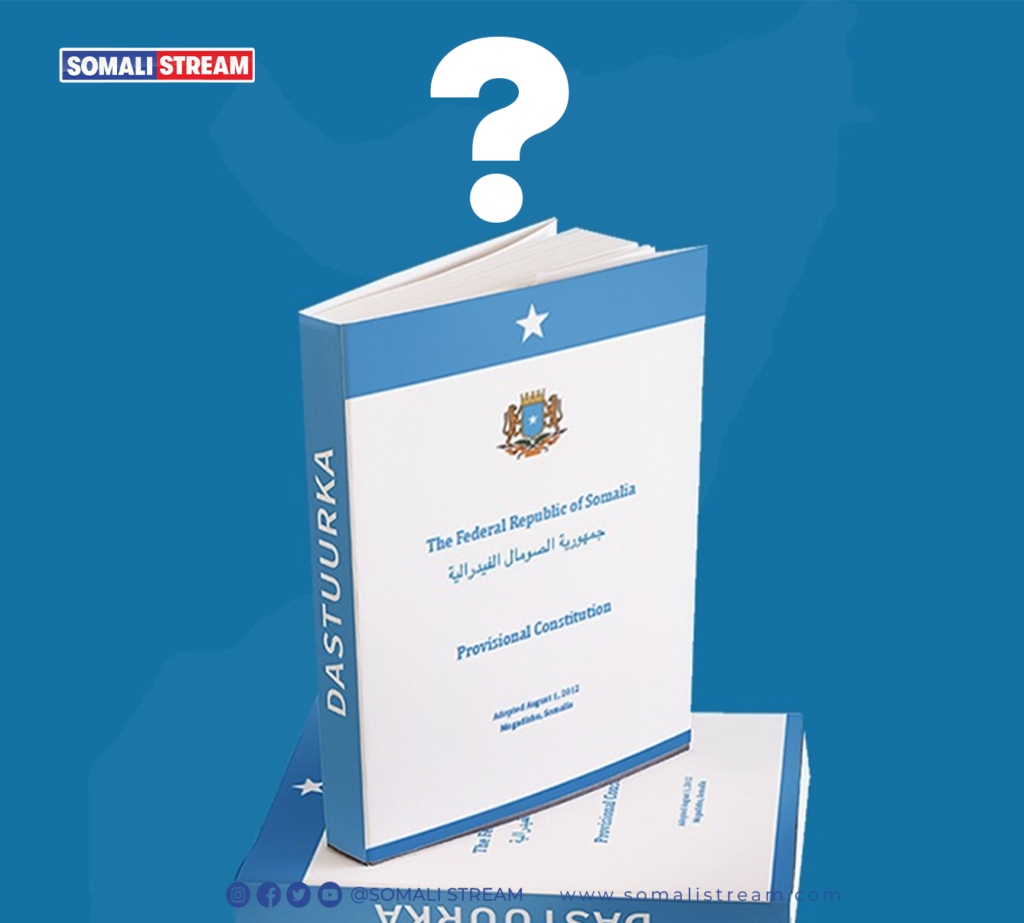
In March, the Somali federal parliament is said to have voted to complete a constitution that had been provisional since 2012. The government proclaims the vote ended a long-delayed process. Its many opponents, among them former presidents, former prime ministers and the governments of Puntland and Jubaland, say it was unconstitutional. The country now has two competing accounts of what its constitution is.
Behind that disagreement lies a more basic question: when those who govern disagree about what the constitution means, who decides? At present, there is none whose authority each side accepts. This remains the institutional problem that worries me and many others the most. Somalia’s future should not entirely depend on who holds power in the moment, whichever interpretation they currently prefer, or not even who can muster the votes.
A Dispute With No Neutral Forum
On 4th March, 222 of 329 lawmakers in a joint sitting approved the amendments, and the president signed them days later. They extend the terms of the president and parliament from four to five years; the speaker said this applies to current officeholders. Elections due this year were pushed to 2027. The text still awaits ratification by a national referendum.
Some of this is touted as settled; much is not. That the vote took place and the terms were extended happens not to be in dispute. What is contested is whether the vote met the two-thirds majority threshold required for amendment, whether opposition groups and members were fairly allowed to take part (some were suspended after making disruptions on the house floor), and whether an extension can lawfully benefit those who voted for it.
Critics also say a change of this weight needs broader consensus. That is a legitimate political demand, but it is not the same as a legal requirement, and the two should not be confused. Equally, winning a vote does not by itself prove that the procedure was followed.
Constitutions must be amendable. But legitimacy depends on more than votes: on procedure, on the distribution of powers, and on a credible way to test both. Without one, each administration may write rules to suit itself while its opponents promise to undo them when power changes hands. What happens when the next government inherits these changes, or when an opposition that rejects them wins? Those questions concern the continuity of the state, not merely the present rivalry.
A Court on Paper
The 2012 Provisional Constitution did anticipate a referee as a means of recourse and redress. Article 109B establishes a five-judge Constitutional Court, and Article 109C gives it exclusive powers, including interpreting the constitution, ruling on the constitutionality of laws, and resolving disputes between the federal government and the member states. Article 86 says legislation may be challenged only before that court.
Yet more than a decade later, reporting indicates it has never been constituted in the first place. One Somali think tank describes a loop in the design: the Judicial Service Commission cannot be complete without the court, and the court cannot be formed without the commission. The 2026 amendments reportedly provide that the Federal Supreme Court will exercise the Constitutional Court’s functions until the court is established, and provide for review of amendment procedures. That is something.
What remains to be seen is whether a court appointed and funded under present arrangements would be trusted by both sides, in a dispute where each side questions the other’s legitimacy, is the real question. Under the 2012 text, the amendment articles themselves did not mention the court, so even a functioning court’s role in a dispute like this one would have been uncertain.
A justice system is more than just a row of judges and buildings. It needs clearly defined jurisdiction, credible appointments, adequate resources and respect for rulings.
Elections and Federalism
Elections show why this matters. An electoral commission administers elections under the law; it cannot be expected to decide whether said law is constitutional. Questions about the legality of amendments, the length of mandates and the rights of political participants need a separate legal forum. Concerns about a commission’s independence should be tested against evidence of how its members were appointed and what protects them from interference; a president’s role in appointments does not by itself prove partisanship.
A constitutional court would not run elections. It would define the legal limits within which those who do must operate. Federalism raises the same problem. The 2012 text gave the court exclusive power over disputes between Mogadishu and the member states, and the 2026 amendments set out detailed lists of federal, shared, state and local powers that will themselves need interpreting.
Without a neutral arbiter, unilateral readings prevail. When South-West State moved to re-elect its president on its own timetable, the federal government declared the process illegal, arguing that the amendments had aligned state and federal electoral cycles. When Jubaland held its own election in 2024, which the federal government refused to recognise, the standoff escalated into armed clashes.
Not every dispute belongs in court of law; negotiation remains essential. But negotiation works best when everyone knows that constitutional questions have a lawful final answer.
What Independence Would Require
Establishing a court is not enough. The 2012 text supplies part of the structure: an independent judiciary (Article 106); nominations by a Judicial Service Commission that must be independent and non-partisan (Articles 109B and 111A); approval by the House of the People before the president appoints (Article 109B); and judges of high integrity, with legal and Shari’a qualifications as well as constitutional competence (Article 109B). Article 71 also gives the Upper House, which represents the member states, a part in appointing the court’s judges, and Article 111 requires consultation with member states on commissioners. But Article 109B mentions only the House of the People, so how the Upper House takes part would need to be settled in law. In principle, that is a merit-based framework.
What it cannot guarantee is trust. The president makes the final appointment, so the integrity of the commission’s nominations matters. And because the court would be formed in the middle of a dispute, a bench seen as one side’s choice would have its first ruling dismissed as partisan. Appointments therefore need a process that the opposition and member states can inspect and help shape, with published criteria and reasons.
Other safeguards must be set out in legislation and honoured in practice: security of tenure, protection from arbitrary removal, a budget the executive cannot withhold, and reasoned judgments made public. The commission and court loop needs resolving. All of it depends on compliance. Judicial independence means little if authorities obey only the rulings that favour them.
The Constitution Must Outlast Its Authors
A constitution that one majority can complete and another can reject has not been settled; it has only been written. Rules that each side may interpret for itself are not rules but positions.
Until Somalia has a court that government and opposition alike would obey when it rules against them, every constitutional change will be a contest of strength, and every transfer of power a threat to the rules themselves. The question is not only who is right today. It is whether the constitution governs those who occupy the presidential palace, or whether they decide what it means.
By Abdirisack Hassan Farah
