


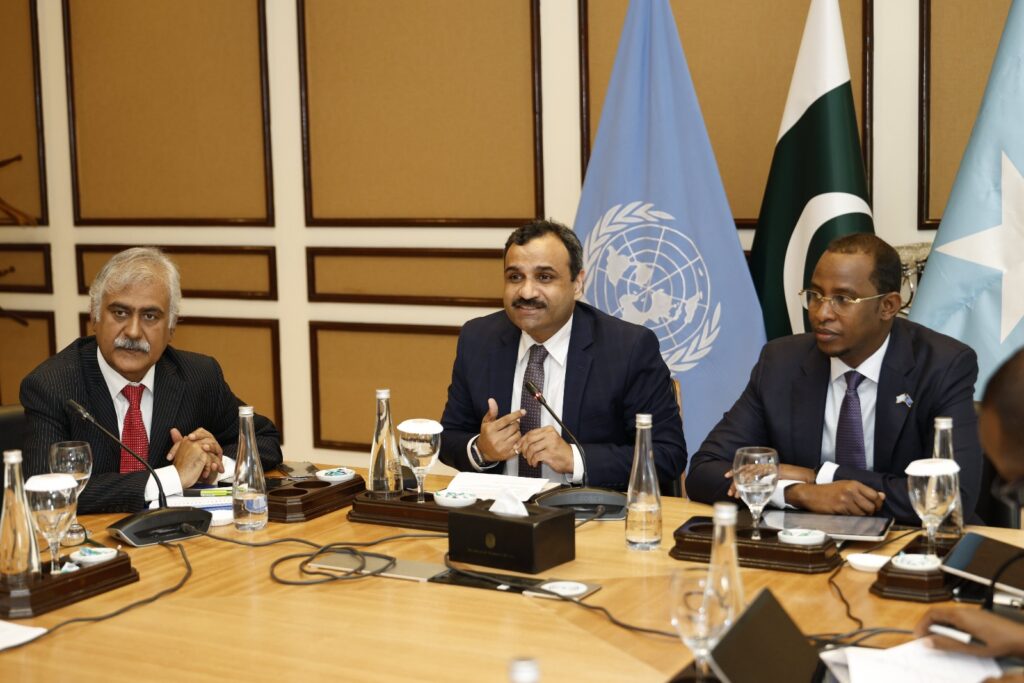
Under the growing theme of South–South Cooperation, the Somalia–Pakistan Peer Learning Programme on Foundational ID and Digital Public Infrastructure has been co-designed by UNDP Somalia, UNDP Pakistan, Somalia’s National Identification and Registration Authority (NIRA), and Pakistan’s National Database and Registration Authority (NADRA).
The ten-day programme brought together a 15-member Somali delegation representing various relevant ministries, agencies and departments for an intensive programme of institutional visits and technical exchanges across the cities of Islamabad and Lahore. During the mission, the delegation engaged with NADRA; the Ministry of Information Technology and Telecommunication (MoITT) and its digital institutions; the National Information Technology Board (NITB); the Federal Board of Revenue (FBR); the Benazir Income Support Programme (BISP); the State Bank of Pakistan (SBP); Karandaaz Pakistan; and the Punjab Information Technology Board (PITB), among other Pakistani counterparts. The engagements covered themes such as foundational identity, digital public infrastructure, interoperability, digital government, social protection, taxation, digital payments, financial inclusion and citizen-centred service delivery.
The programme saw its most symbolic milestone on Wednesday, as Somalia’s national identification system turned three, marking the third anniversary since the launch of the country’s first national ID system in collaboration with NADRA.
The third birthday of the Somali Identification System was marked in Islamabad in a fitting setting: the cake jointly cut by Chairman of the Senate of Pakistan Syed Yousaf Raza Gilani, UNDP Pakistan Resident Representative Dr Samuel Rizk, Director General of NIRA Abdiwali Ali Abdulle, various senior officials of NADRA, and the retinue of the UNDP Somalia team.
The occasion had a lot more than a celebratory marking of three years of identity registration. It became a reflection on how foundational identification can evolve into something much larger: a national infrastructure through which citizens access services, governments build systems, and countries create new forms of digital cooperation.
Speaking at the Somalia–Pakistan Partnership and Technical Cooperation Roundtable, held at the conclusion of the peer-learning mission, Chairman Senate and former Prime Minister of Pakistan Syed Yousaf Raza Gilani placed foundational identity within the broader architecture of the modern state. “I believe that the foundational identity system is much more than a database or a registration document. It is an essential building block of a modern state, facilitating access to public and private services.” For Somalia, that question is becoming increasingly important as NIRA moves from establishing the foundations of a national identification system towards exploring how identity can unlock a wider digital ecosystem.
Gilani also pointed to Pakistan’s own digital transformation, including the Parliament’s transition towards a paperless e-Parliament and the launch of the Senate mobile application. Digital transformation, he said, must be “inclusive, secure, accountable, and rights-based.” He also highlighted the potential for the partnership to extend beyond the two countries, referring to “some of the potential in relation to OIC and the Islamic Development Bank, which is a great opportunity for South-South cooperation.” His message was ultimately one of confidence in solutions emerging from the Global South: “Across the global South, our nations are creating homegrown solutions in digital identity, public infrastructure, e-government, financial inclusion, AI, and citizen-centred public services. We no longer need to look exclusively to the North for answers. The most relevant, innovative, and impactful solutions are already being built right here within the global South.”
From establishing identity to building an ecosystem
For NIRA Director General Abdiwali Ali Abdulle, who led the Somali delegation throughout the mission, the significance of the ten-day exchange was that Somalia was returning home with more than lessons. “We came to Pakistan with clear objectives, to learn from Pakistan’s experience in foundational identity and digital public infrastructure and to understand what could be relevant to Somalia. We are leaving with strong institutional relationships, a clearer sense of direction, and a foundation for a deeper long-term partnership.” Three years after the launch of the national ID, he said, Somalia’s central question has evolved. “The central question is no longer simply how to establish identity. We have one. It is how foundational identity can become a building block of Somalia’s digital public infrastructure.”
That transition, he stressed, cannot be achieved through technology alone.
“Digital transformation is not primarily a technology project. It is institutional transformation. It requires sound leadership, clearly defined mandates, legislation, standards, coordination, investment in human capital, and public trust.” The mission also underscored the growing sense that Pakistan’s unique experience cannot simply be transplanted into Somalia.
“There is no programme that can simply be copied from one country to another. Somalia must build solutions appropriate to the Somali context. Our objective, therefore, is not replication, but adaptation, co-creation and learning from experience, so that Somalia can shorten its own journey.” The bilateral relationship itself has a longer history than the current ID partnership. Recalling the mutual agreement under which Pakistan supported Somalia through NADRA, Abdulle noted: “I understand this relationship has not begun 2018. It began way back since 1962.” And he stressed that the exchange should work in both directions.
“South-South cooperation is not one country teaching another. It is counterparts learning from each other and adapting experience to different realities.” Somalia’s own experience, particularly its rapid adoption of mobile money, offers lessons for Pakistan as well. “This should not be a relationship of knowledge provider and knowledge recipient. It should be a partnership of equals.”
Turning a learning mission into a partnership
For UNDP Pakistan Resident Representative Dr Samuel Rizk, the significance of the mission was precisely that it had moved beyond institutional visits towards a practical framework for continued cooperation. What encouraged him most, he said, was that the mission had moved beyond institutional visits “into something much more concrete, identifying practical areas where Somalia and Pakistan can keep working together.”
The two sides concluded the Roundtable by identifying priority areas and developing an action matrix that sets out practical next steps. The matrix, Rizk said, “names priority areas, focal points, and an action plan for 30, 60, and 90 days, and gives a very practical basis for sustaining this momentum once the delegation departs.” For UNDP, the purpose of South-South cooperation “is not in a cut-and-paste model or transferring some technology, but in adapting lessons to national context and identifying solutions that can be locally owned.”
A partnership that goes beyond a study visit
Representing the Embassy of the Federal Republic of Somalia, Counsellor Jama Hasan described the mission as something considerably broader than a conventional study visit. He expressed Somalia’s appreciation to the Government of Pakistan and the institutions that had opened their doors to the delegation, sharing knowledge, experience and practical lessons. The mission, he said, had demonstrated that functional identity “is not simply about databases or numbers, but about enabling access to financial services, social protection, healthcare, education and public administration while strengthening the relationship between citizens and the state.” The ultimate measure of the mission, he added, would be whether the knowledge gained could be converted into practical action and improved services. “May this programme mark not the end of our engagement, but the beginning of a deeper Somalia–Pakistan partnership in digital transformation and infrastructure.”
From learning to actionable collaboration
Amjad Bhatti, Chief Technical Specialist at UNDP Somalia, described the mission as a deliberately structured learning journey that moved from Pakistan’s federal institutions to provincial systems and services closer to citizens. He expressed appreciation to UNDP Pakistan and NADRA and the other host institutions for their openness in sharing experience. He also recognised NIRA’s leadership for ensuring that the mission did not remain confined to the national ID institution but brought in ministries and agencies to examine sectoral integration and the wider ID and DPI ecosystem. The depth of engagement, he noted, was reflected in the fact that technical discussions frequently extended well beyond their planned time. The learning was also genuinely reciprocal, with Pakistan’s Federal Board of Revenue and State Bank of Pakistan showing interest in Somalia’s experience with the cashless economy and society. “This has truly been a two-sided and reciprocal learning process,” Bhatti said. The immediate task now, he said, is to narrow the broad range of ideas generated during the mission into actionable collaboration in three areas: ID and DPI; digital governance; and financial inclusion and digital public financing, with UNDP continuing to support the partnership through its convening and technical assistance role.
From learning to concrete areas of collaboration
Rahmo Hassan of UNDP Somalia underlined that the Roundtable was intended to take the peer-learning process into its next phase: translating the lessons and relationships developed during the mission into concrete areas of collaboration. “The purpose of the roundtable is to move from the South-South learning programme into concrete areas of collaboration between Somalia and Pakistan.” The mission, she noted, had demonstrated that the two countries face similar challenges in building inclusive, citizen-centred digital systems, while bringing complementary strengths and experiences to the table. The Somali delegation had explored Pakistan’s experience across a wide range of areas, including digitalisation, digital public infrastructure, digital ID, digital services, inclusion, data exchange, interoperability and last-mile delivery. The task now was to determine what could be adapted to Somalia and what the two countries could develop jointly, guided by national ownership, mutual benefit, two-way learning, open standards, interoperability and inclusion.
At the same time, Rahmo cautioned against allowing the breadth of possibilities generated by the mission to become an overly broad agenda. “While the mission has generated many possibilities including digital identity, identity-enabled services, digital payments, financial inclusion, digital government, data governance, cybersecurity and data protection we should avoid creating a broad wish list and instead focus on a limited number of high-impact, actionable areas.”
The three working groups established during the Roundtable therefore focused on foundational digital identity; digital governance, interoperability and data exchange; and financial inclusion and digital public financing, including social protection and taxation. Their task was to map lessons from Pakistan against Somalia’s priorities and institutional capabilities, identify relevant Pakistani expertise and support, and prioritise interventions according to impact, feasibility, timelines and sustainability. The intended outcome was practical: clear counterparts, expected results and 30-, 60- and 90-day next steps.
Three years on: what comes next?
The date of the Roundtable carried particular significance for NADRA as well. 16 September is International ID Day and also marks the third anniversary of the launch of Somalia’s national identification system. Rehan Qamar, Chief Projects Officer at NADRA, recalled the beginning of the journey: “If I recall, three years back we stood together for something to start with, and today we are sitting together to discuss what comes next.” For Qamar, the next chapter should not be defined simply by the production and distribution of identity cards. The larger opportunity lies in turning identity into infrastructure. “The one lesson I would like to share with NIRA is: do not only build the ID system, actually build the DPI.” Pakistan’s two decades of experience with national identity, he said, had demonstrated that the value of an identity card ultimately depends on how it is used.
“We have been in this business for 20 years, and we have realised that the ID card in a drawer cannot help a citizen unless and until that ID card is utilised to unlock potential.” That means creating real use cases for identity and building the institutional and technical infrastructure around it. Qamar also pointed to Pakistan’s experience in creating demand for registration, noting that “in Pakistan, unless and until the ID was made obligatory, there was no uptake of the CNIC.” For Somalia, this is already becoming one of the central challenges.
The gap between capacity and use
The scale of that challenge was laid out by NIRA Operations Director Muhammed Abdullahi Ahmad during the technical working sessions. NIRA has issued 1.5 million IDs, established almost 57 registration centres across 30 federal member states, deployed 18 mobile registration teams to IDPs and rural communities, and established 35 registration centres for the Somali diaspora. Yet the institution is operating far below its registration capacity. “NIRA has the capacity to register 200,000 people per day. As you know, we have printing machines which are able to print almost 20 plus thousand pages per day. But unfortunately, we register only 2,000. So we are missing 18,000 every day.” The reason, he argued, is not simply technical capacity but demand. “That’s why we need to enforce ID. Without the use case, that is meaningless. That’s why people, they don’t want to register themselves.” The contrast with Pakistan is significant. In Pakistan, identity has become closely connected to access to services, financial transactions and other aspects of everyday life. In Somalia, many services can still be accessed without proving identity. “Although some banks, all the 14 banks are integrated with the national ID system, but they are not fully enforce the ID for KYC.” The same challenge extends to interoperability. As Ahmad put it: “There is no national data exchange layer in Somalia.”And technology alone cannot resolve the problem. “There is absence of good governance in terms of interoperability, without the commitment of the leadership, the institutions cannot integrate, cannot work together.”
Building the foundations for DPI
The technical discussions therefore moved beyond the ID card itself to the infrastructure required to make a national digital ecosystem functional. NIRA Technical Lead Abdullatif Ali Tahlil argued that scaling the national ID must remain the starting point, but that this needs to be accompanied by investment in the underlying infrastructure. “The enabler of all of this digital governance and ecosystem, and for that, I mean we need first to scale up the national ID.” He pointed to the need to strengthen the existing network and security operations infrastructure and establish a Tier-3 data centre. “When we have that, that means our system is reliable and it could be trusted, and almost all government services will be able to interact through it.” Rather than attempting to harmonise every institutional and legal question before testing practical applications, the group proposed proof-of-concept initiatives in areas such as e-KYC, single sign-on and verifiable credentials. “To avoid that, what we need is to build a proof of concept.” But the sequence remained clear: “And before we do any of that, we need to scale up the national ID.”
Identity as a gateway to inclusion
The potential application of identity extends well beyond digital government. During the mission, Pakistan’s Benazir Income Support Programme (BISP) demonstrated how verified identity can underpin social protection systems. Muhammad Idrees Mian, Director General Cash Transfer at BISP, highlighted the potential for an ID-based enrolment system to establish a centralised registry of internally displaced persons in Somalia, reducing transaction costs and helping ensure that assistance reaches intended beneficiaries. The BISP experience showed how beneficiary data can be collected and verified in collaboration with NADRA, cross-checked against other registers and ultimately linked to digital payments.
As Idrees explained: “at the end of the day we have unique IDs available with us, and to these unique IDs we transfer money through this digital wallet, and using the banks and partner banking, and we ultimately use the agent network and they get their money.” For Somalia, such possibilities open a much wider conversation about the relationship between foundational identity, social protection, financial inclusion, taxation, humanitarian assistance and digital public services.
From three years of ID to the next generation of partnership
By the end of the Roundtable, the conversation had therefore moved considerably beyond the birthday cake that marked three years of Somalia’s national ID. The mission had started with a question of what Somalia could learn from Pakistan. It ended with a broader question: what can Somalia and Pakistan build together? Three working groups focused on foundational digital identity and digital public infrastructure; digital governance, interoperability and data exchange; and financial inclusion and digital public financing.
The objective was not to create another broad list of aspirations, but to identify a limited number of practical areas where Pakistani expertise and Somali institutional priorities could meet, with clear counterparts, expected results and 30-, 60- and 90-day actions. The three-year anniversary of Somalia’s national ID thus became both a milestone and a starting point. The ID system exists. The next challenge is to make it useful—to turn identity into infrastructure, infrastructure into services, and services into a stronger relationship between citizens, institutions and the state. And, as the NADRA representative put it, the partnership now has a history to build on: “South-South cooperation is spoken about often but delivered rarely. You have given this partnership structure and continuity.” His closing assurance captured the spirit of the mission: “our commitment to you is not a project with an end date. We are always available.”