


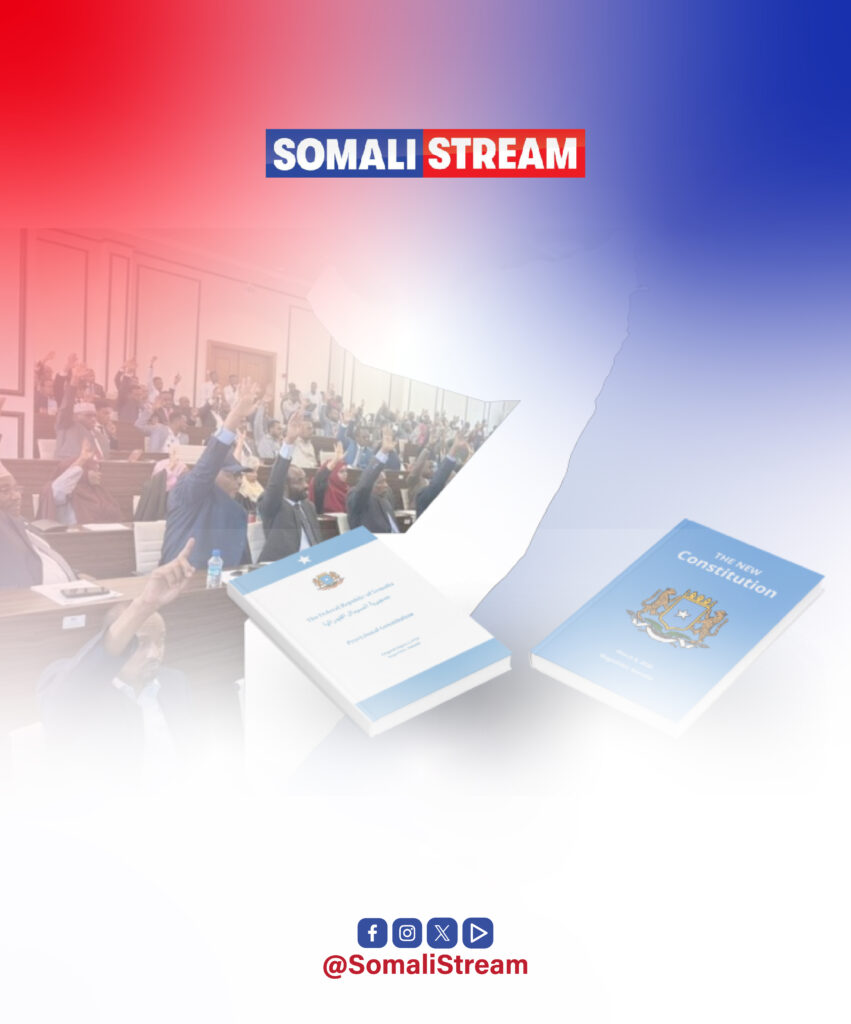
“In questions of power, then, let no more be heard of confidence in man, but bind him down from mischief by the chains of the Constitution.”
— Thomas Jefferson
Thomas Jefferson’s famous observation captures one of the most enduring principles of constitutionalism: constitutions are not designed because leaders can always be trusted, but because political power must always be restrained. A constitution is the highest legal expression of a nation’s collective will, established not merely to organize government but to limit it. It exists to ensure that no individual or institution can exercise public authority beyond the boundaries prescribed by law. In every constitutional democracy, therefore, the Constitution is intended to govern those in power not to be governed by them, This principle is particularly significant in post-conflict societies such as Somalia, where constitutional governance is inseparable from political stability, national reconciliation, and the rule of law. Since the adoption of the 2012 Provisional Constitution, Somalia has sought to rebuild state institutions capable of replacing decades of conflict with constitutional government. Yet the country’s ongoing constitutional reform process raises a fundamental legal question: Does constitutional reform strengthen constitutional governance, or does it weaken the Constitution’s ability to restrain political power?
My argument is that constitutional reform can strengthen governance only when it reflects a genuine national consensus. When constitutional amendments are driven primarily by the preferences of the government of the day, without meaningful public participation, broad political agreement, or federal consensus, they risk weakening constitutional governance rather than strengthening it. Under such circumstances, the Constitution gradually ceases to function as a restraint on power and instead becomes an instrument through which power is consolidated, A constitution is not an ordinary statute that can be reshaped whenever political priorities change. It is fundamentally a social contract between the state and its citizens, defining the distribution of power, protecting individual rights, and establishing the rules through which political disagreements are peacefully resolved. Its legitimacy depends not only on legal enactment but also on broad public acceptance. Constitutional scholars have long argued that enduring constitutions derive their authority from societal consensus rather than temporary political majorities. Where that consensus is absent, constitutional reform risks undermining the very legitimacy it seeks to reinforce.
This concern is particularly relevant in Somalia. Constitutional reform undertaken without the clear consent of the people or without inclusive consultation among federal institutions, member states, civil society, and other stakeholders may create the perception that constitutional rules are being rewritten to serve immediate political interests rather than the long-term interests of the nation. Such perceptions can erode public confidence in constitutional institutions, deepen political polarization, and weaken respect for the rule of law, Perhaps the greatest danger lies in the precedent that such reforms establish. If one administration can substantially alter the constitutional framework without broad national consensus, future governments may feel equally entitled to amend the Constitution whenever it becomes politically inconvenient. The Constitution would then lose one of its most essential characteristics its ability to bind successive governments regardless of who holds office. Instead of serving as a stable legal framework that limits power, it risks becoming a political instrument that changes with every administration.
The consequences extend beyond constitutional design. Once constitutional rules become vulnerable to frequent political revision, the rule of law itself is placed at risk. Judicial independence may be weakened if courts are expected to interpret constitutional provisions whose content shifts according to changing political interests. Institutional checks and balances may become less effective if constitutional arrangements are repeatedly adjusted to favor those exercising executive authority. Most importantly, citizens may lose confidence in the Constitution as the ultimate guarantor of their rights, believing instead that constitutional rules are determined by political power rather than legal principle,For a country emerging from decades of conflict, such instability carries particularly serious consequences. Constitutions in post-conflict societies perform a dual function: they establish legal institutions while simultaneously providing a framework for national reconciliation. Because they are intended to unite deeply divided societies, they require a level of political and societal consensus that extends well beyond parliamentary majorities. Constitutional reform that lacks this consensus risks reopening political divisions instead of resolving them, potentially generating constitutional crises, institutional conflict, and renewed instability.
None of this suggests that constitutional reform is inherently undesirable. Constitutions must evolve to address changing social, political, and institutional realities. However, constitutional amendment should remain an exceptional constitutional process rather than an ordinary political tool. Reform strengthens constitutional governance only when it preserves constitutional supremacy, respects institutional constraints, and reflects the collective will of the nation rather than the preferences of those temporarily exercising political power.
This article therefore argues that the central challenge facing Somalia is not whether constitutional reform should occur, but how it should occur. Constitutional reform that emerges from broad national dialogue, inclusive participation, and genuine political consensus can strengthen democratic governance and reinforce the rule of law. By contrast, reforms undertaken without such consensus risk transforming the Constitution from a safeguard against arbitrary government into an instrument of political convenience. In that scenario, constitutional reform does not strengthen constitutional governance it weakens it by diminishing the Constitution’s capacity to restrain power, preserve institutional stability, and protect the rule of law for future generations.
Mohamed Abdinasir -Law student & Legal Researcher