


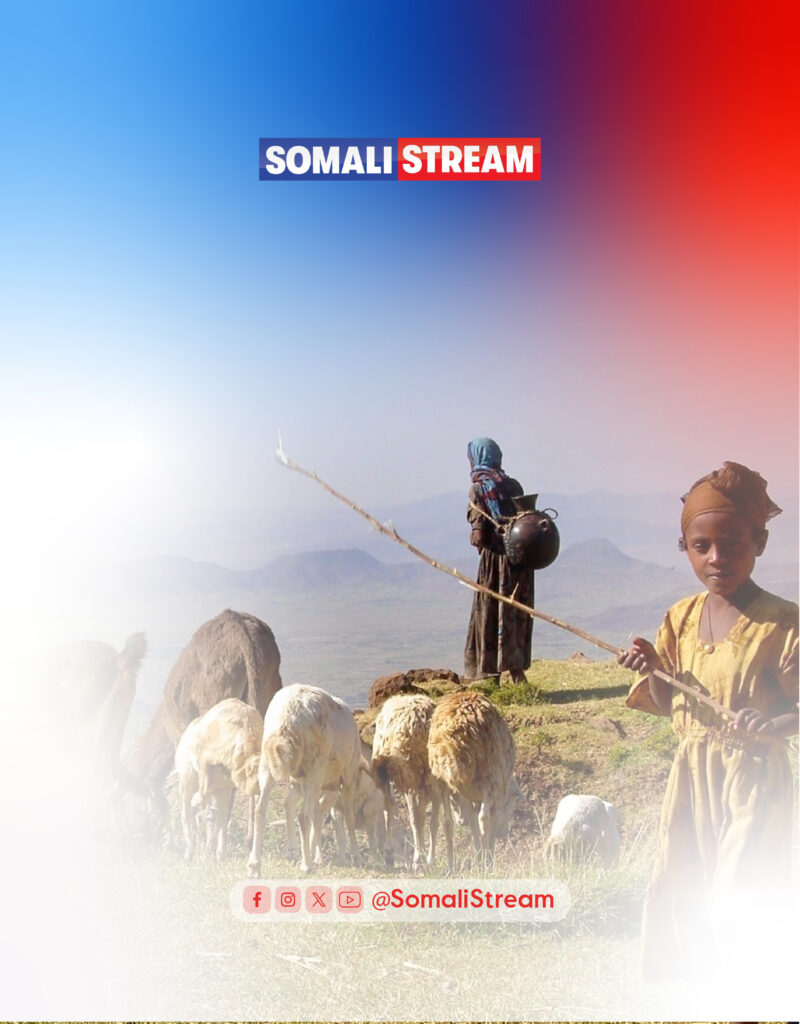
For generations, pastoral communities in Ethiopia’s Somali Region have lived with drought, scarcity and uncertainty. They did not survive because the environment was generous. They survived because they had knowledge, mobility, social networks and livestock-based systems that were carefully adapted to dryland realities. Pastoralism was never a sign of backwardness. It was a sophisticated livelihood system built around reading the seasons, moving with animals, sharing resources, managing risk and recovering after difficult years.
But today, that system is under pressure in ways that traditional coping mechanisms alone can no longer absorb.
The Somali Region is facing a new climate reality. Droughts are becoming more frequent, rainfall is becoming less predictable, water stress is becoming more severe, and pasture recovery is increasingly uncertain. The result is not only livestock loss. It is the weakening of a whole way of life. A recent report on drought and climate-related shocks in the Somali Region noted that many pastoral herds died due to lack of water and pasture, while agricultural production also declined, directly affecting livelihoods and food security.
This is why the conversation must move beyond drought relief.
Relief is necessary when lives are at risk. Food assistance, water trucking, emergency animal feed, health services and humanitarian support remain important during crisis periods. No one should underestimate their value. But relief alone cannot protect pastoral livelihoods if the same households return to the same vulnerability after every drought. Relief saves lives after the shock. Resilience protects livelihoods before the shock destroys them.
The Somali Region does not only need to respond to drought. It needs to rethink pastoral resilience.
The first shift must be intellectual. Pastoralism should not be treated as a problem to be solved, but as a livelihood system to be strengthened. Too often, development planning quietly assumes that pastoralists are waiting to become settled farmers, urban labourers or aid beneficiaries. This assumption is wrong. Pastoralism has fed families, supported trade, supplied livestock markets, maintained cultural identity and sustained communities across harsh environments for generations. Its weakness today is not because pastoralism has failed. It is because the climate, economy and governance systems around it are changing faster than pastoral communities can adapt.
Climate change is making the old rhythm unreliable. Pastoralists traditionally moved according to seasons, pasture conditions, water availability and negotiated access to grazing areas. But when rains fail repeatedly, when dry seasons become longer, when water points collapse, and when pasture does not regenerate, mobility becomes less of a strategy and more of a desperate search for survival. In such conditions, even the strongest pastoral knowledge becomes overstretched.
A 2026 Mongabay feature on Ethiopia’s Somali Region captured this painful transformation by showing how worsening drought is eroding traditional systems of sharing that once helped communities survive. It reported that indigenous systems such as Gergar and communal grazing are weakening as households struggle to sustain their own herds. This is one of the most serious warning signs. When drought kills livestock, it damages the economy. When drought weakens sharing, it damages the social fabric.
Pastoral resilience has always depended on more than animals. It depends on trust, reciprocity, clan-based support, negotiated access, shared grazing, informal loans, milk sharing, animal redistribution and community solidarity. When everyone is affected at the same time, these systems become harder to maintain. A household that has lost its own animals cannot easily help another. A community with exhausted pasture cannot host others. A family struggling for water cannot share what it no longer has.
This is where climate change becomes more than an environmental issue. It becomes a social issue. It becomes a governance issue. It becomes a peace and security issue. It becomes a question of dignity.
In the Somali Region, livestock is not only an economic asset. It is food, income, savings, insurance, identity and social status. When animals die, the loss is not counted only in numbers. A family loses milk for children. It loses cash for school fees. It loses animals that could be sold during emergencies. It loses breeding stock for recovery. It loses the ability to trade, move and negotiate from a position of dignity. The death of livestock is therefore the collapse of a household’s financial system.
This is why drought relief that arrives only after livestock have died is always too late.
A serious pastoral resilience agenda must start before the crisis. It must protect the asset base of pastoral households, not only feed them after they lose it. This means investing in early warning systems that are trusted, localised and linked to early action. Forecasts must not remain in technical offices, workshop presentations or websites. They must reach pastoralists, women, youth, local leaders, traders and veterinary workers in the languages, formats and channels they use. Climate information should help communities decide when to move, when to destock, where pasture is available, where disease risks are rising, and when water stress is likely to worsen.
But information alone is not enough. Early warning without early action becomes polite documentation of suffering. If a forecast shows likely drought, there must be financing, coordination and local action before the drought becomes a disaster. This could include commercial destocking, animal feed support, water point rehabilitation, veterinary campaigns, cash transfers, livestock insurance payouts and support to vulnerable households before their coping options are exhausted.
The second shift must be in water governance. In the Somali Region, water is development. Water is health. Water is livestock survival. Water is education. Water is peace. Water is dignity. A borehole that works during the dry season can protect thousands of animals and reduce conflict. A water point that fails at the wrong time can trigger displacement, livestock deaths and tension between communities. Water trucking may be necessary during emergencies, but it cannot be the foundation of long-term resilience.
The region needs stronger investment in sustainable water systems: borehole maintenance, groundwater monitoring, solar-powered water infrastructure, water harvesting, small-scale irrigation where feasible, community water governance and transparent management of strategic water points. The goal should not only be more water infrastructure, but reliable water infrastructure. Communities do not need projects that look good during inauguration and fail during drought. They need systems that function when pressure is highest.
The third shift is rangeland governance. Pastoralism depends on mobility, and mobility depends on access. When grazing lands are degraded, blocked, privatised, converted or poorly managed, pastoralists lose one of their most important adaptation tools. Climate change is reducing pasture availability, but human decisions can make the situation worse. Unplanned settlement, weak land-use planning, conflict over resources, invasive species and poorly coordinated development can all reduce the flexibility that pastoral systems need.
Rangelands should be treated as productive landscapes, not empty land waiting for other uses. They are the foundation of livestock production, biodiversity, carbon storage, mobility and cultural life. Restoring degraded rangelands, protecting dry-season grazing reserves, managing invasive species, supporting community grazing agreements and integrating traditional institutions into land-use planning are not optional activities. They are central to climate adaptation.
The fourth shift is to strengthen livestock markets and animal health systems. Pastoralists do not only need support when animals are dying. They need fair markets when animals are alive. They need veterinary services before disease spreads. They need access to feed, quarantine facilities, market information, transport infrastructure and cross-border trade systems. A pastoralist who can sell animals at a fair price before drought reaches its peak is more resilient than one who waits until animals are weak and prices collapse.
Livestock insurance also deserves serious attention. A World Bank feature on Ethiopia’s Somali Region highlighted progress linked to roads, water access, livestock insurance and real-time information systems, showing that resilience can be connected to practical investments rather than only emergency response. These are the kinds of approaches that should be expanded, localised and made accessible to ordinary pastoral households, not only piloted as small projects.
The fifth shift is to recognise the link between drought, displacement and urban pressure. When pastoral livelihoods weaken, people move. Some move temporarily in search of pasture and water. Others move permanently after losing their herds. Towns such as Jigjiga, Gode, Kebri Dahar, Dollo and other urban centres then absorb the consequences of rural vulnerability. Displacement increases pressure on housing, jobs, water, sanitation, schools and health services.
In May 2026, Jigjiga hosted a regional IGAD peer learning visit for cities and municipal authorities dealing with displacement-affected communities and durable solutions. This is important because it shows that the Somali Region is no longer dealing with drought only as a rural emergency. The effects are moving into towns. If rural resilience is neglected, urban centres will carry the cost.
This means pastoral resilience is also urban policy. Protecting rural livelihoods reduces distress migration. Supporting water, pasture, livestock and markets in rural areas helps reduce pressure on towns. A strong rural economy creates more stable urban growth. The future of Jigjiga is connected to the future of the pastoral routes, dryland villages and borderland communities around it.
The sixth shift is to put women and youth at the centre of pastoral resilience. Drought does not affect everyone equally. Women often carry the burden of household food insecurity, water collection, caring for children, managing small stock and maintaining family survival during crisis. Young people face shrinking livelihood options and may feel forced to migrate, take informal work or abandon pastoralism without a clear alternative. A resilience agenda that ignores women and youth is incomplete.
Women should be supported through access to finance, livestock value chains, milk markets, water committees, climate information, savings groups and local decision-making. Youth should be supported through skills linked to dryland economies: animal health, fodder production, digital climate services, renewable energy maintenance, livestock trade, transport, water technology and small enterprises that complement pastoralism rather than replace it.
The seventh shift is policy humility. Pastoral communities are not empty recipients of outside knowledge. They have their own knowledge systems, institutions and history of adaptation. Climate science is important, but it should not silence local knowledge. The best resilience systems combine scientific forecasts with indigenous observation, community experience and local decision-making. Pastoralists know their environment. The challenge is not to replace their knowledge, but to strengthen it with better information, services and investment.
This is where government, development partners, researchers and community leaders must work differently. Projects should not be designed only from offices and validated in workshops. They should be shaped with communities that understand the realities of pasture, mobility, livestock disease, water stress and local conflict. Pastoralists should not appear only in reports as vulnerable beneficiaries. They should sit at the centre of planning as knowledge holders and economic actors.
The Somali Region has made progress. This must be acknowledged. Stability has improved. Infrastructure is expanding. Development partners are more engaged. There is growing attention to resilience, water, displacement, livestock systems and climate adaptation. These gains matter. They create a foundation on which a stronger pastoral resilience agenda can be built.
But the region must avoid a dangerous comfort: mistaking response for resilience.
Every drought should not restart the same cycle of emergency appeals, water trucking, livestock deaths and recovery meetings. Every failed rainy season should not find communities equally exposed. Every crisis should teach the system to act earlier, invest smarter and protect livelihoods before they collapse.
The future of pastoralism in the Somali Region will not be secured by nostalgia. It will not be secured by romanticizing the past or pretending that traditional systems can handle today’s climate pressures alone. It will also not be secured by pushing pastoralists out of their livelihoods in the name of modernization. The real solution lies in climate-smart pastoral development: protecting mobility, strengthening water systems, restoring rangelands, improving markets, expanding animal health services, linking early warning to early action, supporting women and youth, and treating pastoralism as a modern economic system adapted to dryland realities.
The Somali Region stands at a critical moment. Climate change is no longer a future threat. It is already changing the meaning of seasons, the value of livestock, the routes of migration, the strength of social support and the future of young people. The question is whether policy will change as fast as the climate is changing.
Drought relief will remain necessary. But it must no longer be the centre of thinking. Relief should be the last line of defence, not the main development strategy.
Pastoralists do not need sympathy alone. They need systems that protect their livelihoods before they are destroyed. They need water that works, markets that pay fairly, forecasts they can use, roads that connect them, veterinary services that reach them, rangelands that regenerate, and policies that respect mobility as an adaptation strategy.
Beyond drought relief lies the real work: building a Somali Region where pastoral communities are not repeatedly rescued from crisis, but supported to live with dignity, adapt with confidence and contribute fully to the region’s future.
Hussien Mohamed Yusuf is a Climate Change and Environmental Sustainability Practitioner based in Nairobi, Kenya.