


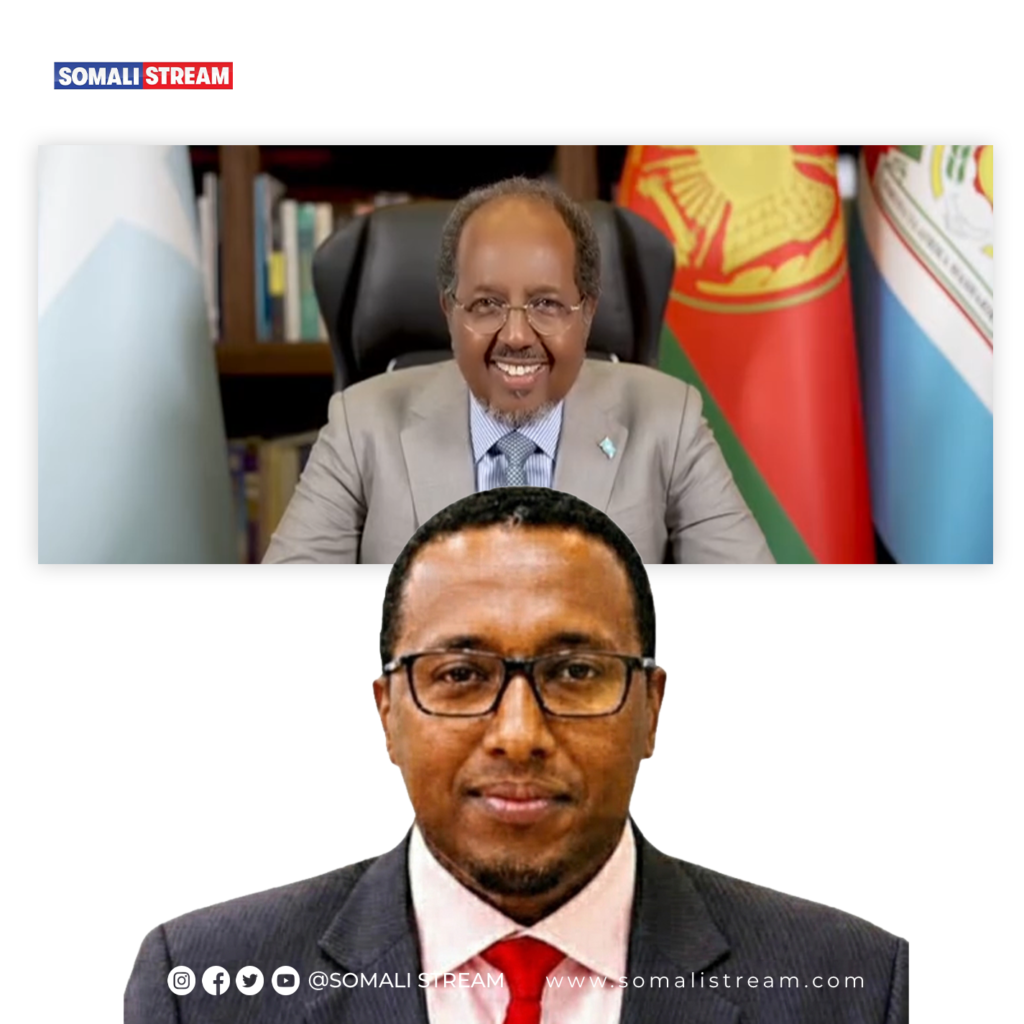
Why an invitation to dialogue means little when the matters in dispute have already been declared a success
Some years ago I came across a word in an article, which also gave its definition. I never thought I would want to revisit it.
Tergiversation: being pointedly evasive and making conflicting statements; in politics, a sudden U-turn from a previously stated position or principle.
On 25 October, President Hassan Sheikh Mohamud spoke to the nation in a televised speech. Just ten days earlier, he had told his party’s members of parliament that “there will be no such consultation” on the disputed national questions. Now he said the door to dialogue is open “at all times and under any circumstances” and invited the opposition to talks. A meeting is planned for 4 November, reportedly with international backing. Whatever changed his mind, a return to dialogue is welcome. But to understand the invitation, we need to listen to the whole speech, not just one line.
Two Speeches in One
The speech began by explaining what he had meant before. When he said “no decision will be put in the middle” (talo dhexda la dhigaa ma jirto), he was not rejecting consultation, he said; he meant that governing and consulting are two separate things. He then described the state elections as a success: more than 1.8 million registered voters, 1,435 officials chosen, and, in his words, not a single polling station with violence. He promised to carry on with one person, one vote. Then, in the same minute, he invited those who disagree to talk. Hear it once and it sounds open. Hear it twice and you notice something: everything the opposition wants to discuss has already been declared settled. The disagreement was never about small details. It is about the constitutional changes, the voting model and the independence of the electoral commission, and with them the extension of his term. The speech calls these very things a success and promises more of them. If they were a success, why would we need talks at all?
Many Reasons, One Answer
The psychologist Lucian Gideon Conway and his colleagues studied this in a 2008 paper called “Two Ways to Be Complex and Why They Matter”. Their point is simple: there are two ways to sound open-minded. The first is to really listen, to say “the other side may be right about this, so let us find a middle way.” The second is to give many reasons, all of which support what you already believed. Both sound thoughtful, but only the first is truly open. They also found that the more strongly someone holds a view, the more likely he is to talk the second way. The President’s speech sounds like the first kind. He said differences of opinion “are not a bad thing” and that he is ready to compromise. But every reason he gave, the voter numbers, the peaceful polling stations and the promise to continue, pointed to one conclusion: the plan stays as it is. The speech talks about listening, but does not show it. That is why it leaves people confused.
Decided Before the Talks
The political scientist Alex Mintz explains another part of the puzzle in his 2004 article “How Do Leaders Make Decisions? A Poliheuristic Perspective”. The long word hides a simple idea. When leaders face a hard choice, they usually decide in two steps. First, they throw out any option that could cost them politically. Only then do they look at what is left and pick the best of it. Think of a family choosing a house: before looking at any rooms, they cross off every house they cannot afford. The President’s speech did the first step in public. Reopening the constitutional changes, pausing the voting model and reconsidering the term extension were all crossed off before the meeting was even arranged. What is left is a conversation about how to carry on, not whether to. That is consultation, and the President chose the word carefully. But the federal member states and the opposition are not asking to be consulted on a road already chosen. They are asking to choose the road together.
Too Much Invested to Turn Back
Why hold on so firmly to a disputed process? Hal Arkes and Catherine Blumer gave part of the answer in their 1985 paper “The Psychology of Sunk Cost”. They found that once people have put a lot of money or effort into something, they find it very hard to stop, even when it is not working, because stopping would mean admitting the effort was wasted. It is like someone who keeps repairing an old car simply because he has already spent so much on it. Barry Staw added to this in “The Escalation of Commitment to a Course of Action” (1981). He showed that leaders under strong pressure tend to dig in deeper rather than change direction. The state elections show how much is at stake in admitting doubt. In Hirshabelle and Galmudug, people voted for state assemblies, not presidents. Galmudug’s first vote was cancelled by the Supreme Court, the party that won that court case was left out of the rerun, and the ruling party’s candidate then became president with 72 assembly votes. When voters elect an assembly and the assembly then chooses the president, that is a selection, not one person, one vote. A few opposition figures sending their congratulations afterwards does not change that. As one Somali outlet put it, the government should not treat the approval of individual politicians as a substitute for broad political agreement.
Dialogue at Full Speed
Put together, the speech is like a driver racing at full speed who refuses to stop, yet offers a lift to anyone willing to jump in. Passengers are welcome, but where the car is going is not up for discussion. Real dialogue means slowing down long enough to agree on the destination together. For the 4 November meeting, that means putting the constitutional changes, the voting model, the electoral commission and the timetable on the table as open questions, not as achievements waiting to be approved. Words that change every ten days cannot carry a country through a crisis. Rules that everyone agrees on can.
Awale Kullane is a Somali diplomat and political analyst who writes on institutions and political leadership in the Horn of Africa. Find him at www.linkedin.com/in/awale-kullane-2632a5388
