


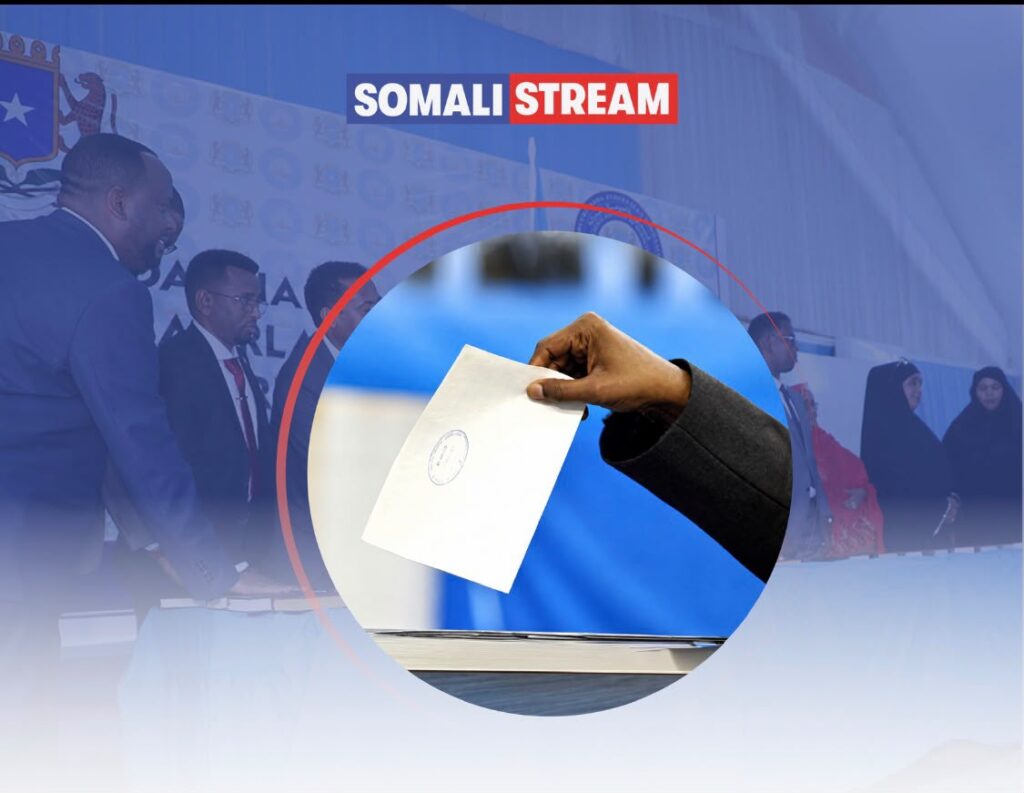
Somalia’s electoral commission has scheduled parliamentary elections for 15 April 2027 and a presidential vote for 15 May, drawing an immediate rebuke from opposition leaders who say the government is imposing an electoral process without the political agreement needed to prevent a fresh crisis.
The National Independent Electoral and Boundaries Commission (NIEBC) announced the dates on Thursday, setting out a timetable for elections to both houses of the federal parliament and the presidency.
Commission chairman Abdikarim Ahmed Hassan, elected to lead the body in December 2024, announced the schedule at a news conference in Mogadishu.
Former president Mohamed Abdullahi Farmaajo swiftly rejected the announcement, describing it as a unilateral decision by an electoral commission established by President Hassan Sheikh Mohamud.
In a statement issued on Thursday, Farmaajo warned that proceeding without an agreement among the country’s political stakeholders could lead to parallel elections and renewed civil conflict. He called for negotiations to resume and for an inclusive electoral process agreed upon by the federal government, federal member states and opposition groups.
Farmaajo also urged international partners to intensify their mediation efforts, saying Somalia’s political future could not be determined through unilateral decisions.
The commission’s announcement provides dates but leaves unresolved the central question dividing Somalia’s political leadership: what electoral model will govern the next vote, and who has agreed to its terms?
Candidate selections deepen questions over political competition
The timetable comes amid criticism of recent regional elections in South West State, Galmudug and Hirshabelle, where Mohamud’s Justice and Solidarity Party (JSP) secured substantial victories.
The party’s candidate selections have added to concerns among opposition figures about the competitiveness of the regional contests.
Mohamud’s JSP announced Liban Ahmed Hassan, widely known as Liban Shuqul, as its candidate for the Galmudug presidency. The selection came amid reports that
incumbent President Ahmed Abdi Karie, commonly known as Qoor Qoor, had been pressured to vacate office.
JSP also announced its backing for the incumbent president of Hirshabelle State, Ali Abdullahi Hussein, widely known as Ali Guudlaawe.
The selections have fuelled criticism from opponents who argue that party-backed candidates have enjoyed advantages that weaken the competitiveness of regional elections. Some have described the contests as examples of negotiated political outcomes in which the likely winners were identified before voting began.
Nevertheless, the party’s strong performance across the three regional administrations is likely to intensify scrutiny of the electoral commission as it prepares for the national polls.
In Galmudug, the Supreme Court annulled the results of an earlier election and ordered a fresh vote following legal challenges over alleged irregularities. The rerun subsequently returned a large majority for JSP, renewing debate over the credibility of the process.
The judicial intervention highlighted shortcomings in the original election, although the annulment and the subsequent rerun must be distinguished when assessing the legal status of the results.
Constitutional arguments under scrutiny
The electoral dispute has also exposed tensions over the government’s interpretation and application of the constitution.
Mohamud’s administration has repeatedly invoked constitutional provisions to defend its political and electoral decisions.
Critics, however, say the government’s position is inconsistent with its own approach to constitutional restrictions, pointing to cabinet members who continue to hold seats in the federal parliament while serving as ministers.
The constitution’s provisions on the separation of executive and legislative responsibilities have become a point of contention.
The issue nevertheless adds to the opposition’s broader argument that constitutional rules should be applied consistently across the political system, rather than invoked selectively in disputes over electoral authority.
The administration’s position on the next election remains contested, with opposition leaders challenging the constitutional amendments adopted in March 2026 and rejecting the government’s interpretation of its mandate.
The commission, meanwhile, cited Article 56 of the federal constitution and provisions of the National Elections Law as the legal basis for setting the parliamentary and presidential election dates.
Neither the announcement nor the opposition’s response resolves the underlying disagreement over the electoral framework.
International mediation faces a new test
For years, Somalia’s international partners have sought to broker agreement between the federal government and opposition leaders over the country’s electoral model and timetable.
Those efforts have focused on bridging differences over direct voting, the role of federal member states, the independence of electoral institutions and the arrangements needed to secure a broadly accepted transfer of power.
The newly announced schedule does not explain how those unresolved issues will be addressed.
The commission has published dates for registration, candidate nominations, voter lists and campaigning, but has not specified in its announcement the precise electoral model under which the parliamentary and presidential contests will be conducted or demonstrated that the principal political stakeholders have agreed on the arrangements.
That omission is significant. An election calendar establishes when events are intended to occur; it does not, by itself, determine how candidates will be selected, how votes will translate into representation or how disputes between the federal government and regional administrations will be settled.
The absence of a clearly articulated and broadly agreed electoral framework risks turning the timetable into another source of political confrontation rather than a mechanism for resolving the dispute.
The opposition has called for negotiations to resume, with international partners continuing their mediation efforts.
Under the commission’s schedule, registration for political organisations and voters will reopen from 1 to 22 November 2026. Candidate lists for both houses of parliament must be submitted by 22 November, while the provisional voter register is due to be published on 21 January 2027.
Campaigning for parliamentary elections is scheduled to begin on 27 February, followed by publication of the final voter register on 15 March.
Parliamentary elections are set for 15 April, with the presidential vote scheduled for 15 May.
The timetable leaves a limited period for resolving political disagreements while electoral preparations advance. It also raises practical questions about voter registration, security, campaign access and the administration of polling in a country still confronting the al-Shabaab insurgency.
The commission’s announcement did not provide a detailed account of how security arrangements would be coordinated across the country or how political disputes over the electoral framework would be resolved before the deadlines arrive.
Dates announced, consensus still elusive
The federal government faces the task of translating the commission’s schedule into an electoral process that can operate across Somalia and command confidence beyond its political supporters.
The opposition, for its part, is demanding negotiations and a framework agreed upon by the principal political stakeholders. International partners face renewed pressure to help bridge the divide before the dispute escalates further.
The experience of the regional elections, the controversy over candidate selections and the unresolved constitutional arguments have made the credibility of the national process a central issue.
The commission has set the dates. It has yet to demonstrate, through the announcement alone, that the political agreement needed to underpin those dates exists.
Somalia now has a timetable for its next presidential election, but the electoral model remains the missing piece. Without agreement on the rules of the contest, the calendar risks becoming a deadline for confrontation rather than a roadmap to a credible vote.
The federal government on its part, welcomed the announcement, describing it as an important step towards implementing the electoral process. In a statement issued by the Office of the Prime Minister on behalf of the federal government, the administration welcomed the commission’s schedule as a step towards fulfilling citizens’ constitutional right to vote and strengthening national unity.
The government said it had spent the past 18 months offering opportunities for consultation and negotiations among Somali political stakeholders, particularly on electoral arrangements and other matters of national importance.
It said those discussions would continue, with the aim of securing a broader political understanding.
“Welcoming the election timetable and continuing negotiations are two complementary efforts,” the government said, according to its statement.
It urged all political stakeholders to participate in consultations in good faith and with a sense of national responsibility, and to work towards peaceful elections that would strengthen public confidence and the future of the Somali state.
The statement presents the government’s position that announcing election dates need not preclude further negotiations. It did not, however, specify what changes to the proposed arrangements might be considered or whether the timetable would be subject to agreement with the opposition.