


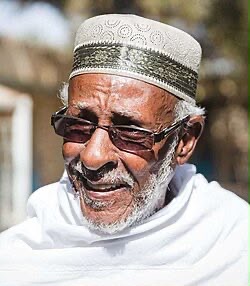
Somalia has no shortage of people willing to explain its collapse. Warlords blame foreign intervention. Politicians blame tribalism. Commentators blame history, colonial borders, bad luck, anyone but themselves. Somalia has almost never had someone willing to stand up and say, plainly, “I did this too.” Mohamed Ibrahim Warsame, known to the world as Hadraawi, did exactly that.
Hadraawi’s standing in Somali letters was never in question. Educated in both Arabic and English, he wrote with one foot in classical Islamic rhetorical tradition and the other in the structural range of Western literary form, a combination that let him speak to Somalis and to the world at once. In Beledweyn, he turned a town into a meditation on exile, showing how missing a homeland and losing a sense of self are the same ache. In Hooyo, he elevated the mother figure into something like a moral compass, the origin point of both nourishment and conscience. These poems shaped how Somalis understood themselves for a generation.
Then, in 1995, came Daba Huwan, an epic of roughly 800 lines that stands as Somalia’s answer to the Odyssey or the Aeneid, a civilizational reckoning with catastrophe written on the same scale as the collapse it surveys. Its deeper achievement, though, is the moral turn at its center, where Hadraawi does something almost no public figure in Somali life has managed before or since. He puts himself on trial.
The self-indictment builds like a legal case, one the poet brings against his own profession. He places the poets, himself first among them, in the dock beside the warlords and politicians usually blamed for the war. Those who supplied the language of revolt, he argues, cannot claim innocence just because they never touched a weapon. Words aimed at a crowd can do a violence no less real for being unarmed.
The charge sharpens from there. The poets did not only speak; they spoke recklessly, stoking appetite for rupture without ever designing what should replace what they tore down. Hadraawi describes this as a kind of professional malpractice, the engineer who sets the charge without drafting the blueprint for what should rise from the rubble. He extends the charge further still, from professional failure to spiritual failure:
Ilaah ka durkaynu nahay, Islaam dilan baynu nahay
Dugaag u dhacaynu nahay, Ka daatay muskaynu nahay
We departed from God; our Islam has taken a beating
We are menacing beasts who have scaled the pen fences
Here the poets are recast as beasts that broke through the fences meant to restrain them, having abandoned the very faith that might have steadied their hand. Hadraawi does not describe “the poets” from a critic’s remove. He implicates his own hand in the wreckage directly, refusing the shelter of the collective pronoun even while extending the charge to his peers:
Markay dani meeday tidhi, Maxaan talo meel ka deyey
Markay dani maaha tidhi, Weydiiyey qof meel ka deyey
Markay dani maaha tidhi, Ku laabtay halkaan ka deyey
Markay dani maaha tidhi, Ka sii deyey meel la deyey
When necessity demanded, many times I searched for the solution.
When reality said this is not it, many times I asked one who had sought it.
When reality said this is not it, many times I returned to where I first looked.
When reality said this is not it, once more I searched the very first place.
The repetition carries its own argument. Each stanza circles back to the same failed search, and the form enacts the futility it describes.
Set this against how Somalia’s political class has handled the same history. Three decades on, most leaders and commentators still reach for justification before admission, attributing collapse to tribalism, foreign intervention, or historical misfortune. Hadraawi’s willingness to say “I too am responsible” stands as a quiet rebuke to everyone who has since preferred to explain the collapse rather than own a piece of it.
The epic closes not in political argument but in prayer. Hadraawi sets down critique and turns to address the Creator, asking for the nation’s future and for his own transgressions to be forgiven:
Rabbow debecaaga saar,
Rabbow dambe noo ogow,
Wixii tegey duudsi yeel
Lord, apply on us your lenience,
Lord, improve our lot in future,
[Lord,] pardon our all bygones.
The poet who indicted himself as a citizen ends the poem pleading as a penitent, asking that the burden of Somalia’s collapse, and his share of the blame for it, be lifted by a mercy no human reckoning could supply.
May Allah treat Mohamed Ibrahim Warsame with the same mercy he sought in these closing lines. May his repentance be accepted, his bygones pardoned, and his legacy remain a guide for a nation still rebuilding itself. Ameen.
All translations from the Somali are the author’s own.
Ahmed Abdullahi Gulleid is Poet, Cultural Expert and Linguist. He can be reached at: gulleidthepoet@gmail.com
