


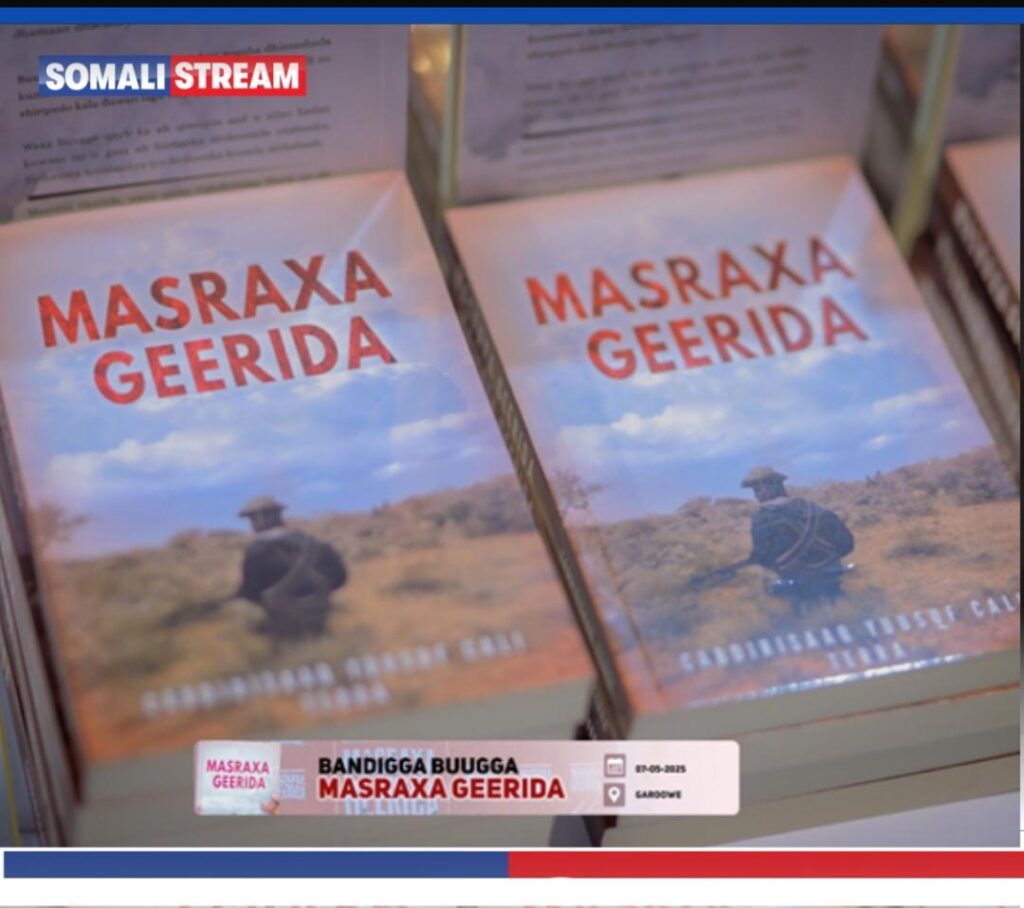
GAROWE, Somalia — Under countless flickers of fluorescent lights in a crowded hall in Garowe, a city that has long served as a sanctuary of relative stability in the otherwise volatile country, a hushed audience (dressed all in black) gathered this week for what many are calling a moment of reckoning.
The crowds were occasioned by the launch of The Theatre of Death (Masraxa Geerida in Somali) a harrowing new volume by the investigative journalist Abdirizak Terra. For those who have closely followed the grinding, decades-long conflict against Al-Shabab, the book is being promoted as yet another watershed moment of truth—a rare, unvarnished post-mortem of the Somali National Army’s (SNA) 2022–2024 offensive operations, written by a man who documented the carnage as it unfolded. Mr. Terra, formerly an embedded reporter with the SNA, does not offer an exactly triumphalist narrative of a Somali state that is on the mend. Instead, he rather paints a portrait of a military “reborn within a crucible of war, anarchy, and constant struggle,” only to be hamstrung by a “dangerous maze” of competing foreign interests and internal betrayals.
A Fractured Command
The central thesis of The Theatre of Death is that Somalia’s path to a national security which is sovereign is being blocked not just by the insurgency of Al-Shabab, but by the very architecture of the international support intended to defeat it.
Mr. Terra starts by detailing the rise of elite units that have become the backbone of the state’s security apparatus: the Danab Commandos, trained by the United States at the Balidogle airbase, and equally the Gorgor Commandos, a product of a longtimeTurkish military mission. While these units are the most capable in the Somali arsenal, the book exposes a lack of “unified domestic strategic cohesion.”In Terra’s telling, the Somali security sector is less a single unitary purpose and more a collection of fiefdoms, each functioning as they deem fit. The Somali police, military, and intelligence units operate with overlapping roles, often clashing over undefined jurisdiction and resources. This unholy friction, the author argues, has led to catastrophic failures on and around the battlefield.
The most chilling example cited is an act of “friendly fire” incident at Hawadley. Following a brutal an Al-Shabab dawn attack that claimed the life of the respected Colonel Abshir Shataqey along with his men, the chaos of the battlefield was said to be compounded by “a technological error”. A Turkish-made Bayraktar TB2 drone, operated by Somali intelligence, mistakenly identified surviving SNA soldiers as insurgents. As the soldiers tended to their wounded in the dim light of dawn, a MAM-T missile struck their position. It is a sequence Terra describes with clinical, heart-breaking detail—a symbol of a war where the left hand rarely knows what the right was doing.
The Shadow of Foreign Bases
A significant portion (a whole chapter) of the book has also been dedicated to the “opaque geopolitical maneuvers” that Terra claims have undermined institutional progress. He lifts the lid on secretive defense agreements with the United Arab Emirates (UAE), specifically focusing on the General Gordon Military Base.Terra describes the facility as a “parallel power structure” that functions less like a training camp and more like a sovereign embassy. He recounts instances where the top commander of the Somali National Army was required to submit written requests days in advance simply to enter the base.This “parallel command” has had its fair share of lethal consequences. Terra chronicles the February 2024 security breach at the base, where an Al-Shabab infiltrator named Mustafa Mukhtar Adan—who had spent months building trust within the facility—opened fire, killing three Emirati officers and a Bahraini officer. The incident, Terra argues, highlighted the vulnerability of foreign-run enclaves that operate outside the direct oversight of the Somali state.
The Enemy Within
Perhaps the most unsettling chapters of The Theatre of Death deal with the Amniyaat, Al-Shabab’s sophisticated intelligence wing. Terra reveals how the group has successfully placed double agents at the highest levels of the Somali government.The book highlights the case of one Abdisatar Abdikadir, a defector who meteorically rose to the rank of colonel within the National Intelligence and Security Agency (NISA) months after being released from prison. In what Terra calls a “chilling masterclass in betrayal,” Abdisatar allegedly leaked the entire “Operation Black Lion” war plan to Al-Shabab leadership before defecting back to the insurgents. The leak effectively neutralized a major offensive before it could begin, leading to heavy losses for the government.
A War of Survival
As the evening in Garowe drew to a close, the mood was one of somber reflection. The Theatre of Death does not provide full, easy answers or a roadmap to peace. Instead, it serves as a question to the international community and the Somali leadership to confront the “systemic rot” that sustains the conflict.Terra concludes his work with a sobering observation: for many in the SNA and the regions they defend, the war has ceased to be a grand struggle for reclaimed sovereignty. Instead, it has devolved into a matter of “simple survival”—a desperate attempt to see another day in a landscape where the lines between friend and foe, protector and predator, have become dangerously blurred.In a region where information is often scantly available and impervious to research, Terra’s book is a rare, brave act of documentation. Whether it will lead to the strategic shift he so calls for remains to be seen, but for one night in Garowe, the human cost of the Horn of Africa’s longest-running war of the century was impossible to ignore.
