


By: Ahmed Abdullahi Gulleid
Prefatory Note
A civilization does not survive seven millennia in one of the world’s most demanding ecological and geopolitical environments by accident. It survives, in significant part, because it develops sophisticated internal mechanisms for protecting its most vulnerable members — children, guests, the elderly, and the defenseless — without the apparatus of a written legal code, a standing police force, or a formal judiciary. The three customary social-safety codes examined below belong to that survival architecture. Each is a masterwork of applied behavioral psychology: a precisely calibrated threat, socially authenticated, deployed through language, and requiring no enforcement infrastructure beyond the collective imagination.
What makes these codes remarkable is not merely that they worked — though they did — but how they worked. Each operates through a distinct psychological mechanism: displacement of fear onto a non-existent or misrepresented entity, elevation of consequence beyond the threshold of rational resistance, and the gendered precision of threat-calibration. Crucially, the custodians of these codes — the elders who formulated and transmitted them — were not operating from ignorance of the natural world. They knew precisely what they were inventing. These were not superstitions. They were deliberate constructions, authored by a knowing class and deployed with full awareness of their own artifice. Together, they constitute what might be called an indigenous protective linguistics — a grammar of deterrence embedded in oral culture and transmitted across generations not through legislation but through the authority of elders and the disciplining power of communal narrative.
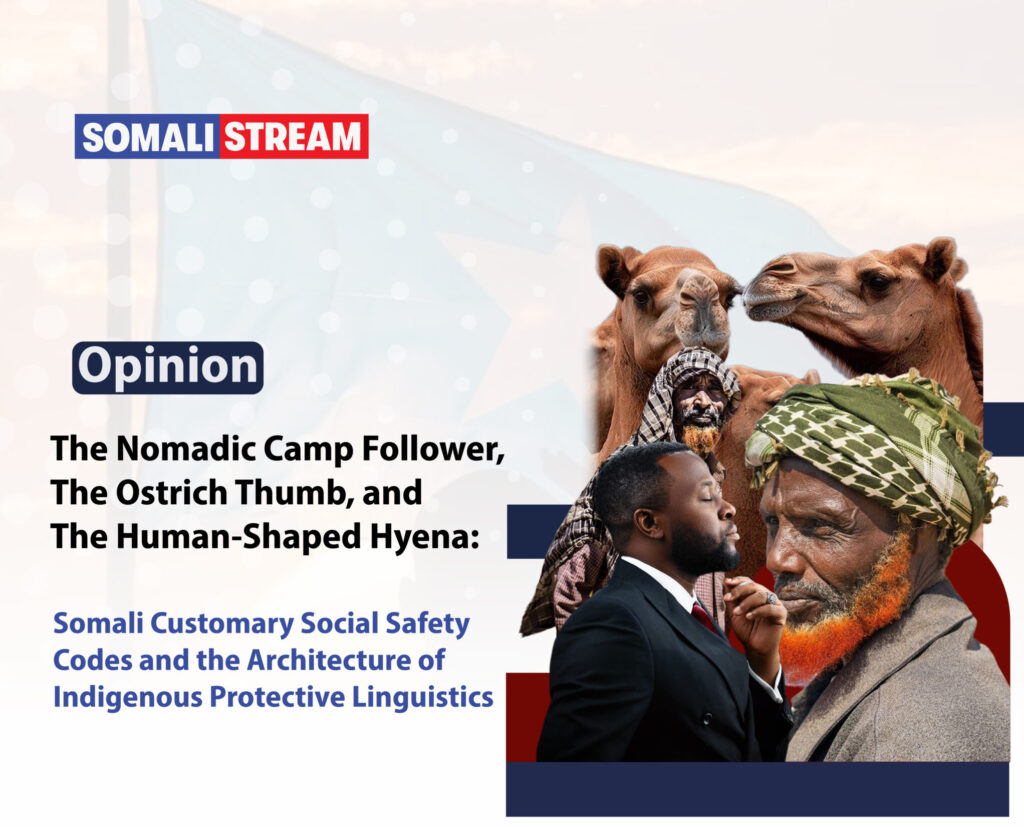
- Reer Guure Raac — The Nomadic Camp FollowerThe Code: “Reer guura raaca ka soo carar” — “Flee from the camp-follower of the nomadic household.”This warning was directed at children who fell behind during the relentless seasonal migrations that have defined Somali pastoral life for millennia. The nomadic household moves on a timetable dictated by rainfall, pasture, and security — it does not wait. A child who cannot keep pace with the caravan becomes, in an instant, both geographically isolated and socially detached from the only protection available in an open landscape.The code resolved this vulnerability through a deliberate act of zoological invention. Children were told that a specific predatory creature — the reer guure raac — shadows every nomadic caravan, and that a child who lags behind risks being consumed by it. No such animal exists. The “camp-follower predator” is a fiction, and the elders who deployed it knew this. But the fiction was engineered with precision: the creature is mobile (it follows the caravan), patient (it waits for stragglers), and singular in its targeting (it threatens not the group, only the separated child).The behavioral outcome was entirely rational: a child who believes a predator shadows the rear of the caravan has every incentive to remain at its center. The deterrent required no adult supervision, no physical constraint, no repeated intervention. Fear, once installed, self-administered. That the animal did not exist was, from a protective engineering standpoint, irrelevant. Its functional existence — in the child’s imagination — was sufficient.
- Suul Gorayo — The Ostrich ThumbThe Code: “Qofkii falkaa ku kaca Suul Garayo ha ka gaabto” — “Let whoever commits such an act get shorter than the Suul Gorayo.”This code was directed at youth — and by extension any community member — who might be tempted to transgress against guests or against the vulnerable: those who, by social position, age, or circumstance, could not defend themselves. The Somali tradition of hospitality (martisoor) and the protection of the weak are not peripheral social courtesies; they are load-bearing pillars of the xeer system. Violations required a deterrent proportionate to their gravity.Suul Gorayo — literally, the ostrich thumb — provided that deterrent. The gorayo is the ostrich; the suul its thumb — an unformed anatomical phantom. The elders knew the ostrich has no thumb. That was the point. The invocation of a non-existent anatomical feature as an instrument of absolute punishment — annihilation so total it would strike at the very root of a person’s existence, beyond death, beyond recovery — was a conscious construction by custodians who understood exactly what they were doing. The threat operated precisely because it named something impossible and rendered it lethal. A young man willing to discount supernatural consequence still had to contend with an erasure that the community’s moral architecture, fully internalized, made feel absolute.
- Waraabe Dadow — The Human-Shaped HyenaThe Code: “Waraabe Dadow iska jir” — “Beware the Human Hyena.”This is the most precisely gendered of the three codes. It was addressed almost exclusively to young girls tending livestock at a distance from the family enclosure — a routine pastoral task that placed them, predictably and repeatedly, in situations of physical exposure and social isolation.The threat it named was not invented. It was renamed. Men who might approach girls in isolated pasture — predatory strangers, men unknown to the family, individuals who might cause harm — were reframed not as human beings subject to the ordinary social ambiguities of encounter, but as a distinct ontological category: waraabe dadow, the hyena that has taken human form. The creature is real in its danger but disguised in its appearance. It looks like a person. It is not.The genius of this construction lies in what it forecloses. A girl warned about strangers must still navigate the cognitive complexity of deciding who is a stranger, whether a stranger is dangerous, and whether her judgment is reliable. A girl warned about the waraabe dadow has been given a categorical rule: any unfamiliar male who approaches when she is alone and far from the enclosure is, by definition, a potential non-human predator. The appropriate response is not social negotiation. It is flight and alarm.The code also extended, with appropriate modification, to young boys in similar circumstances. Its primary architecture, however, was gendered female — a recognition, encoded in oral tradition, that the specific vulnerability of girls in isolated pastoral settings required a specific, non-negotiable protective protocol.
Concluding Observation
These three codes share a structural elegance that rewards analytical attention. Each identifies a genuine social vulnerability (the straggling child, the defenseless guest, the isolated girl), engineers a behavioral response calibrated precisely to that vulnerability, and deploys linguistic and zoological resources to make the deterrent self-sustaining. None requires institutional enforcement. All three worked.
They worked because they were not the products of credulity. They were the products of sophistication. The elders who formulated them were, simultaneously, naturalists who understood the actual behavior of ostriches and hyenas, social psychologists who understood how fear operates in the imagination of a child, and moral architects who understood which behaviors required the most durable constraints. The fictions they constructed were not accidental. They were chosen — each element calibrated, each zoological reference selected for maximum psychological yield.
In an oral civilization, stories are the most durable technology available. A child who has internalized the reer guure raac does not need to be told twice to keep pace with the caravan. A youth who has absorbed the weight of Suul Gorayo carries it into every social encounter. A girl who knows the waraabe dadow walks in pasturelands with a cognitive map that protects her without requiring real-time assessment of a stranger’s intentions. The Somali customary tradition produced a jurisprudence of protection that operated precisely where formal law could not reach: in the open landscape, in the unwitnessed moment, in the private imagination of a child far from home. These codes are not curiosities. They are evidence.
Ahmed Abdullahi Gulleid is a Poet, Cultural Expert and Linguist and can be reached at: gulleidthepoet@gmail.com