


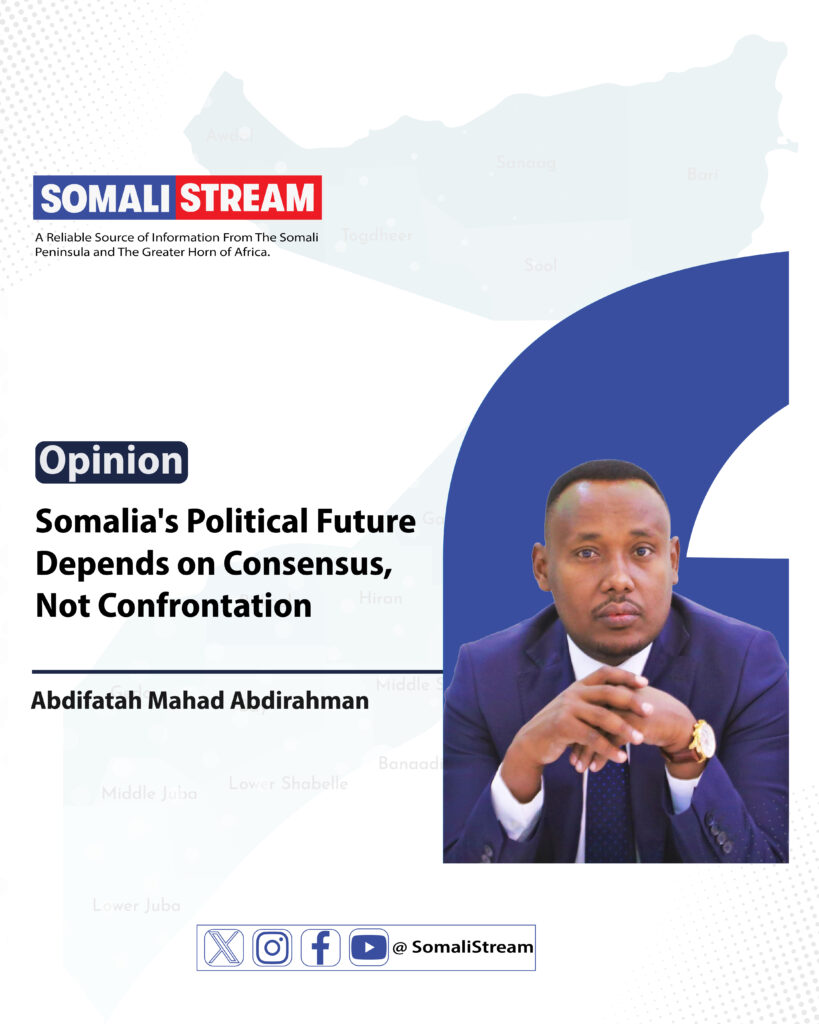
Somalia finds itself at a decisive political crossroads. The nation, after decades of conflict, state failure, reconstruction, and limited political gains, is now once again uncertain about its political course. The current conflicts between the Federal Government and some of the Federal Member States, along with election issues, governance, and security concerns, have led to concerns among many Somalis and international observers regarding the country’s future stability.
Central to these discussions is the question of political legitimacy and the oversight of Somalia’s electoral process. President Hassan Sheikh Mohamud’s term in office was originally scheduled to end on 15 May, a date which has been a trigger for the debates over governance and political transition. However, Somalia’s challenges are not limited to one person or one political office. The leadership of all political actors, from the Federal Government, Federal Member States, opposition leaders, traditional elders, and civil society, is critical for a national consensus on the path forward.
Recent political events have added to the polarization concerns. Opponents to the present administration argue that there is a growing use of pressure and confrontation to settle political differences instead of dialogue and compromise. Trust is a fragile commodity needed for the effective operation of Somalia’s fledgling federalism, and it is being undermined by tensions between regional administrations. The sense of increasing divides, whether or not these concerns are justified, is a significant threat to national unity itself.
Somalia’s federalism is designed to reconcile national unity with regional autonomy. This system requires a degree of cooperation between Mogadishu and the Federal Member States for it to be successful. As political disagreements turn into security clashes and public accusations, citizens dealing with instability and insecurity are left further in a state of uncertainty. Ordinary Somalis have concerns about safety, jobs, services, and a secure future for their families that outweigh politics and political competition.
In this regard, the role of the national security institutions is of particular significance. Somalia’s security forces have been developed over the years with a generous contribution from Somali soldiers and international partners, with a number of sacrifices in the process. They are mainly tasked with protecting the nation from threats like Al-Shabaab and other extremist groups. A sense that security institutions are getting entangled in political controversy, undermining public confidence and diminishing the unity that security institutions need to function effectively. National security should be a national duty to protect the country for all Somalis, irrespective of political and regional identity.
Similarly, Somalia remains vulnerable to security threats. Al-Shabaab can still strike, wreak disrupting economic activity, and take advantage of political fissures. Historically, extremist groups have flourished whenever political parties have been divided. Political instability makes it easier for militants to grow in influence and to offer themselves as alternatives to the state. Therefore, peaceful settlement of political issues is vital not just for the democratic process but also as a security imperative.
The most important question facing Somalia today is how to have a fair and meaningful election process. History has proved that elections that are imposed by one side are not likely to be widely accepted. Legitimacy in a country with an intricate clan structure, federalism, and diverse political interests depends on consensus rather than on one individual making decisions. Somalia requires an election model that is agreed upon by a wide consensus across the country.
Such a consensus should be represented by all the major stakeholders. The electoral framework must be agreed to by the Federal Government, Federal Member States, opposition parties, traditional leaders, women, youth representatives, and civil society organizations. The future of the nation should not be left to a single leader, institution, or political group. Political stability is not sustainable until all parties feel listened to, and their concerns are taken up and dealt with in a process of negotiation.
The lessons from Somalia’s recent history are clear. Inclusion in politics can lead to instability, and dialogue can lead to compromise. The nation has risen to significant challenges in the past by negotiating and conciliating. The same approach is required today. Somali leaders should not seek to deal with personalities or political squabbles but invest more in establishing institutions that would not end with the end of any administration.
Somali’s future won’t be guaranteed by confrontation, political pressure, or unilateral measures. It will be achieved by an inclusive dialogue, mutual respect, and a consensus-driven electoral process that is trusted by all stakeholders. The expiration of a presidential mandate must not be a time of conflict, but of fresh national pledges in favor of democracy. Stability in Somalia, a more viable federal system, and a more peaceful and prosperous future can only be realized with consensus.
Abdifatah Mahad Abdirahman
