


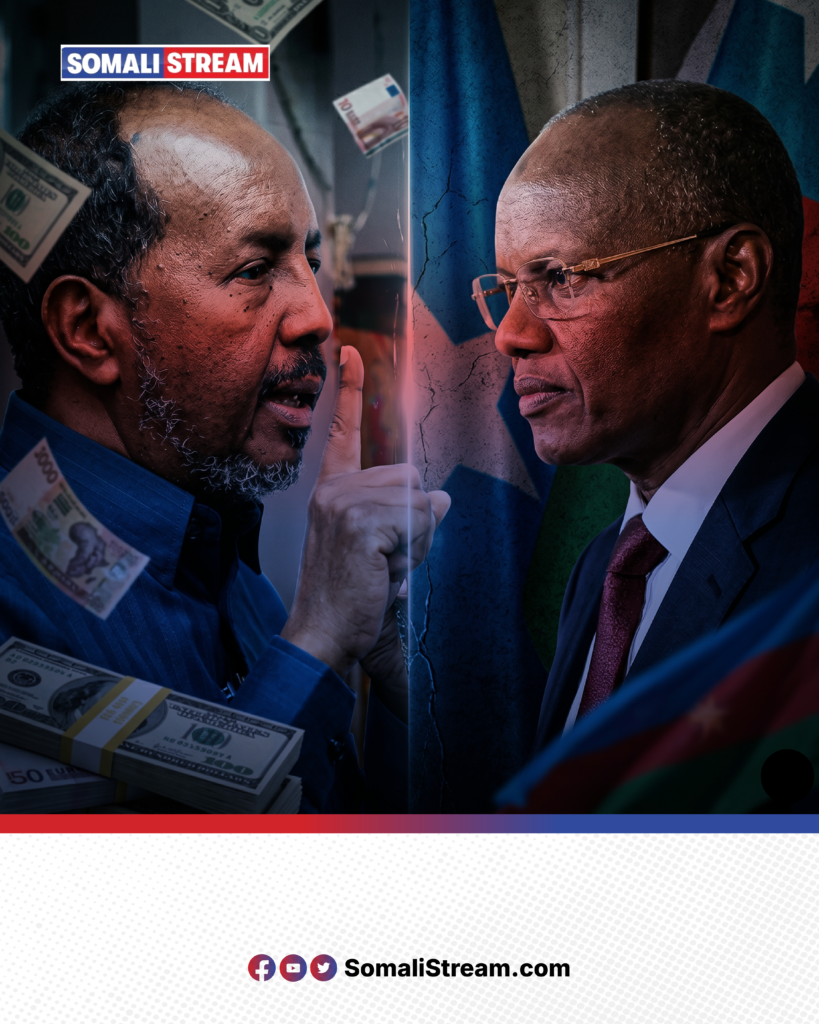
A widening political controversy is gripping Somalia as new allegations suggest a deeply entrenched system of financial misconduct tied to international aid flows. At the center of the claims is Hassan Sheikh Mohamud, accused by regional leaders of presiding over a covert network that diverted critical funds away from their intended public use.
In an exclusive interview on the Geedfadhi program aired by Somali Stream and Kaartalk, South West State President Abdiaziz Hassan Mohamed popularly known as Laftagareen delivered one of the most direct and detailed accusations yet. He alleged that regional administrations, including South West State, Galmudug, and Hirshabelle, were not only pressured to return portions of their budget support funds, but did so without ever officially declaring those withdrawals to the World Bank.
According to Laftagareen, this deliberate lack of disclosure represents a serious breach of financial transparency and raises the risk of systemic misappropriation. “These transactions were never reported,” he indicated, suggesting that both domestic oversight mechanisms and international partners were effectively kept in the dark.
The funds in question form part of Somalia’s budget support framework, an essential lifeline intended to stabilize fragile institutions, fund public services, and support reconstruction. However, Laftagareen claims that once the funds reached regional accounts, directives were issued to quietly extract and redirect significant sums, reportedly up to $1 million per administration, back to the federal leadership.
He characterized the process as neither voluntary nor transparent, but rather as a form of financial coercion. Regional leaders, he alleged, were left with little choice: comply and maintain access to future funding, or resist and face financial isolation. This dynamic, he argued, transformed development aid into a political tool used to consolidate power.
Beyond the immediate claims of undeclared transfers, the allegations point to broader concerns about governance under President Hassan Sheikh Mohamud. Critics have increasingly raised questions about centralized control over financial flows, the politicization of aid distribution, and the erosion of institutional accountability. Laftagareen suggested that funds intended for public welfare were instead repurposed in ways that undermined federal member states and weakened their autonomy.
He further implied that this system created an environment where loyalty was financially incentivized, and dissent was penalized through restricted access to resources. Such practices, if substantiated, would not only violate principles of good governance but could also jeopardize Somalia’s standing with international donors.
The implications extend beyond domestic politics. The World Bank and other global partners rely on transparent reporting and accountability to ensure aid effectiveness. Undeclared withdrawals and off-the-books transfers could severely damage trust, potentially leading to tighter controls, reduced funding, or suspension of key programs.
Laftagareen has called on the international community to take these allegations seriously, urging a thorough audit of aid disbursement mechanisms and stronger safeguards against misuse. He warned that without immediate intervention, financial assistance risks being diverted away from the Somali people it is meant to support.
While these claims remain unverified and have yet to be independently confirmed, they have intensified scrutiny on Somalia’s leadership and reignited debate over corruption, accountability, and the true destination of international aid.