


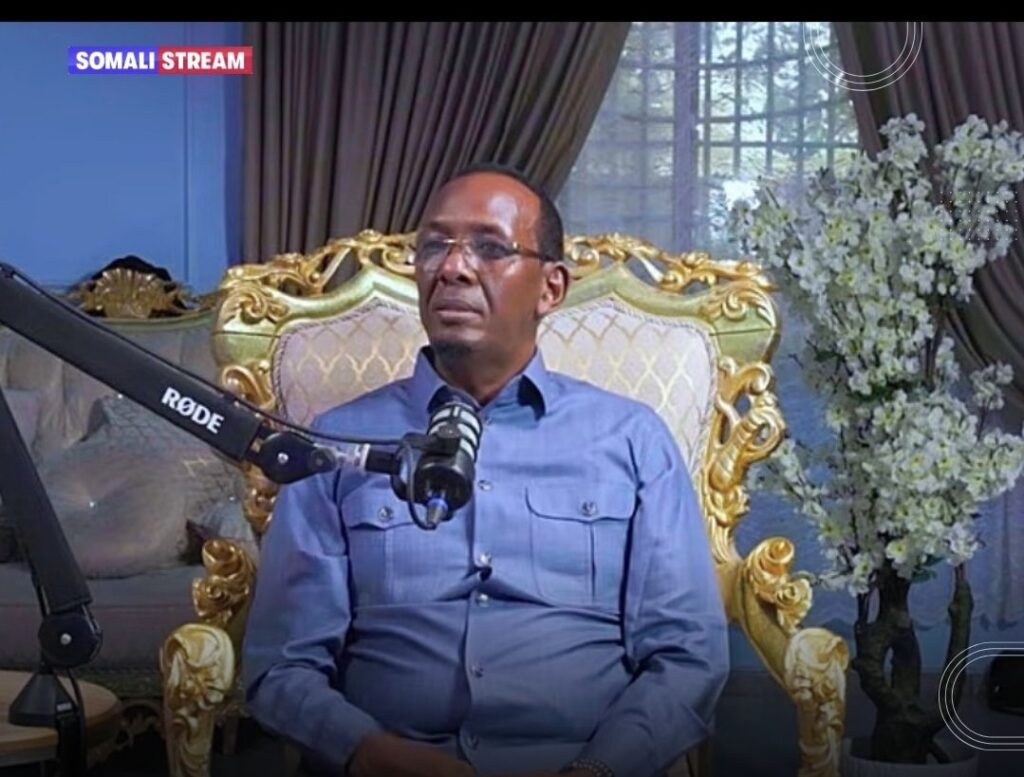
In a political system defined by shifting loyalties, fragile institutions, and ever present security threats, few figures capture the paradoxes of Somalia’s statehood as vividly as Abdullahi Mohamed Ali Sanbalooshe. Speaking in a wide ranging interview on the Geed Fadhi Podcast aired on April 24, 2026, the former intelligence chief, diplomat, and cabinet minister delivered an unfiltered account of power, conflict, and the deep structural tensions shaping the country’s future. His remarks, at once defensive and accusatory, revealed a political class locked in cycles of mistrust while confronting threats that demand unity.
Sanbalooshe moved quickly to dismantle a narrative that has long shadowed Somalia’s intelligence leadership, the idea that those who occupy the country’s most sensitive security positions inevitably become aligned with foreign powers. Dismissing claims of allegiance to countries such as Qatar, Turkey, or the United Arab Emirates as politically motivated propaganda, he argued that such accusations are less about evidence and more about strategic delegitimization.
He pointed to predecessors like Mahad Mohamed Salad and Fahad Yasin, both of whom faced similar claims rooted in personal histories rather than demonstrable influence. In his own case, he said accusations tied to Abu Dhabi emerged from his position that Somalia should normalize relations and avoid unnecessary diplomatic confrontation, a stance he framed as pragmatic rather than transactional. The deeper implication was unmistakable, Somalia’s vulnerability lies not simply in foreign interference, but in the domestic political incentive to weaponize suspicion.
That same tension between perception and reality surfaced in his response to criticism from President Hassan Sheikh Mohamud, who had accused him of being absent from intelligence headquarters. Sanbalooshe rejected the claim outright, recasting it as a misunderstanding of leadership itself. He drew a sharp contrast between bureaucratic micromanagement and strategic command, portraying himself as a leader who empowers subordinates and directs operations beyond the confines of an office. In fragile security environments, he suggested, effectiveness is not measured by physical presence but by outcomes, a subtle but pointed rebuttal to a presidency he increasingly portrayed as disconnected from operational realities.
His most consequential intervention came in the form of a stark hierarchy of threats facing Somalia. At the top, he placed Al-Shabaab, describing it as the country’s immediate and overriding danger. Beneath it, he identified secessionist tendencies and centrifugal fragmentation, warning that the gradual erosion of national unity poses an existential risk.
The third threat, perhaps the most insidious, was elite polarization, a political class, he argued, incapable of consensus and driven instead by competition for power and resources. In Sanbalooshe’s telling, Somalia’s instability is not the product of isolated crises but of an interconnected system in which political fragmentation undermines security, and insecurity in turn deepens political division.
His account of leaving office offered a rare glimpse into a political culture where transitions are often fraught with tension. When his tenure ended, he said, he departed without resistance, no mobilization of allies, no institutional brinkmanship. The message was deliberate, public office, particularly in the security sector, must not be treated as personal property. In a system where leaders often cling to power, his departure was framed as both principle and contrast, a quiet indictment of a broader political culture that equates authority with survival.
Yet Sanbalolshe’s insistence on independence also extended to his complex relationship with the president who repeatedly appointed him. He rejected the notion of political loyalty as a binding obligation, arguing that public service should not devolve into a system of personal debts.
His admission that he backed a rival candidate in the 2017 election, and miscalculated, was less an apology than an illustration of Somalia’s fluid political landscape, where alliances are temporary and recalibrated as circumstances shift. Competition, he emphasized, should not be conflated with hostility, though his broader remarks suggested that in Somalia’s current climate, that distinction is increasingly blurred.
Nowhere was that tension more evident than in his discussion of relations with Ethiopia. Addressing the fallout from the controversial Somaliland memorandum of understanding, Sanbalooshe described a dual track approach in which public rhetoric masked quiet diplomatic engagement.
Meetings in Doha and backchannel negotiations, he said, were aimed at de escalation, even as political actors on all sides engaged in nationalist posturing. Ethiopia’s primary concern, he revealed, was maintaining its role within regional security arrangements rather than pursuing outright confrontation. For Somalia, the calculation was stark, with Al Shabaab still active, the country could not afford to open multiple fronts. It was a pragmatic assessment that underscored the limits of political theater in a state still fighting for internal stability.
Sanbalooshe’s reflections on Somalia’s internal political settlement were equally blunt. He argued that historical grievances, particularly among Darood communities displaced and dispossessed after the collapse of the state in 1991, continue to shape perceptions of the current order.
For many, he suggested, the political center in Mogadishu is seen as disproportionately favoring certain blocs, undermining the legitimacy of the broader social contract. This sense of exclusion, he warned, is not merely rhetorical but structural, feeding into the very fragmentation that threatens national cohesion.
The question of federalism, long a source of contention, remains unresolved. Whether through an eight province model, an eighteen region framework, or a new configuration entirely, Sanbalooshe argued that Somalia has yet to reach an honest settlement on territorial and political organization. Any durable arrangement, he insisted, must secure genuine buy in from all major constituencies, including regions like Hiiraan. Without that inclusivity, the state risks perpetuating a cycle of partial agreements and recurring instability.
His critique of President Hassan Sheikh’s current leadership was among the most pointed elements of the interview. While acknowledging the pragmatism that once defined the president’s earlier tenure, Sanbalooshe argued that the current administration is increasingly insular, shaped by a narrower circle of advisers and weakened institutional structures. The implication was clear, a leadership style that once relied on compromise has, in his view, given way to one marked by consolidation and reduced dissent.
The human cost of Somalia’s conflict surfaced in a deeply personal anecdote, as Sanbalooshe recounted burying more than a hundred relatives killed in fighting against Al Shabaab, only to be dismissed from office the following day.
Whether taken literally or as a reflection of cumulative loss, the story underscored his broader claim that political decisions are often made with little regard for the sacrifices of those on the front lines. It was a moment that shifted the interview from analysis to indictment, highlighting the emotional toll of a conflict that remains far from resolved.
Throughout the conversation, Sanbalooshe returned to a recurring theme, the logic of preemption that governs Somali politics. Rivals, he suggested, are neutralized before they can pose a threat, whether through dismissal, exclusion, or public discrediting. This culture, rooted in both historical experience and contemporary competition, reinforces a system in which survival often takes precedence over governance.
On security, however, his assessment was more measured. Improvements in Mogadishu, he said, are the result of sustained, incremental pressure on Al Shabaab rather than any single breakthrough.
He credited former President Mohamed Abdullahi Farmaajo and Fahad Yasin with strategic direction, while portraying other leaders as implementers rather than architects. The gains, he cautioned, remain fragile and dependent on continued focus.
His remarks on the concentration of security authority within the president’s family drew on historical precedent, invoking the example of Mohamd Siad Barre to argue that kinship based protection ultimately fails to insulate leaders from broader political forces. The lesson, he suggested, is that no system of control can indefinitely override the structural realities of governance.
As Somalia approaches another political inflection point, with the presidential mandate nearing its end, Sanbalooshe warned of the risks inherent in rigid timelines within a volatile environment. His suggestion that a negotiated extension might be preferable to violent instability is likely to provoke debate, but it reflects a broader concern that constitutional uncertainty could exacerbate existing tensions. In that context, he floated the idea of a transitional authority to oversee an orderly transfer of power, framing it as a pragmatic response to a fragile and fragmented landscape.
On the fight against Al Shabaab, Sanbalooshe rejected the premise that electoral cycles and counterterrorism efforts are inherently in conflict. The real danger, he argued, lies in treating insurgents as political equals. His strategy emphasized weakening the group through sustained pressure, encouraging defections, disrupting finances, and fragmenting its leadership, before any meaningful negotiation could occur. It was a vision grounded less in immediate resolution than in long term attrition.
By the end of the interview, the tone had shifted again, this time toward introspection. Sanbalooshe acknowledged past misjudgments and a degree of political naivety, suggesting that he had been used by actors pursuing their own agendas. His closing remark, that he is still weighing his options, left open the question of his future role in a system he both critiques and seeks to shape.
Taken together, his remarks offer a portrait of a state caught between competing imperatives, the need for unity in the face of insurgency, the pull of factional politics, and the enduring challenge of building a state that commands both authority and legitimacy.
Whether his analysis is read as candid diagnosis or calculated positioning, it underscores a reality that remains difficult to ignore, Somalia’s greatest battles may not be fought solely on the battlefield, but within the corridors of its own political class.