


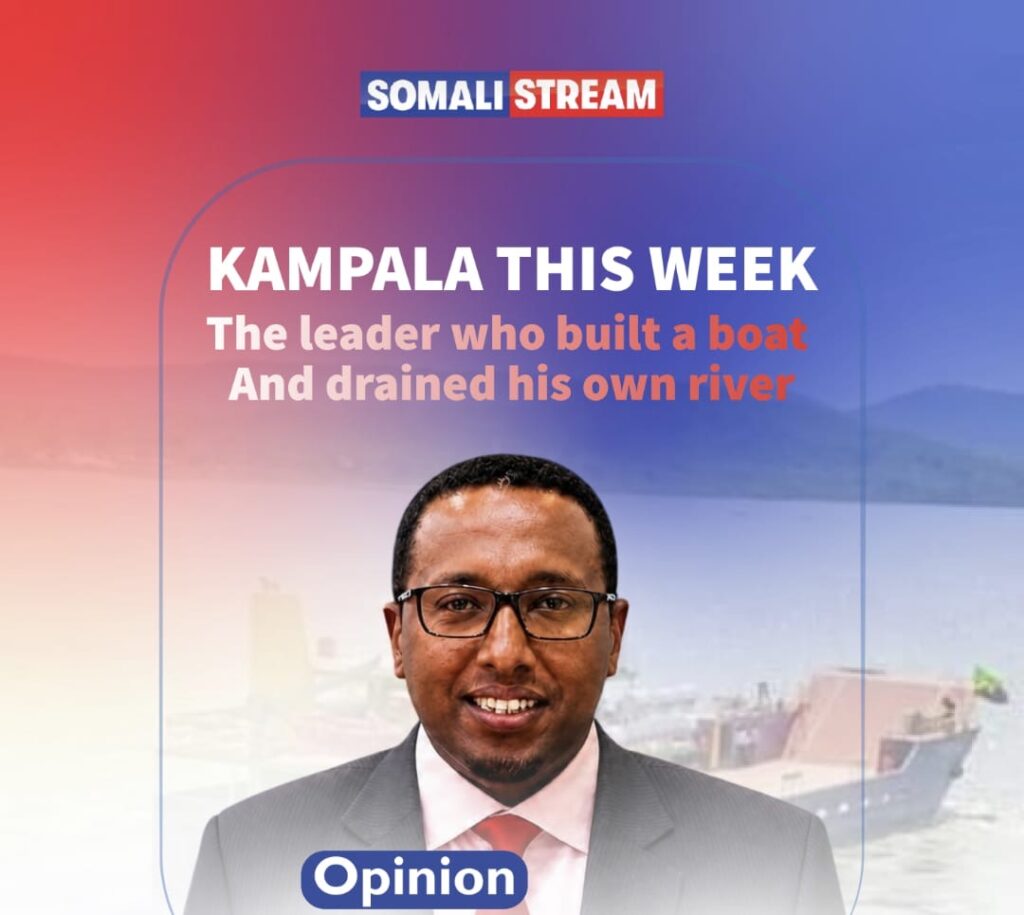
Every Somali who has watched the last four years knows something has gone very wrong, but few have seen the whole shape of it. This week in Kampala, that shape becomes visible. This is how the country got here, and where it is going.
A meeting that is really a reckoning
Kampala this week is not a routine African Union meeting. When the troop-contributing countries sit down on 29 July with the AU Commission’s 20 July letter in front of them, warning that the mission’s future is no longer guaranteed, they are not being asked to fix a bad year. They are being asked what remains of a Nineteen-year international project after one presidency has finished with it.
The clock is tighter than most Somalis realise. The UN Transitional Assistance Mission closes on 31 October 2026. AUSSOM’s Security Council authorisation expires on 31 December 2026. Somalia loses its UN political mission and its UN logistics platform inside a nine-week window, as the Balqiis Insights paper “No Time to Drift” documents.
For nine of the fourteen years since Somalia became a Federal Republic, one man has run the country. Two terms out of three. A rewritten constitution over the objection of federal member states. An intention, now openly stated, to stay in power until May 2027, and an architecture designed to reach beyond it. More than half the life of the Federal Republic has unfolded under a single presidency.
The bet behind this term
The bet behind the current term was specific. Defeat Al Shabaab with Somali forces and community militias. Frame the AU mission’s drawdown as proof of Somali success. Run in 2026 as the president who liberated Somalia, on a constitutional framework designed to convert that victory into a term extension. In April 2023 at Entebbe, the president brought Uganda, Kenya, Burundi, Djibouti and Ethiopia to endorse the December 2024 exit date. Somali forces, he was telling the region, could take over because Somali forces were already winning.
The bet lasted six months
By September 2023 the National Security Adviser was writing to the UN asking for a pause in the drawdown the presidency had championed. Puntland withdrew recognition of the federal government in March 2024. Jubaland walked out of the National Consultative Council in December 2024. In April 2025 Al Shabaab retook Adan Yabaal, Moqokori and Mahaas. Positions transferred to Somali forces during the ATMIS drawdown were among the first to fall.
Partners noticed something else, and this is the point Somalis should sit with longest. When Villa Somalia mobilised forces for political disputes in Baidoa, Ras-Kamboni, and reportedly Puntland, it found the funding, logistics and personnel. When it fought Al Shabaab, it asked the international community to pay. As Balqiis Insights puts it, “partners read the revealed priorities and not stated ones.” That sentence explains most of what has since happened in Washington.
Washington began responding in kind
From May 2025, Washington moved. It blocked activation of UN Resolution 2719, the hybrid funding model that would have put AU stipends on predictable UN financing. Congress passed the AUSSOM Funding Restriction Act with bipartisan support. In August and September 2025 the White House cancelled the American 25 percent share of UNSOS, roughly 130 million dollars a year. In July 2026 Washington circulated a note verbale to the AU stating that it would not support a Security Council renewal of AUSSOM if it included UNSOS or any UN logistical support.
The note verbale was precise about why. It cited, in Washington’s own words, “internal rivalries and political infighting” as the reason international support had not translated into progress. That phrase is now on the diplomatic record. It is Washington naming the presidency’s method as the cause.
A mandate without logistics
The Balqiis Insights paper “No Time to Drift” frames what has happened in a phrase that is now unavoidable. Somalia, it argues, is facing a mandate without logistics. The United States did not object to renewing AUSSOM’s Chapter VII mandate. It objected to renewing UNSOS. Without UNSOS, the mission loses fuel, food, water, casualty evacuation, troop transport and field sustainment, functions the UN delivers at half a billion dollars a year. A mission that cannot move, cannot resupply, and cannot evacuate its wounded is not a mission. It is an authorisation on paper.
What Kampala is actually deciding
Many scenarios can be sketched for what comes after 31 December. My diplomatic read is that most of them are not live options this cycle, and one is.
The Gulf bailout that some in Villa Somalia are quietly hoping for is not coming. Qatar, Saudi Arabia and the UAE spent the first quarter of 2026 absorbing Iranian missile and drone strikes on their own territory during the US-Israel-Iran war. Qatar alone was targeted by more than two hundred missiles and eighty drones between late February and mid March. Gulf capitals are now managing their own reconstruction, their own energy infrastructure exposure, and the lesson their strategic community has drawn from the war, that security cannot be subcontracted. Underwriting a half-billion-dollar African peacekeeping logistics package is not a decision any Gulf capital will take in this quarter.
Türkiye has just told the region what its posture is by how it announced the renewal. The Turkish Grand National Assembly approved the two-year extension of Turkey’s Somalia deployment on 21 July, three days before Kampala. The 2017 mandate went through parliament quietly. The 2024 renewal was foregrounded. The 2026 renewal was amplified. When a state moves a routine bilateral renewal to the front of its public diplomacy on the eve of a regional decision, it is not signalling that more is coming. It is signalling that what is being renewed is the ceiling of the commitment. Ankara is telling both the region and Villa Somalia that the training, the drones and the naval cooperation are what Türkiye will do. An expanded multilateral sustainment role to replace UNSOS is not on the Turkish table.
If the Gulf is absent and Türkiye has capped its bilateral role, the remaining outcome is one scenario with a range of endings. The mission ends inside the twelve months ahead. The question is only how orderly the ending is. Whether troops leave on national timelines with dignity intact or leave behind positions Al Shabaab takes within weeks. Whether the Somali National Army has been prepared for the handover or whether the handover happens because no one in the region can stop it.
There is a way to read the run-up to this meeting that requires no leak and no inside source. It only requires knowing how the African Union prepares difficult decisions. What is happening now is what practitioners call diplomatic laddering. Continental blocs do not begin difficult mission-ending decisions with the frontline states. They begin with peripheral pre-clearance, using member states that carry no direct cost from the decision to establish concerned language on the record so that the frontline actors can adopt the framing later under cover of a continental consensus that has already been legitimised. At the AU Peace and Security Council’s emergency session on 3 July 2026, Cameroon and Gabon, neither of whom has troops in AUSSOM and neither of whom shares a border with Somalia, told the room that “every peace support operation eventually reaches a conclusion.” That sentence is now on the record. It is the ladder. The frontline states will climb it at and after Kampala.
What could have saved Somalia
What could have saved Somalia from Al Shabaab was never a mission. It was three things Somalis have always known. Consensus among federal member states. Political unity across the country. An agreed constitution that all sides accept. These are the three foundations on which any counterinsurgency, any elected government, and any sustainable security architecture would have stood.
These are also the three things the leader compromised to build his boat. He did not lose them by accident. He traded them, deliberately, for a constitutional rewrite that a majority of federal member states rejected, for a National Consultative Council he narrowed until Puntland and Jubaland walked out, and for an electoral timetable designed to convert incumbency into a term extension. The consensus is broken because he broke it. The unity is broken because he chose the fight. The constitution is contested because he wrote it over the objection of the states that were meant to ratify it.
The same choices drained the river. He spent years of trust with neighbours who had endorsed his timetable and then reversed it. He spent years of trust with the African Union whose troops he asked to stay after asking them to leave. He spent years of trust with Washington, which has now put “internal rivalries and political infighting” on the diplomatic record as the reason it will not renew UNSOS. He spent years of trust with an international community that has run out of patience with a Somali presidency that mobilises resources for political disputes and asks partners to pay for the war against Al Shabaab.
It is a sad accounting. Consensus, unity, constitutional legitimacy and international trust are what any Somali leader inherits when they take office and what any Somali leader is meant to hand to their successor. He inherited them. He spent them. What he leaves behind is a country with fewer instruments to defend itself than any Somali federal presidency since 2012, at the moment those instruments are most needed.
A boat was built to reach a second comeback. The river was drained to build it. The boat cannot travel now, and the river is not there for the country, or for whoever comes next.
To lose so much, so quickly, for one person’s ambition, is not only a political failure. It is a moral one.
Awale Kullane is a former Somali Ambassador to Sweden and China, and former Deputy Permanent Representative of Somalia to the United Nations. He previously served as Chief of Staff in the Office of the Prime Minister. He writes on Horn of Africa geopolitics, constitutional affairs, and regional security.