


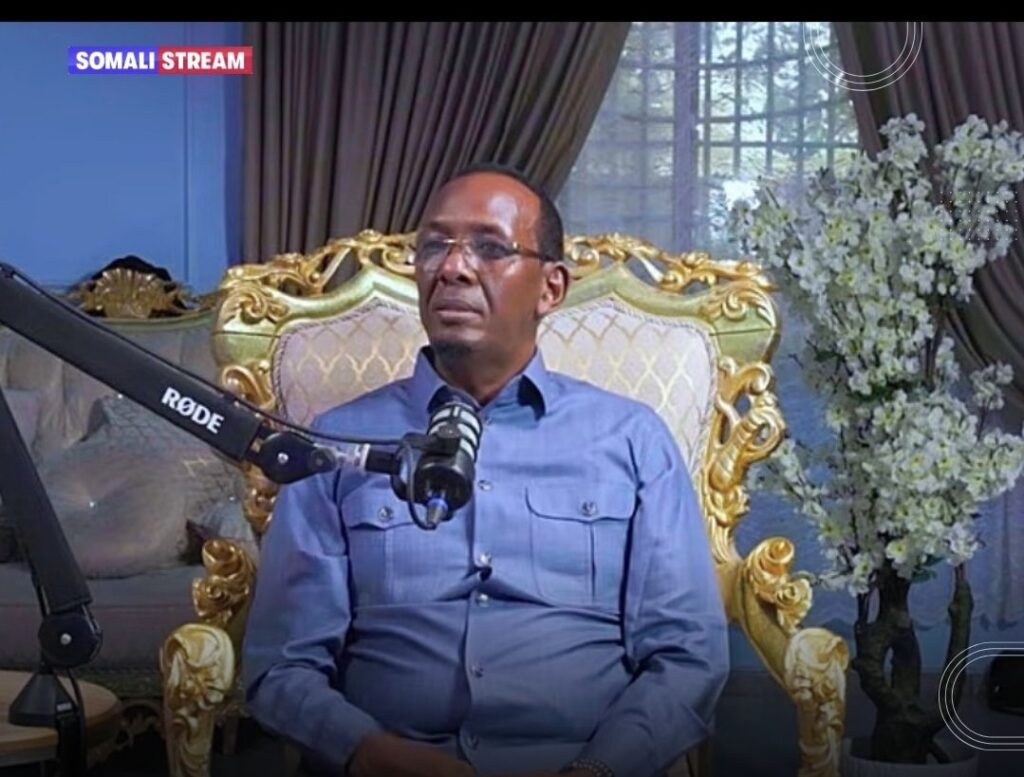
A former head of Somalia’s intelligence service has called for sweeping structural reforms to the country’s spy agency, arguing it must evolve into a forward-looking institution capable of anticipating threats beyond terrorism.
Speaking on the Geed-Fadhi Podcast by Somalistream and Kaartalk, aired on April 24, veteran intelligence official Abdullahi Mohamed Ali Sanbalooshe, a three-time director of the National Intelligence and Security Agency (NISA), said Somalia’s intelligence culture remains narrowly defined and overly politicized.
Sanbalooshe, who has also served as Somalia’s Ambassador to the United Kingdom and Türkiye, Minister of Internal Security, and a Member of Parliament, described himself as among a small group of officials with experience across government, legislature, diplomacy and intelligence operations.
He argued that intelligence in Somalia is widely misunderstood as a tool limited to counterterrorism operations, particularly against groups such as Al-Shabaab. In his view, intelligence should be the institution that knows everything capable of affecting the state before others do, functioning as both a diagnostic and predictive arm of government.
According to him, a modern intelligence agency should track not only security threats but also social grievances, economic vulnerabilities, foreign influence operations and shifts in public sentiment, all before they escalate into crises.
Sanbalooshe said Somalia’s intelligence mindset remains shaped by the legacy of former leader Siad Barre, whose security apparatus initially focused on external threats but later turned inward. He pointed to the aftermath of the 1978 Somali coup attempt as a turning point when intelligence structures were increasingly used against domestic dissent.
While he praised the former National Security Service (NSS) for its professionalism, discipline and technical capabilities, including advanced signals intelligence for its time, he warned against romanticizing a system that ultimately became politicized.
He described intelligence agencies as inherently tied to executive power, often serving as what he called the “final shield” of the presidency. He cited differing priorities under recent administrations, including Mohamed Abdullahi Farmaajo and Hassan Sheikh Mohamud, but argued that regardless of leadership, intelligence bodies tend to be shaped by the political survival needs of those in power.
Addressing foreign involvement, he acknowledged that intelligence cooperation is unavoidable in a globalized security environment, particularly in combating transnational militancy. However, he stressed that sovereignty must remain a red line, warning that any external influence undermining national independence should be resisted.
He added that such cooperation is often accompanied by underlying mistrust. Somalia, he said, is frequently integrated at the execution stage of operations rather than fully included in planning, intelligence collection or technical system design, limiting the country’s ability to build independent capabilities. He pointed to gaps in Somali-controlled signals intelligence and human intelligence networks, suggesting that international partners may prioritize operational dependency over meaningful capacity transfer.
He described intelligence agencies as the “first gate of the nation,” operating in gray zones beyond the reach of diplomacy or conventional military action, and said effective services should maintain insight even into adversarial networks such as Al-Qaeda.
On the question of surveillance capabilities, including whether authorities can monitor encrypted platforms such as WhatsApp, Sanbalooshe declined to provide a direct answer, citing national security considerations. However, he indicated that public officials should exercise caution in digital communications, reiterating that a serious intelligence service should not be constrained by technical blind spots when it comes to national security awareness.
A central theme of his remarks was the lack of continuity within NISA. He criticized a pattern in which each incoming director reshapes the agency, disrupting systems, reshuffling personnel and altering priorities, undermining institutional memory and encouraging short-termism among officials uncertain of their tenure.
He called for reforms including preservation of institutional knowledge and operational files, protection and retention of experienced officers, merit-based systems over factional loyalty, and stability during leadership transitions.
Sanbalooshe also warned against informal influence by former officials after leaving office, arguing that intelligence leaders should fully disengage once their tenure ends. He said loyalty must be to the state rather than individuals, framing continued backstage involvement as a sign of weak institutional culture.
He proposed formalizing the appointment and protection of intelligence chiefs through parliamentary vetting, fixed renewable terms and legal safeguards. He also called for post-service protections and dignified exit processes, noting that former intelligence leaders often retain sensitive knowledge that could make them vulnerable to exploitation.
He added that while laws exist, their application often depends on shifting political circumstances rather than consistent principles, underscoring what he described as a broader governance challenge in Somalia.
Sanbalooshe’s remarks add to ongoing debates about the future of Somalia’s intelligence architecture as the country continues to confront security threats while attempting to build durable state institutions.