


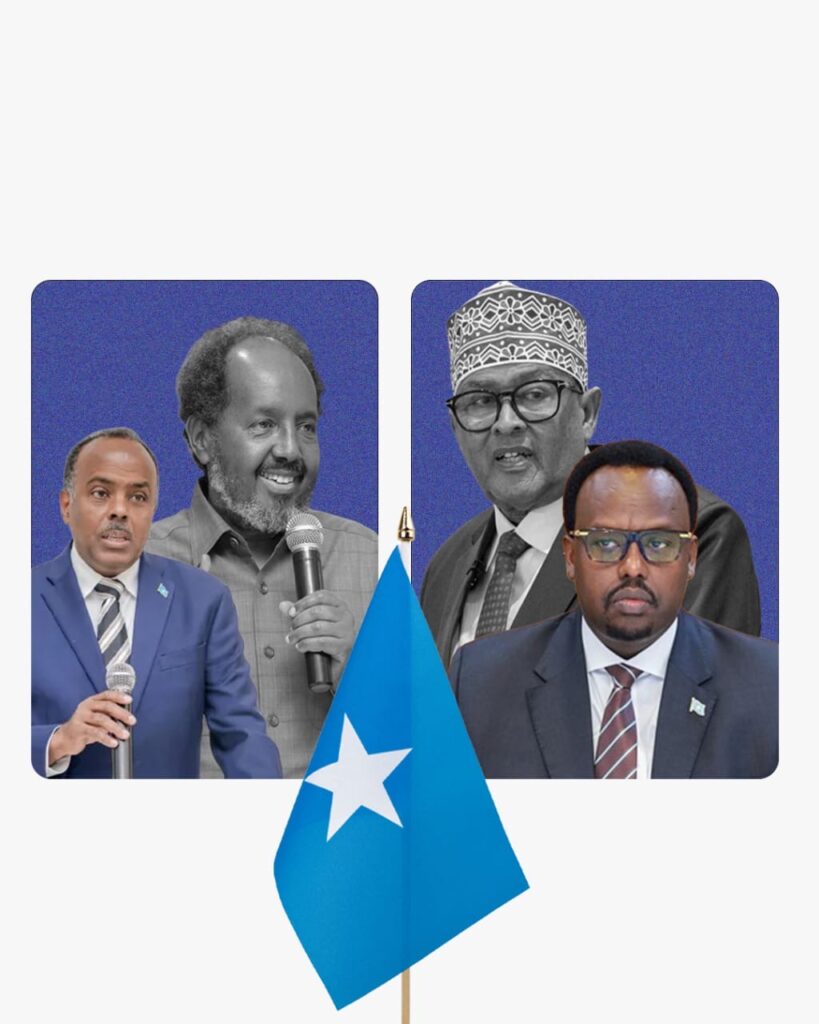
Somalia’s federal government has moved to counter what officials in Mogadishu regard as an increasingly sophisticated political and diplomatic campaign by Somaliland President Abdirahman Mohamed Abdullahi ‘Irro’ in Washington, dispatching a senior delegation to the US capital days before the Somaliland leader is due to arrive.
The decision to put Deputy Prime Minister Salah Ahmed Jama at the head of the delegation reflects growing concern inside Villa Somalia that Cirro’s visit could have implications well beyond Somaliland’s traditional diplomatic outreach.
According to multiple sources familiar with the planning, the Somali delegation is scheduled to travel to Washington on 9 September, with Salah Jama leading a team that includes State Minister for Foreign Affairs Ali Omar ‘Balcad’, Director-General of the Presidency Abdihakim Mohamed Yusuf and other officials from the presidential office.
The delegation was initially expected to be a relatively low-level advance team led by Balcad, tasked primarily with preparing meetings and the agenda for President Hassan Sheikh Mohamud’s planned attendance at the United Nations General Assembly later this month.
That plan was subsequently expanded, with the deputy prime minister brought in and additional officials from the presidency added to the mission.
The shift has effectively moved control of the operation from the Foreign Ministry to the presidential palace, according to officials familiar with the arrangements.
More significantly, Foreign Minister Abdisalam Abdi Ali and senior diplomatic specialists from his ministry have been left out of the delegation.
Two Foreign Ministry officials told us that Abdisalam is not part of the team handling the Somaliland file in Washington and that the ministry has been kept at arm’s length from the planning and intelligence surrounding the mission.
The minister could still join President Hassan Sheikh when he travels to New York on 20 September for the UN General Assembly, one official said.
The unusual division of responsibilities underscores how seriously Mogadishu is now treating Somaliland’s diplomatic push and how directly the issue has been pulled into the presidential orbit.
Cirro is expected to arrive in Washington on 10 September, one day after the Somali delegation.
Although his trip is understood to be a private visit rather than an official invitation from the US government, sources familiar with his itinerary say he has been lined up for meetings with government-linked figures, private organisations and influential actors involved in Washington’s foreign-policy debate.
Somali officials believe those engagements could give Cirro an opportunity to make the case for Somaliland’s independence directly to people capable of influencing the debate in Washington.
The concern in Mogadishu is therefore not simply that Cirro is visiting the United States. It is that Somaliland is attempting to move its diplomatic campaign closer to the centre of American foreign-policy decision-making.
According to people familiar with the Somali government’s assessment, Villa Somalia has concluded that the visit carries greater political weight than initially anticipated and has responded by deploying a senior political delegation of its own.
The delegation’s immediate objective is to reinforce Mogadishu’s position on Somalia’s territorial integrity, engage US policymakers and counter what officials fear could become a more effective Somaliland lobbying effort.
In effect, Washington is emerging as a new front in the long-running contest between Mogadishu and Hargeisa.
The Somali government’s concerns have also been heightened by Cirro’s growing engagement with Israel.
Cirro travelled to Israel in June, where he held meetings with senior Israeli officials, including the country’s president and prime minister.
The visit was closely watched in Mogadishu, particularly because of the wider strategic significance of Israel’s reported recognition of Somaliland as an independent state on 26 December last year.
Sources close to the Somali government say Israeli involvement is now an important element of its assessment of Somaliland’s diplomatic strategy.
During his Israel visit, Cirro also reportedly adopted a highly consequential position on Jerusalem, recognising the city as Israel’s permanent capital, a position that would place Somaliland markedly closer to Israel’s position than that of most governments around the world.
The episode has further sharpened concerns in Mogadishu that Somaliland’s diplomatic strategy could be developing into a broader geopolitical alignment involving actors with interests extending well beyond the Horn of Africa.
Nairobi served as a staging point
Cirro’s Washington trip follows an intensive round of regional diplomacy.
On 5 August, the Somaliland president travelled to Nairobi for a ten-day visit, during which he met organisations, diplomatic representatives and other actors with an interest in Somalia and Somaliland.
It was during that period, according to sources familiar with the matter, that Cirro obtained his US visa.
There has also been renewed speculation over the travel document he will use for the Washington trip.
People close to the Somaliland presidency have told local media that Cirro will travel on a Somaliland passport, despite holding Finnish citizenship. Previous Somaliland administrations have repeatedly maintained that their leaders travel using Somaliland passports, although the international acceptance and practical use of those documents has long been difficult to independently verify.
The issue is politically sensitive because the recognition, or otherwise, of Somaliland travel documents is closely tied to the territory’s unresolved international status.
Somalia fears that Somaliland is attempting to leapfrog the traditional diplomatic arena in Africa and take its independence campaign directly into Washington, where political networks, congressional interests, think tanks and private organisations can shape foreign-policy debates even without formal government endorsement.
For Hargeisa, meanwhile, the trip offers an opportunity to cultivate relationships in the United States and strengthen the case for international recognition at a time when the strategic importance of the Horn of Africa is rising.
The Somali government’s decision to send Salah Jama therefore amounts to more than a routine diplomatic deployment.
It is a signal that Mogadishu does not intend to allow Cirro to dominate the Washington conversation unchallenged.
And with the two delegations arriving within 24 hours of each other, the next phase of the Mogadishu-Hargeisa contest is likely to play out not in Somalia or Somaliland, but in the corridors of power in the American capital.