


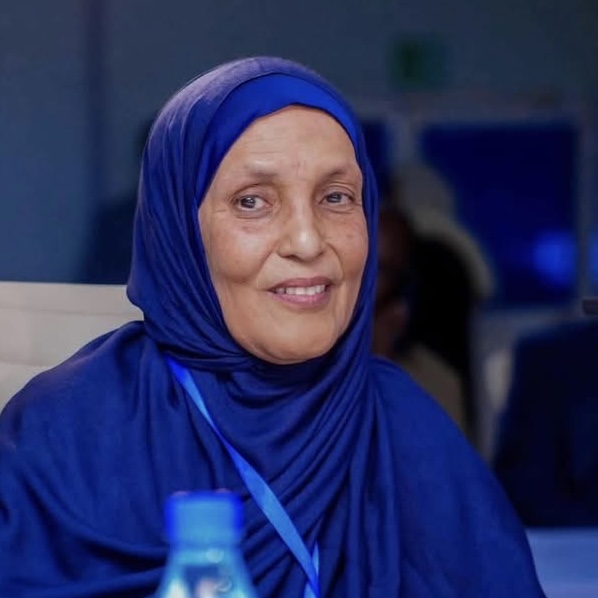
Dr. Maryan Qasim Ahmed, the newly elected Chairperson of Somalia’s Independent Human Rights Commission, stands as a symbol of resilience, vision, and transformative leadership in a country rebuilding itself from decades of conflict.
Her election marks a historic milestone for Somalia: the first ever national commission fully dedicated to protecting and promoting human rights under Somali ownership. Elected in Mogadishu in early 2026, Dr. Qasim now leads a body mandated to safeguard the dignity, rights, and freedoms of every citizen, a role for which few are better equipped than she is.
Born in 1959 in Baardheere, Somalia, Dr. Maryan’s story is rooted in service, courage, and an enduring commitment to her people. She pursued medicine at Somali National University from 1979 to 1983, specializing in surgery, before furthering her medical education abroad. In 1986, she attended a seminar at Berrlin University in Germany and studied at the Catholic University of Nijmegen in the Netherlands. Her commitment to health and public service culminated in 2011–2012 when she earned a Master’s degree in Public Health from the University of Warwick in the United Kingdom.
Her professional career began as an Assistant Lecturer at Somali National University from 1984 to 1986, and later as a medical doctor in primary health care in Yemen (1988–1989), working with a Dutch humanitarian organization in Dhamar. She became a trusted figure in the health sector, combining clinical expertise with deep compassion, particularly for women and children.
But Dr. Maryan’s journey was not without profound hardship. In the early 1990s, as Somalia descended into civil war, she was forced to flee her homeland. She became a refugee in Europe, leaving behind the life she had built, her family, and her community. Yet even in the stark confines of refugee camps, where human lives were reduced to numbers on registration sheets, Dr. Maryan Qasim refused to surrender her purpose. She emerged as a leader among displaced communities, organizing structures to support vulnerable populations, advocating for the voiceless, and ensuring that their needs were recognized. Her courage and empathy shone brightest when the odds seemed insurmountable.
Returning to Somalia after completing her Master’s at Warwick, Dr. Qasim brought her global perspective, expertise, and determination to her homeland, becoming one of the country’s most effective and visionary cabinet ministers.
She was first appointed Minister of Women and Family Affairs on November 18, 2010, in the government of Prime Minister Mohamed Abdullahi “Farmaajo,” where she championed women’s rights, family welfare, and social development policies.
She went on to become a leader in the Tayo Political Party in 2012, before being appointed Minister of Social Development on November 4, 2012, in Prime Minister Abdi Farah Shirdon’s government.
In 2016, she served as Social Affairs Advidor to the then Prime Minister Omar Abdirashid Ali Sharmarke, while also chairing CARMA and working closely with international organizations including UNICEF, WHO, and UNFPA.
Her influence extended beyond policy; she became a goodwill ambassador, leveraging her voice to bring global attention to Somalia’s post-conflict challenges and opportunities.
Her tenure in health and humanitarian affairs is marked by historic achievements.
She led the development of Somalia’s first Health Sector Strategic Plan, introduced the Essential Package of Health Services across nine regions, launched the country’s first pentavalent vaccine, and spearheaded national campaigns to end obstetric fistula. She was a champion of maternal health initiatives, including the Programme for Accelerated Reduction of Maternal Mortality in Africa, convened the first post-conflict national health conference, and ensured health policy aligned with international best practices while rooted in Somali needs.
Dr. Maryan Qasim’s impact on education is equally transformative. She led the Go-To-School initiative, enrolling over 250,000 children in primary education and restoring learning opportunities for a generation deprived of access. She was instrumental in passing the National Education Act and spearheaded the relaunch of the Somali National University, cementing foundational pillars of education essential for Somalia’s long-term development.
A fierce advocate for gender equality, Dr. Maryan guided the development of the National Gender Policy, shaped the Family Act, and led campaigns against female genital mutilation. Her work provided legal frameworks, public awareness, and practical support, dramatically improving the lives of Somali women and girls.
Now, as Chairperson of the Independent Human Rights Commission, her leadership has entered a new historic phase. Appointed by the Federal Government of Somalia following presidential assent, Dr. Maryan represents not only decades of expertise but the trust of a nation seeking a Somali-owned, Somali-led approach to human rights governance. Her appointment underscores the government’s firmness and dedication to safeguarding citizens’ rights, strengthening state-building, and protecting the dignity of every Somali.
Dr. Maryan Qasim Ahmed’s life story, from refugee to global health expert, from cabinet minister to the nation’s first human rights commission chairperson, is a testament to resilience, courage, and purpose-driven leadership. She embodies the transformative power of women in leadership, the enduring impact of compassion paired with vision, and the ability of one individual to shape the destiny of a nation. Her journey continues to inspire a generation, proving that even in the most challenging circumstances, knowledge, determination, and heart can rebuild lives, communities, and nations.