


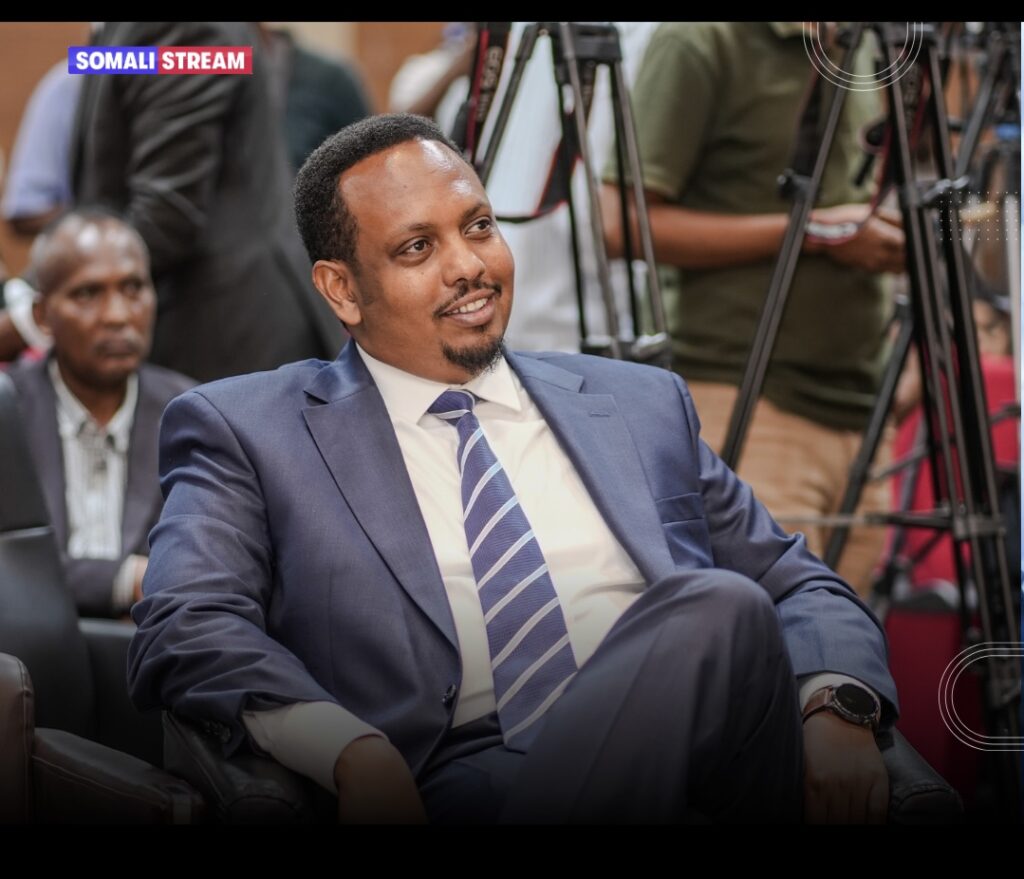
MOGADISHU — What began as a formal campaign declaration by Abdisatar Gelle at the Jazeera Palace Hotel on Tuesday night, quickly evolved into a broader political messaging forum, as senior and leading Somali political figures used the occasion to weigh in on both his candidacy for Vice President of Galmudug and the wider direction of Somalia’s political climate. While Gelle put himself forward as a candidate grounded in state-building experience and economic ambition, the political discussion that followed reflected a more layered national mood; one shaped by unresolved political tensions and competing visions of governance.
Across the board, speakers acknowledged Galmudug’s progress from its tumultuous and conflict-ridden past into a more structured federal member state. They also stressed that its future as with that of Somalia more broadly, remains contingent on political clarity, institutional integrity, and sound leadership choices at both state and federal levels. The event thus became less about a single candidacy and more about the direction of the Somali political project itself.
Former Galmudug President Abdikarin Gulled delivered a characteristically measured remarks culminating in a politically pointed address. He reaffirmed his longstanding familiarity with Gelle, fully backing him to be the next Galmudug Vice President. Abdikarin describing Gelle as a personality he has consistently regarded in a positive light. Gulled emphasized the candidate’s own innate social positioning, noting that he descends from two of Galmudug’s most consequential communities; groups that have historically played a decisive role in shaping the federal state’s stability and political trajectory.
Turning to the state’s evolution, Gulled acknowledged that Galmudug is in a far better position today than in the formativeyears (which he oversaw) that were marked by armed conflict and marginalization. However, he expressed skepticism toward the recent narrative surrounding imminent oil production in Galmudug, suggesting that the federal government’s framing of the issue could amount to a political inducement rather than a genuine development strategy. For Gulled, the more pressing issue lies in the unresolved national political framework. He openly questioned the trajectory of the country’s electoral model and challenged president Hassan Sheikh Mohamud over what he characterized as a tendency toward unilateral governance. Addressing Abdisatar Gelle directly, he posed a strategic question that resonated across the room: under which political “field” does he intend to contest?
Former intelligence chief Fahad Yasin also took the stage to offer a contrasting tone, blending endorsement with subtle critique. He welcomed what he described as Galmudug’s transition from a previously violent contestation to a more technocratic engagement, joking that the state now “writes proposals and sends emails” rather than resolving disputes through force of arms. This candidacy, not even for the presidency but the vice presidency he said, signals to political maturity.
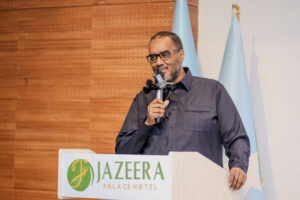
Fahad strongly endorsed Gelle, describing him as a competent and forward-looking figure with deep knowledge of the region. He framed his candidacy as emblematic of a new leadership style. At the same time, Fahad used the moment to raise a pointed butlighthearted question about political alignment. He called on Gelle to clearly declare the party under which he intends to run, particularly given the presence of figures associated with both Xaqsoor and Heybad Qaran.
Former Planning Minister Abdi Aynte approached the discussion from a developmental and institutional perspective. Recalling the first exchange with Gelle in 2013, initiated through an email and followed by a Skype conversation. Aynte classified the candidate as part of a generation that engaged governance through ideas even in the formative stages of state-building.
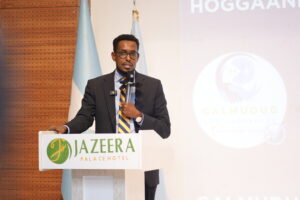
Aynte also highlighted a structural paradox within Galmudug: despite producing a significant share of Somalia’s national leadership and benefiting from a pool of experienced professionals, the state has yet to fully translate this human capital into sustained development outcomes. He acknowledged the progress achieved so far but stressed that Galmudug still falls short of its potential, suggesting that the next phase of leadership must focus on converting these past gains into tangible economic and institutional advances.
Former Minister of Public Works Abdi Adam Hoosow delivered perhaps the most overtly political intervention of the evening, placing his attention squarely to the national crisis. He questioned why the political class appeared reluctant to confront what he described as a deepening gridlock, arguing that even at a campaign event, leaders have a responsibility to address the uncertainty beyond the venue’s walls.
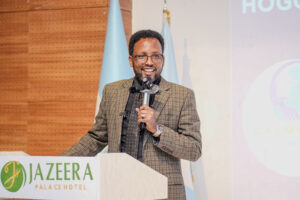
In a direct message to President Hassan Sheikh Mohamud, whom he noted he respects much. Hoosow warned of the risks associated with overstaying political mandates. Drawing on metaphor, he quipped “If you see the same tree twice in the forest, then you are surely lost.” The line, was aimed at President Hassan who has been twice president of Somalia, seeing his fair share of political impasses as a result of not honouring the general consensus regarding the country’s agreed upon political framework.
Collectively, the remarks from these senior figures transformed Abdisatar Gelle’s campaign launch into a platform for wider political reflection. This line up of voices revealed a rare convergence of support for his candidacy and a shared insistence that Galmudug’s future cannot be seen in isolation from the national questions currently facing Somalia; questions of electoral legitimacy, governance models and the balance of power within its fragile federal system.