


By Abdifatah Mahat
What happens when people begin to fear their government more than the enemies attacking their country?
Somalia has endured war, terrorism, poverty, and the collapse of central government. For decades, Somalis have dreamed of a state that would safeguard their homes, educate their children, protect their resources, and give citizens a voice in choosing their leaders. Yet as President Hassan Sheikh Mohamud’s government has become dogged by controversy, an uncomfortable question has emerged: Is Somalia becoming a place of fear for those the government is meant to protect?
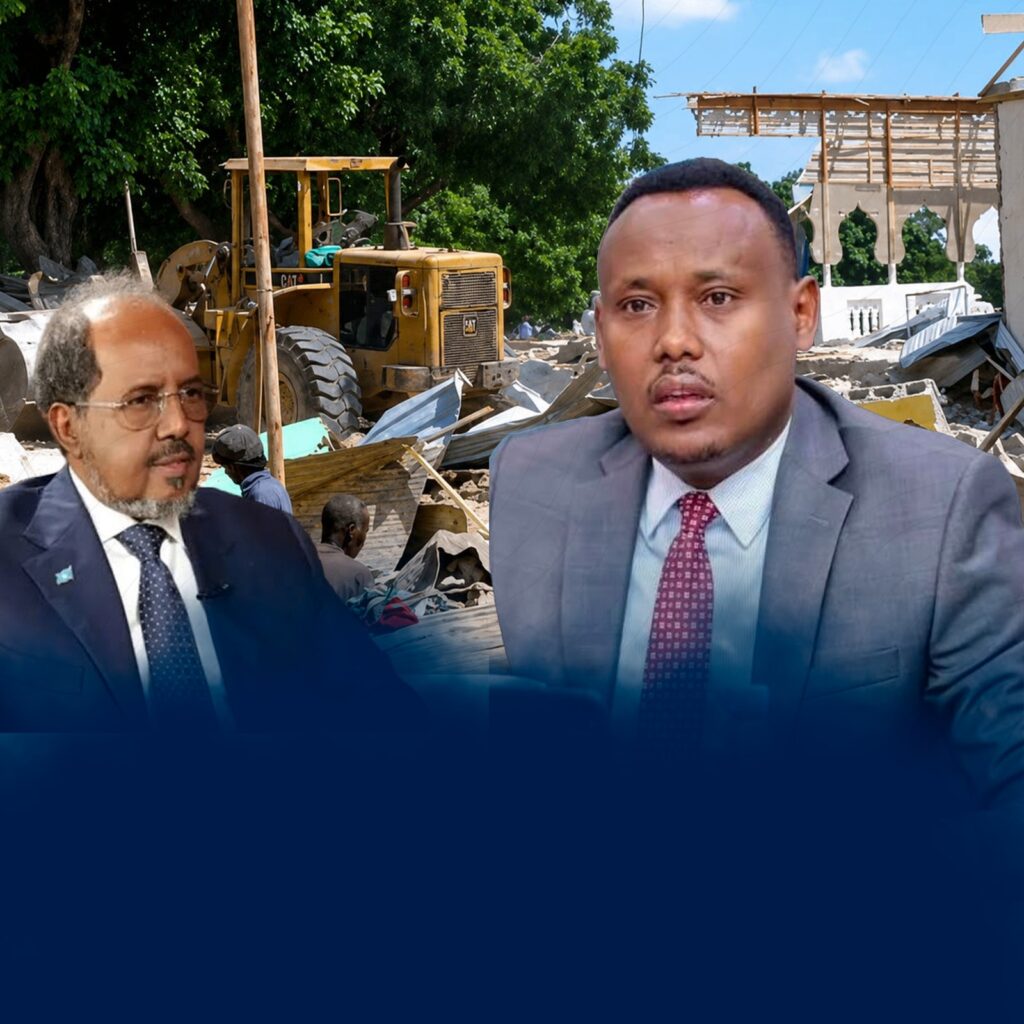
The most visible struggle concerns land. In Mogadishu, government operations to reclaim public property have led to forced evictions, demolished homes, and widespread displacement.
In 2025, the European Union Agency for Asylum reported 143,548 asylum seekers from Mogadishu, including more than 63,000 people evicted from public land. For families who have lived on these plots for years, a bulldozer does more than demolish a building; it destroys their home, livelihood, and, in many cases, their children’s sense of safety.
The opposition has accused the government of illegally giving away and selling public property to wealthy individuals, including three former Somali presidents. Critics have complained that some transactions were not properly monitored and that the proceeds were not handled transparently. The allegations remain disputed, but the controversy has raised an essential question: To whom does public land belong; the public or people with money and connections?
There is an equally troubling contradiction in education. President Hassan Sheikh Mohamud has a background in the field, so expectations are high that education will play a central role in Somalia’s reconstruction. A nation that has been wracked by conflict for decades requires classrooms, teachers, universities, and a well-trained young population. Yet critics say education has been sidelined, arguing that the president has relied on advisers whose recommendations have not prioritized it.
If Somalia’s children are neglected and political priorities focus on maintaining the status quo and ensuring political survival, the country cannot build a strong future.
Then there is Türkiye. Ankara has established a strong partnership with Mogadishu in defense, security, development, and Somalia’s emerging energy sector. Türkiye is one of Somalia’s most important strategic partners, and Turkish companies are participating in oil-exploration operations in the country. However, international partnerships should never replace national responsibility. Somalis have the right to question whether agreements concerning their oil, gas, minerals, and other resources are made in the public interest or primarily to serve foreign and domestic political or commercial interests.
The question becomes even more significant when Somalia’s democratic future is considered. One person, one vote has long been a national aspiration: a system in which all Somalis have a voice in governing the country. Nevertheless, opposition figures have alleged that the electoral system can be manipulated through party registration and SIM cards. Abdirahman Abdishakur Warsame, the leader of Wadajir Party and a Member of Somalia’s Federal Parliament, has raised concerns that thousands of SIM cards may have been registered as party members, creating what he called “artificial digital voters.” If true, this would alter the very nature of voting: a citizen’s political voice could be replaced by a number in a database.
The government maintains its commitment to free, fair, and transparent one-person, one-vote elections. However, electoral institutions must be trusted for that commitment to have meaning. A ballot is valid only when people believe that the person casting it is a real voter, that the vote will be counted fairly, and that the outcome will reflect the people’s will.
Land, education, natural resources, and elections may appear to be unrelated issues. In reality, they converge around one word: trust. If people are losing their homes, if their education is being neglected, if the country’s resources are being mismanaged, and if they begin to suspect that their votes are not being counted as intended, the bond between government and governed will become dangerously strained.
History offers a simple warning: hardships are bearable, but injustice is not. When people continually feel disenfranchised, neglected, and deprived of a political voice, they turn their anger against the political system. Citizens do not have to take up arms to punish a government; they can withdraw their trust, reject its policies, and demand accountability.
A president is entrusted with the people. The people are not entrusted to the president. When a government forgets that distinction, the people eventually remind it.