


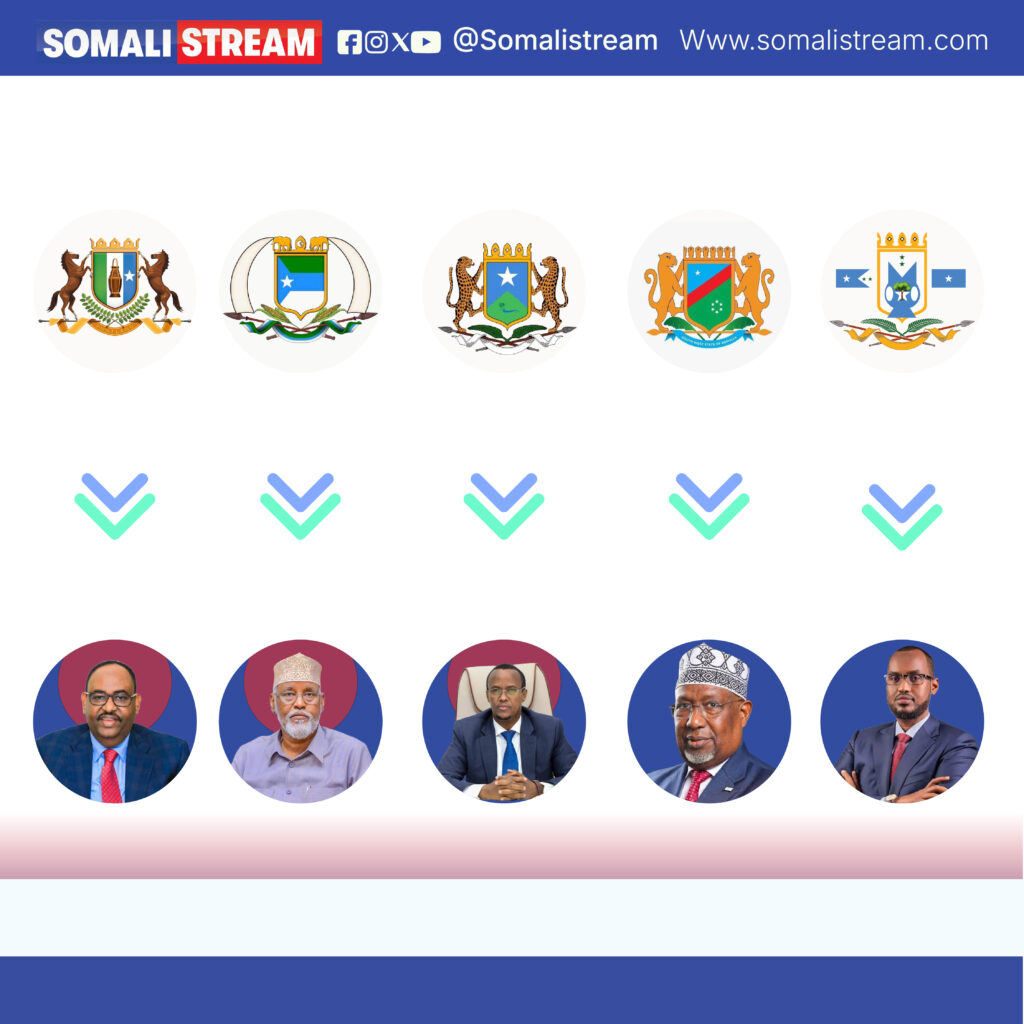
Somalia’s political future is increasingly shaped by disputes over internal boundaries. Federalism was intended to distribute power and bring government closer to the people. Yet, in practice, the boundaries between federal member states have also become sources of political competition, often expressed through clan loyalties and rival claims to land. Where the central government lacks the authority to settle these disputes, competition over territory, taxation, ports and political representation can become a threat to national unity. This raises a fundamental question: who ultimately has the power to protect Somalia’s territory and govern it as one country?
The present situation cannot be separated from Somalia’s recent history. The country has passed through the government of President Siad Barre, civil war, repeated efforts to establish transitional institutions, the rise of the Islamic Courts Union and the continuing threat posed by Al-Shabaab. International involvement has also shaped attempts to rebuild state institutions. Federalism emerged within this difficult political environment, but the division of responsibilities between the federal government and the member states remains deeply contested.
Internal borders and competing regional interests
Some of the most serious territorial disputes are in northern Somalia. Somaliland bases its claim to the territories of the former British Somaliland Protectorate on colonial-era boundaries. Communities in the Northeastern State and Maakhir areas have challenged that claim, leading to a conflict in which Las Anod has experienced shelling, civilian displacement and significant loss of life. Questions of representation and territorial authority have also arisen in Awdal. These disagreements show how historical boundaries, political identity and local consent can come into direct conflict.
The problem is not confined to the north. Around Galkayo and the wider Mudug region, Puntland and Galmudug have experienced tensions over territory and administration. These disputes are often discussed through clan affiliations, including Majeerteen and Habar Gidir interests. When political boundaries are understood primarily as extensions of clan influence, even disagreements over local administration can become wider contests for power.
Kismayo presents another example. Competition involving Marehan and Ogaden political interests has centred in part on control and influence over this strategically important port city, which connects trade between Somalia, Kenya and Ethiopia. Elsewhere, tensions involving Habar Gidir and Hawadle interests in the Mataban area have been linked to questions of administration and revenue collection. Efforts to establish local tax-collection structures can create friction when communities disagree about who has the authority to govern them.
Political representation and the current traditional leader Ugaas Yusuf Ugaas Hassan also matters have expressed concerns about their position within Hirshabelle, particularly in relation to the influence of Abgaal political actors maintaining Jowhar as the Hirshabele capital and the Hirshabale Presidency both occupied by Abgaal. Similar concerns about boundaries and influence have been raised in parts of South West State, including the Barawe area, where competing interests have been described in clan and regional terms. The details differ from place to place, but the underlying problem is familiar: local disagreements become harder to resolve when there is no widely accepted national authority to make and enforce impartial decisions.
Federal states should be able to govern local affairs, but decentralisation cannot mean that every administration is free to define its own borders, claim new territory or establish competing systems of taxation without an agreed legal process. Ordinary citizens ultimately bear the cost of this uncertainty.
The colonial legacy and the question of sovereignty
The roots of Somalia’s territorial disputes reach further back than the present federal system. European colonial powers drew boundaries across the Horn of Africa that did not always reflect the social and cultural connections of the people living there. Britain established the British Somaliland Protectorate in the late nineteenth century, and it was subsequently administered by officials including Sir Geoffrey Francis Archer. Colonial administrators often viewed the region through strategic and economic interests rather than the long-term political interests of its people.
As discussed in historical accounts of British Somaliland, colonial descriptions of Somali society were sometimes deeply dismissive. Millman records a characterisation of local people as those who ‘could not understand, and ultimately despised any other way of life than their own’ (Millman, 2013, p. 9). Such attitudes help explain why colonial rule cannot simply be remembered as a period of imposed order. Its boundaries and institutions also left a legacy of division. Britain valued the coastline for its strategic position, including the supply of livestock to Aden, and for the commercial possibilities of resources such as coal and mica.
The dispute over the Ogaden region is another example of the enduring effect of colonial-era arrangements. Although the area has a predominantly ethnic Somali population, it became part of Ethiopia. This helped fuel the idea of a ‘Greater Somalia’ and later contributed to the Ogaden War. Under President Siad Barre, Somalia sought to change the border by force, while Ethiopia’s Derg government resisted. Somalia’s did not remove the historical grievances; it demonstrated how costly territorial disputes become when they are settled through war rather than negotiation.
More recently, the memorandum of understanding between Ethiopia and Somaliland concerning proposed access to the sea has revived arguments over sovereignty. The Somali federal government regarded the arrangement as a challenge to its territorial integrity, while Somaliland pursued its own political objectives. The broader lesson is that external agreements affecting territory or strategic infrastructure can have consequences far beyond the immediate parties. Even experiences elsewhere, such as Bolivia’s historical loss of access to the sea, show how issues of territory and access can shape national politics for generations.
Weak institutions, corruption and public trust
Territorial disputes are made worse by the weakness of national institutions. Decades of conflict have driven many skilled Somalis abroad and disrupted education for younger generations. As a result, government institutions have struggled to develop the legal, administrative and technical capacity required to address complex constitutional and land disputes. Unless Somalia invests in capable public institutions and a professional workforce, the same disagreements are likely to return in different forms.
Corruption and clan patronage further undermine confidence in public decision-making. Clan elders and community leaders play important roles in Somali society, but political influence can also be used to shield individuals from scrutiny. The concern is not that every clan leader or public official acts improperly; it is that accountability becomes difficult when public office is treated as an extension of a particular clan’s interests.
International assistance has sometimes operated through political and traditional power structures, and weak oversight can leave vulnerable communities without the support intended for them. Historical accounts describe how outside funding, aid and political influence could become concentrated among selected leaders (Smith, 2021, p. 210). Foreign assistance was substantial during periods of Somalia’s modern history; one figure cited in the original discussion puts aid at as much as 57% of gross national product. The wider point remains that dependence on external assistance, without strong domestic accountability, can leave institutions fragile.
A country cannot build lasting stability if people believe the law is applied differently according to clan, region or political connections. National authority must therefore be accompanied by transparent institutions that citizens can trust.
A national land and boundaries framework
In my view, one of Somalia’s most important reforms should be a comprehensive Land Ownership Act, considered and passed by the Somali Parliament. Such legislation should establish clear rules governing land ownership, use, registration and the settlement of disputes. It should also clarify the responsibilities of the federal government and federal member states in relation to territorial jurisdiction and administrative boundaries. It can only happen if the central government earns the trust of the people, accompanied by fair political representation without favouritism or nepotism
The current federalism module the central government aims to have the ultimate authority over questions affecting the country’s national territory, subject to the constitution and an agreed legal framework. This is different from taking away the legitimate property rights of individuals and communities. Citizens must be able to own and use land for housing, farming and commerce, while public institutions must have a lawful way to decide which administration has authority over an area. Without clear rules, disputes over territory are too easily transformed into political confrontations.
Land governance is a challenge in many African countries, including Ghana, where customary and statutory systems have had to operate alongside one another. Somalia’s circumstances are different, but the broader lesson is useful: a clear and accessible legal framework can protect property, reduce conflict and support long-term economic development. Land is finite, and the rules governing its use should serve future generations as well as those living today.
Legislation alone will not be enough. The federal government and member states would need to agree on practical mechanisms for implementation, including impartial dispute resolution, proper records, public consultation and a means of handling disagreements over revenue and resources. Communities must be heard, and decisions must be based on law rather than on whichever group has greater political or military influence.
In summary, after 35 years of trying reconciliation and state-building, I will summarise the current political situation in Somalia.
- A weak central government based in Mogadishu, with no territorial control outside Mogadishu.
- Somaliland continues seeking international recognition, and Israel has become the first country to recognise Somaliland.
- Puntland is currently disconnected from the central government and is operating independently.
- Southwest is currently being destabilised by the central government, and this has created extensive security risks for both citizens and neighbouring countries.
- Hirshabelle is currently also at loggerheads between the Abgaal and Hawadle, with the president giving a helping hand to his fellow Abgaal political representation in the presidency
- Jubaland is disconnected from the central government and is operating independently
The way forward
Somalia’s future does not have to be a choice between an all-powerful central government and competing regional administrations. Local government can work effectively when powers are clearly assigned and exercised within a national constitutional framework. People often place great trust in those who live near them and understand their concerns. That local accountability should be encouraged, but it is currently undermining the country’s wider unity.
Dialogue and diplomacy are essential, both between central government and federal member states. International partners can support mediation and institution-building, but the responsibility for resolving Somalia’s internal disputes ultimately rests with Somali leaders and citizens.
The central question is not simply who owns a particular district, port or stretch of land. It is whether Somalia can establish a system in which citizens know who governs them, which laws apply and how competing claims can be settled peacefully. Until those questions are answered, internal borders will continue to become points of competition, and the authority of the central government will remain weak.
By Said Ahmed
© 2026 Said Ahmed. All rights reserved.
